Create your CubeMars account

In the field of human-robot interaction, exoskeleton technology has emerged as a key solution for rehabilitation, assisted locomotion, and physical augmentation. However, achieving efficient and precise human-exoskeleton interaction remains a significant challenge, particularly in force estimation and control. Traditional methods rely on force sensors to measure interaction forces, which increases system complexity and cost. This study introduces a force estimation method based on quasi-direct drive (QDD) technology, enabling interaction force estimation without additional force sensors by leveraging the intrinsic dynamics of the actuator.
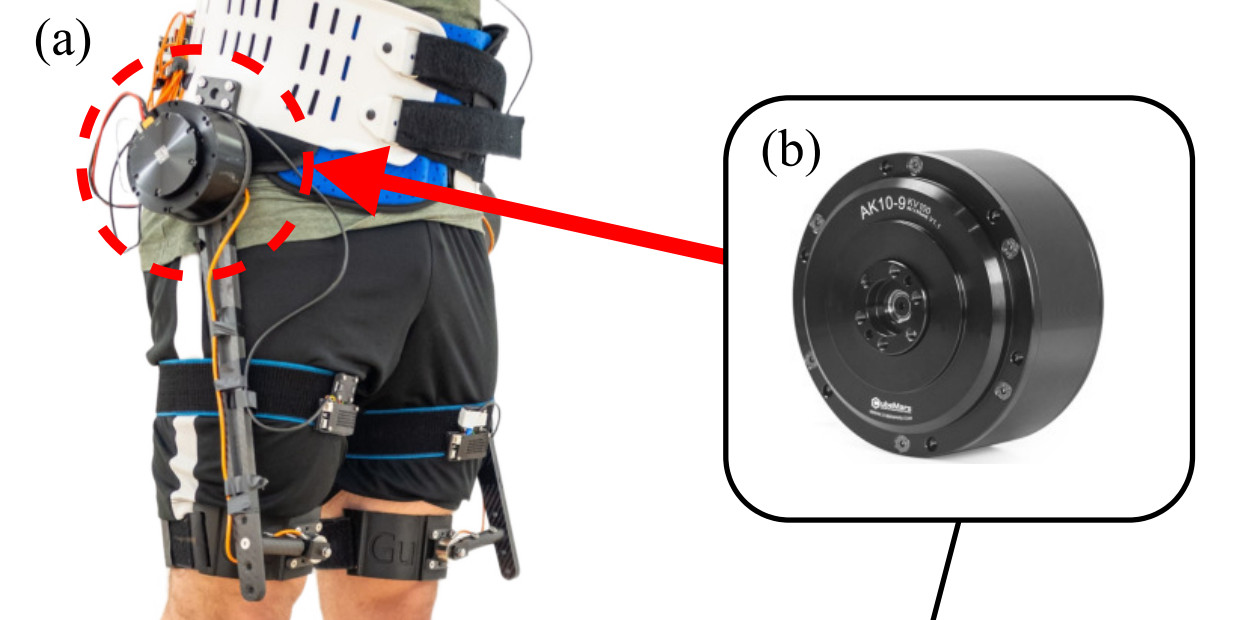
The research team developed a hip exoskeleton utilizing QDD technology to provide assistive torque while minimizing constraints on natural human motion. The core of the system design lies in using a low-reduction-ratio actuator for direct joint actuation, enhancing backdrivability and user comfort. This study employs the CubeMars AK10-9 V1.1 robotic actuator, which features high torque density and low mechanical impedance, making it well-suited for QDD-based systems.
To achieve sensorless interaction force estimation, the researchers established a comprehensive dynamic model of the actuator, incorporating factors such as rotational inertia, frictional torques, and gear transmission characteristics. This model enables real-time torque estimation based on current and angular velocity measurements, ultimately deriving the interaction forces between the exoskeleton and the user.
The research team developed a test platform to first characterize the actuator’s performance under controlled conditions and then validated the system in a walking experiment. The test involved a subject walking on a treadmill while wearing the hip exoskeleton, with varying assistive torque levels (6 Nm, 8 Nm, and 10 Nm).
Results showed that the proposed force estimation method achieved a mean absolute error (MAE) of only 2.78±0.58 N, representing 6.4% of the rated output force. Compared to conventional force sensor-based methods, this approach maintained high accuracy while reducing hardware dependence, thereby improving system efficiency and reliability. Additionally, the model-based open-loop torque control method improved tracking accuracy, reducing error by 23% compared to nominal control methods.
The key contributions of this study include:
1、Reducing reliance on force sensors, thereby lowering system complexity and cost while improving exoskeleton practicality.
2、Enhancing torque control strategies, leading to more stable gait assistance and improved user walking comfort.
3、Improving system backdrivability, allowing the exoskeleton to naturally adapt to human motion without impeding normal gait.
This technology provides new insights for the future development of exoskeleton systems, particularly in applications such as rehabilitation training, industrial assistance, and mobility support for the elderly. Future research could further refine personalized parameter optimization to enhance interaction force estimation accuracy and adapt to a wider range of users.

.png)