Create your CubeMars account

As robotics systems continue to expand across industries such as mobile robotics, industrial automation, humanoid platforms, and wearable devices, robot motors have become the fundamental components that enable motion. Their role extends beyond simply generating power—they directly influence how efficiently, precisely, and reliably a robot performs in real-world conditions.
Motor selection plays a critical role in shaping system behavior. A drive solution suitable for a wheeled robot may not meet the requirements of a multi-axis robotic arm, while applications such as humanoid locomotion or exoskeleton assistance demand higher responsiveness, torque density, and adaptability.
Rather than representing two separate categories, robot motors can be implemented at different levels of control capability. In many cases, they operate as standalone drive units for continuous motion, while in more advanced applications, they are integrated into servo-based systems to enable precise, feedback-driven control.
Instead of asking which solution is inherently better, the more relevant question is how well a motor aligns with the actual requirements of the application. This article focuses on how robot motors are applied across different scenarios, and when servo-based implementations become necessary to meet higher performance demands.
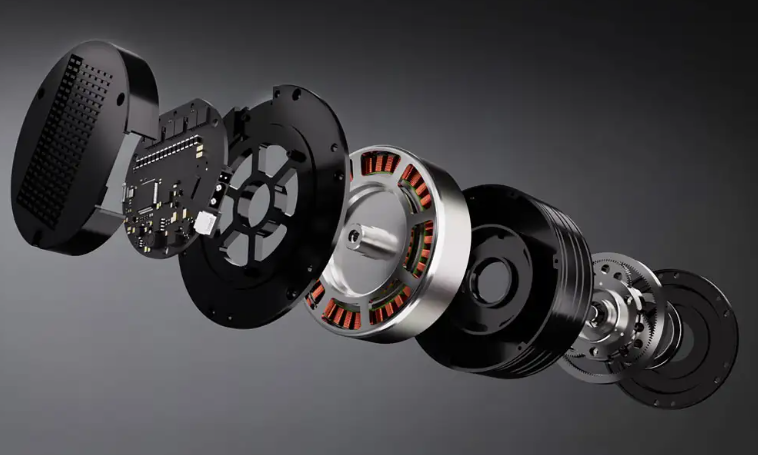
In modern robotics, integrated robotic actuator modules serve as the primary source of motion, combining a brushless DC motor, gearbox, encoder, and driver into a compact, high-performance unit. These modules deliver predictable torque, continuous power, and simplified system integration, making them the foundation of most robotic applications.
Actuator modules are particularly suited for scenarios that require:
Consistent, high-density torque output
Continuous and reliable motion
Compact, modular integration for scalable deployment
Efficient mechanical and electrical design with minimal external components
While robotic actuator modules provide the core mechanical capability, servo motor systems are employed when precise position, speed, or adaptive control is required. By adding real-time feedback and closed-loop regulation, servo systems enhance the performance of the underlying module without replacing its fundamental role.
A typical servo-enhanced system consists of:
The actuator module delivering primary motion
A feedback device, such as an encoder, monitoring performance
A controller dynamically correcting motion to achieve high precision
At the system level, the distinction is clear: the actuator module drives the robot, supplying essential torque, speed, and reliability, while the servo system fine-tunes performance for applications demanding high precision, adaptability, or multi-axis coordination.
In practice, robotic systems are built around the actuator module as the core component. Servo feedback is added selectively, only when the application's requirements call for refined control or real-time adaptation. This hierarchy emphasizes the module’s central role, with servo systems as performance enhancers rather than primary drivers.
In real-world robotics, choosing the right motor or actuator module is about more than peak torque or speed—it's about how the system performs under dynamic loads, long-duration operation, and integration constraints.
Actuator modules are specifically engineered to deliver consistent, high-density torque, compact form factors, and simplified integration, which makes them the backbone of most robotic platforms. Servo motors, by contrast, provide precision through feedback but often introduce added complexity, cost, and design constraints that may not justify their use in standard applications.
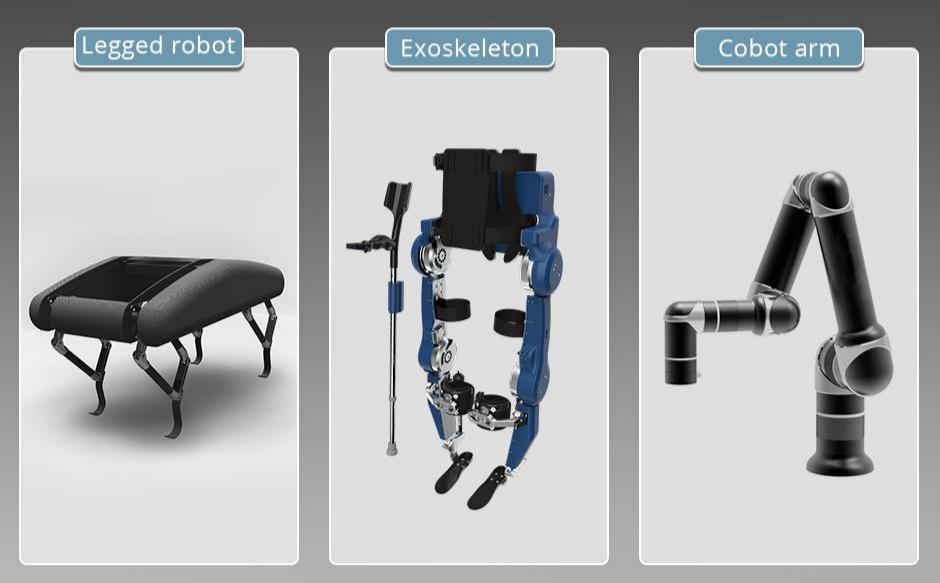
Mobile Robots and Drive Systems: Continuous Operation Under Load
Mobile robots—including AGVs and AMRs—face extended operating times and variable payloads, where energy efficiency and reliability are paramount. Here, robotic actuator modules excel because they:
Deliver sustained torque without overheating, even under prolonged operation.
Maintain high efficiency with minimal energy loss, enabling longer battery life and fewer recharges.
Feature compact integration with gearboxes and drivers, reducing design complexity and mechanical interfaces.
Why servo motors are less ideal: Closed-loop control adds computational overhead and requires additional wiring and calibration. In many mobile robots, navigation and speed control can be handled sufficiently through the module’s inherent mechanical response, making full servo feedback overkill. Thermal management and component weight also become critical; servo-driven systems can generate additional heat and require larger enclosures, which limits design flexibility.
Key Takeaway: Robotic Actuator modules provide the necessary robustness and efficiency for most mobile robot applications, with servo feedback reserved only for precision-intensive navigation scenarios.
Humanoids and Legged Robots: Torque Density vs. Feedback Complexity
| Requirement | Robotic Actuator | Servo Motor |
| Base Torque | High, compact design enables stable locomotion | Requires external tuning and controller adjustments to match base torque |
| Dynamic Response | Naturally handles predictable variations in load | Sensitive to sensor noise and control delays under rapid load changes |
| Integration | Modular, scalable, and easy to combine with mechanical structures | Often bulky; requires extra wiring, encoders, and real-time control units |
| Long-term Reliability | Lower maintenance due to mechanical simplicity | Higher risk of drift, calibration errors, and component wear |
Analysis: In legged robots, actuator modules provide the primary mechanical capability, ensuring high torque density and efficient energy use for continuous motion. Servo motors can improve balance or joint precision, but achieving this often requires sophisticated sensor fusion and real-time control loops. This introduces potential points of failure, latency, and increased software and hardware complexity. The module’s mechanical robustness ensures the robot can handle sudden impacts or terrain variation reliably, whereas servo systems alone may struggle without a solid base.
Exoskeletons and Prosthetics: Precision, Safety, and Adaptive Motion
Key considerations in wearable robotics: smooth motion, user safety, energy efficiency, and responsive adaptation to human movement.
1. Mechanical foundation (Robotic Actuator):
Provides predictable torque output, allowing safe and smooth movement.
Compact and energy-efficient, suitable for lightweight, wearable designs.
Capable of continuous operation without frequent recalibration.
2. Precision enhancement (Servo Motor):
Introduces adaptive torque and position corrections.
Requires real-time sensors, encoders, and controllers, which increase weight, wiring, and control complexity.
Sensitive to sudden load changes or sensor errors, which can reduce reliability and increase maintenance needs.
Conclusion: Actuator modules enable safe, reliable core motion. Servo systems enhance adaptability and tracking only where real-time feedback is critical, but cannot substitute for the module’s torque density, compactness, or energy efficiency.
Summary Insight: Across scenarios, actuator modules excel due to their mechanical simplicity, energy efficiency, high torque density, and integration flexibility. Servo motors provide fine-tuning, not foundational actuation; relying solely on servo-driven solutions often adds complexity, weight, and thermal management challenges without proportional benefit. Proper system design leverages actuator modules as the primary driver and introduces servo feedback selectively, where precision or adaptive control is essential.
Understanding the difference between actuator modules and servo motor systems requires looking beyond basic specifications. In robotics, performance is not defined by a single parameter such as precision or torque, but by how effectively a system balances power density, efficiency, responsiveness, and integration constraints.
Actuator modules are designed to meet these system-level requirements by delivering integrated, high-efficiency actuation, while servo motor systems focus on control accuracy through feedback and real-time correction. The distinction, therefore, is not simply between two motor types, but between two fundamentally different approaches to motion delivery.
System-Level Performance Comparison
| Aspect | Robotic Actuator Module | Servo Motor System |
| Core Function | Integrated actuation (motor + gearbox + driver) | Feedback-driven motion control |
| Torque Density | High, optimized for compact robotic joints | Dependent on motor + external design |
| Efficiency | High under continuous operation | Reduced by feedback loop overhead and tuning |
| Response | Mechanically stable, low latency | Fast but dependent on sensor and control loop |
| Thermal Performance | Optimized for sustained loads | Additional heat from control electronics |
| Integration | Compact, modular, plug-and-play | Requires multi-component integration |
| Scalability | Easily deployed across multiple systems | Scaling increases control complexity |
| System Complexity | Lower, fewer dependencies | Higher, requires tuning and calibration |
Engineering Perspective: What Actually Matters in Robotics
In real robotic systems, motor selection is driven by a combination of mechanical output requirements and system constraints, not just control accuracy. Several key parameters determine suitability:
1. Torque Density and Mechanical Output
Robotic joints,especially in humanoids, legged robots, and mobile platforms require high torque within limited space and weight constraints.
Robotic Actuator modules are optimized for this requirement, integrating reduction mechanisms and motors to deliver high torque in compact form factors.
Servo systems, while capable of precise control, often rely on external gearboxes and additional components, which increase system size and reduce overall power density.
Result: For most robotic applications, actuator modules provide more usable torque per unit volume, which directly impacts performance and design flexibility.
2. Energy Efficiency and Thermal Constraints
Robots—especially mobile and wearable systems—operate under strict energy budgets and thermal limits.
Actuator modules are designed for continuous operation with high efficiency, minimizing energy loss and heat generation.
Servo systems introduce continuous feedback loops, signal processing, and control corrections, which increase energy consumption and thermal load.
Result: In long-duration applications (AGVs, AMRs, exoskeletons), servo-based solutions may require additional thermal management, reducing system efficiency and reliability.
3. Control vs Stability Trade-off
Servo motors excel in precision, but this comes with trade-offs:
Servo systems rely on high-frequency feedback and control loops, making them sensitive to sensor noise, latency, and tuning quality.
Actuator modules provide inherently stable mechanical output, which is often sufficient for tasks involving continuous motion or predictable load patterns.
Result: In many real-world scenarios, especially those without strict positioning requirements, the added control complexity of servo systems does not translate into meaningful performance gains.
4. Integration and System Architecture
Modern robotic systems prioritize compactness, modularity, and ease of deployment.
Robotic Actuator modules reduce system complexity by integrating motor, gearbox, encoder, and driver into a single unit, minimizing wiring, alignment issues, and assembly time.
Servo motor systems typically require separate components, increasing design complexity, potential failure points, and calibration effort.
Result: Actuator modules significantly simplify system architecture, which is critical for scalable robotics development.
Practical Implications in Real Applications
Rather than applying a single solution universally, the choice depends on how these factors align with application requirements:
When actuator modules are the better choice
Continuous motion systems (AGVs, AMRs, conveyors)
Space-constrained designs (humanoid joints, wearable robotics)
Energy-sensitive applications (battery-powered robots)
Scalable deployments requiring modular design
In these scenarios, actuator modules deliver most of the required performance inherently, without the overhead of complex control systems.
When servo systems become necessary
High-precision positioning (industrial manipulators)
Multi-axis synchronization
Dynamic environments requiring real-time correction
Even in these cases, the robotic actuator module still provides the mechanical foundation, while the servo system enhances control performance.
Key Insight: In robotic systems, actuator modules are not just an alternative to servo motors—they are the primary enabler of motion, delivering torque, efficiency, and integration at the system level.
Servo motor systems, while essential for precision and adaptive control, introduce additional complexity, energy consumption, and design constraints. Their use is therefore driven by specific control requirements, rather than being a default choice.
The most effective robotic designs leverage robotic actuator modules as the core actuation layer, applying servo-based control selectively to refine performance where necessary.
After understanding the differences between robotic actuator modules and servo motor systems, the next step is translating that knowledge into a practical selection strategy.
In robotics, selection is not about choosing a motor category in isolation, but about defining how actuation capability, load characteristics, control requirements, and system architecture interact. In most real-world systems, actuator modules form the physical foundation, while servo control is introduced only when the application justifies the added complexity.
1. Start from Motion Profile, Not Motor Type
The first step is to define how the robot actually moves under operating conditions, rather than starting from predefined motor categories. Motion characteristics directly determine whether additional control layers are necessary.
Instead of asking “which motor is better,” a more relevant engineering question is whether the system prioritizes continuous motion or controlled motion.
Continuous motion systems (mobile robots, AGVs, conveyors)
Focus on stability, efficiency, and long-duration operation
→ Robotic Actuator modules are typically sufficient
Trajectory controlled systems (robotic arms, surgical robots)
Require precise position, velocity, and coordinated motion
→ Servo control becomes necessary
Key Takeaway: Motion profile defines control demand, not the other way around.
2. Match Torque to Real Load Behavior
Motor selection in robotics is fundamentally a torque-matching process. What matters is not nominal specifications, but how torque demand evolves during real operation.
In many robotic systems, loads are not constant. Acceleration, gravity, interaction forces, and dynamic motion all contribute to highly variable torque requirements. A motor that meets average torque but fails at peak demand will still lead to instability or failure.
From an engineering perspective, three factors must be evaluated together:
Peak torque for acceleration and transient loads
Continuous torque for sustained operation
Load variability across different motion phases
Actuator modules provide a clear advantage here. By integrating motor design with gear reduction, they deliver higher usable torque density within a compact structure, making them better suited for joint-driven and mobile robotic systems.
3. Add Control Only When Necessary
Control complexity should emerge from system requirements, not be assumed as a default design choice. Many robotic applications do not require continuous real-time correction, especially when motion patterns are predictable.
In such cases, introducing full servo control can increase system burden without delivering proportional benefits.
Robotic Actuator modules alone are sufficient when:
Motion is repetitive or continuous
Load changes are relatively predictable
High-frequency feedback is not critical
Servo systems are justified when:
Real-time error correction is required
Multi-axis synchronization is essential
External disturbances must be actively compensated
At the same time, servo systems introduce additional challenges, including controller tuning, feedback dependency, and increased energy consumption.Control improves performance, but only when the application truly requires it.
4. Evaluate Integration Constraints Early
In modern robotics, integration constraints often have a greater impact on system design than raw performance specifications. Space, weight, wiring complexity, and thermal limits all directly influence feasibility and reliability.
This is particularly critical in humanoid robots, wearable systems, and compact robotic joints, where design margins are limited and system complexity scales quickly.
From a system integration perspective:
Robotic Actuator modules offer:
Integrated motor, gearbox, encoder, and driver
Reduced wiring and assembly complexity
Improved reliability through fewer interfaces
Servo-based architectures often involve:
Multiple discrete components
More complex system layout
Higher calibration and maintenance effort
A solution that simplifies the system often outperforms one that only improves a single parameter.
5. Think in Terms of System Architecture
At the system level, motor selection is ultimately an architectural decision. The goal is not to maximize control capability everywhere, but to allocate it where it creates real value.
Most modern robotic systems follow a layered approach: actuator modules provide the core actuation capability, while servo control is selectively applied to joints or subsystems that require higher precision or adaptability. This avoids over-engineering and keeps the system both efficient and scalable.
Selection Summary
A practical selection strategy can be summarized as follows:
Start with actuator modules to establish torque, efficiency, and integration baseline
Validate performance under real load conditions, not theoretical assumptions
Introduce servo control selectively based on precision and synchronization needs
Prioritize system simplicity, reliability, and scalability over control complexity
Key Takeaway: The real decision is not “actuator module or servo motor,” but how much control should be built on top of a solid actuation foundation.
Actuator modules deliver the mechanical performance that most robotic systems rely on. Servo systems enhance that performance in precision-critical scenarios, but they do not replace the need for efficient, high-density actuation at the core.
In modern robotics, motion systems are increasingly built around integrated actuator modules rather than discrete motor components. This shift reflects a broader move toward system-level optimization, where performance is determined not only by individual components, but by how efficiently they are integrated and deployed.
By combining the motor, gearbox, encoder, and driver into a unified architecture, actuator modules reduce system complexity while enabling more consistent and predictable behavior under real operating conditions.
Integration as a System-Level Advantage
As robotic systems scale in complexity, more degrees of freedom, higher dynamic requirements, and tighter spatial constraints, the limitations of traditional multi-component designs become more pronounced.
Separating motors, transmissions, sensors, and controllers introduces a range of engineering challenges that accumulate at the system level, including mechanical misalignment, signal coordination issues, and inconsistent dynamic response.
Integrated actuator modules address these challenges by structurally reducing internal interfaces and aligning key components within a single optimized unit. This results in:
More efficient torque transmission with reduced mechanical losses
Simplified system architecture with fewer external dependencies
More stable and predictable control behavior across operating conditions
At the same time, integration allows the inherent strengths of robot motors, like continuous operation capability, efficiency, and torque output—to be fully utilized without being limited by external mismatches between components.
Why Not Default to Servo Systems?
Servo systems play an important role in applications that require high-precision positioning, strict trajectory control, or multi-axis synchronization—such as CNC machinery, industrial automation lines, or fixed robotic manipulators operating in controlled environments.
However, in many robotic applications, especially those involving mobility, human interaction, or dynamic environments, the priorities shift. System efficiency, compactness, robustness, and scalability often become more critical than absolute positioning precision.
In these scenarios, relying on traditional servo architectures can introduce trade-offs:
Increased system complexity due to distributed components
Higher dependency on calibration, tuning, and feedback stability
Greater sensitivity to environmental disturbances and latency
Reduced integration efficiency in space-constrained designs
As a result, while servo control remains valuable as a functional layer, it is not always the most practical foundation for the actuation system itself.
Key Takeaway: Integrated actuator modules represent a shift toward system-oriented design in robotics, where efficiency, reliability, and scalability are prioritized alongside performance.
They do not replace servo systems entirely, but redefine their role—from a default architecture to a selectively applied control layer. In most modern robotic applications, integrated actuation provides a more practical and robust foundation, upon which higher-level control strategies can be built as needed.
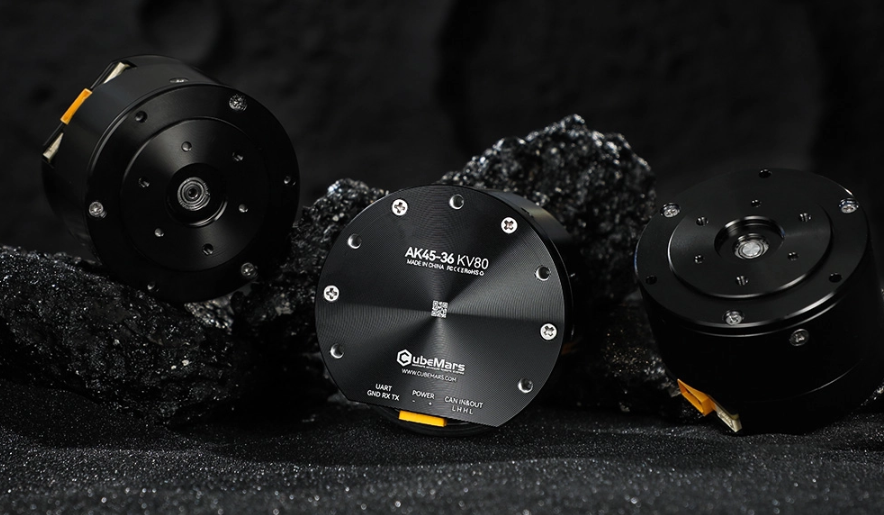
In real-world applications, different robotic systems impose distinct requirements on torque delivery, motion behavior, and control complexity. Actuator modules address most of the mechanical and integration needs directly, while servo control is introduced only when performance demands justify it.
The table below reflects how this relationship is applied across typical robotic scenarios:
| Application | Key Requirement | Recommended Actuation | Integrated Solution Example |
| Mobile robots (AGV/AMR) | Continuous motion, efficiency, moderate precision | Robotic Actuator Module | (optional closed-loop integration for advanced navigation) |
| Robotic arms | Trajectory accuracy, multi-axis synchronization | Robotic Actuator Module + Servo(ensures precise motion) | AK60-39 KV80,AK70-10 KV100 |
| Humanoid robots | Compact high-torque joints, dynamic balance | Robotic Actuator Module | AK45-36 KV 80 |
| Legged robots | Stability under variable loads, dynamic response | Robotic Actuator Module | AK80-9 V3.0 KV100 |
| Exoskeletons & prosthetics | Smooth, safe, adaptive motion | Robotic Actuator Module + Servo(enables human-interaction responsiveness) | AK80-64 KV80、AK60-6 V3.0 KV80 |
This comparison highlights an important point: integrated actuator modules form the foundation of robotic design, delivering the essential torque, efficiency, and reliability. Servo systems typically serve as a performance-enhancing layer, applied only when precision, adaptability, or feedback is critical. This approach maximizes system robustness while minimizing complexity.For engineers, this means the decision is no longer limited to selecting a motor type, but rather identifying a complete actuation solution that aligns with system-level requirements.
Explore CubeMars integrated actuator solutions to find the right match for your specific application.
In robotics, the choice between actuator modules and servo systems is not about superiority, but about fit-for-purpose design:
Robotic Actuator modules: Core actuation, high torque density, compact, energy-efficient, scalable. Ideal for most mobile robots, humanoids, legged platforms, and wearable devices.
Servo systems: Added selectively to improve precision, synchronization, or adaptive control, as the supplement of the mechanical foundation.
By prioritizing integrated robotic actuator modules as the primary driver and layering servo feedback only where needed, engineers achieve efficient, reliable, and adaptable robotic systems. This reflects the current industry trend: high-performance motion stems from system-level integration, not from selecting a motor in isolation.


