Create your CubeMars account

To many people, a wheelchair is simply a means of transportation. But for Christina, Osi’s wife, it’s about “having the freedom to get around.”
Christina suffers from muscular dystrophy. She has lost the ability to walk, and even simple movements like raising her arms are extremely difficult. For most people, going out for a walk or heading somewhere on a whim is a choice that requires no thought; but for her, every outing depends on the help and companionship of others, and “the freedom to go out alone” has become an elusive luxury.
Osi refused to accept this.
He didn’t want “limited mobility” to mean “a limited life.” He wanted Christina to still be able to step outside and participate in life, rather than being confined to a small world. So, he made a decision—to build an electric wheelchair for Christina.
It needed to be foldable and lightweight enough for easy transport and storage; it needed stable and sufficient power to handle small slopes with ease; it needed a range of about 10 km and fast-charging capabilities to accommodate frequent daily use; most importantly, it had to support lightweight wireless remote control, allowing Christina to move and operate it independently even with limited hand mobility.
What turned this seemingly distant idea into reality, step by step, were two completely different yet equally important “drivers.”
The first driving force comes from emotion. It is Osi’s hope that their loved one can regain freedom of movement—a determination that refuses to compromise.
But they soon realized the challenge was far more complex than simply “building an electric wheelchair.”
Existing products on the market were either too heavy to fit easily into a car, or their dimensions made it impossible to sit comfortably at a dining table; or they lacked sufficient power to handle even simple slopes; or their controls were so complex that they were virtually unusable for users unable to lift their arms.
This wasn’t a matter of missing features—it was that these products had never truly been designed for someone like Christina.
Thus, from the very beginning, this wheelchair was redefined. It didn’t need to meet the generic needs of thousands of people; it simply needed to perfectly align with the rhythm of one person’s life.
If “love” gave birth to this idea, it was engineering and technology that brought it to life.
Once the requirements were clearly defined, the challenges became concrete:
How to provide sufficient power while ensuring lightweight construction?
How to keep the wheelchair stable and reliable when facing slopes?
How can we achieve an efficient, controllable drive system within a limited space?
Ultimately, the core of these questions all points to a single critical factor: the design of the drive system.
Within the drive system, the motor is no longer merely a simple actuator; it is the “core” that defines the performance limits of the entire machine. It not only determines whether the wheelchair can climb slopes smoothly and travel steadily but also directly impacts the precision of control, energy efficiency, and the compactness of the overall structure. In other words, how far this wheelchair can travel, how stable it is, and whether it is truly effortless to use depend largely on how the motor is selected and utilized.
For this very reason, from this moment on, this project is no longer simply “building a wheelchair for a wife.” It has entered a more concrete phase: how to build, from the ground up, an electric drive system that is truly suited to Christina, and create a wheelchair exclusively for her.
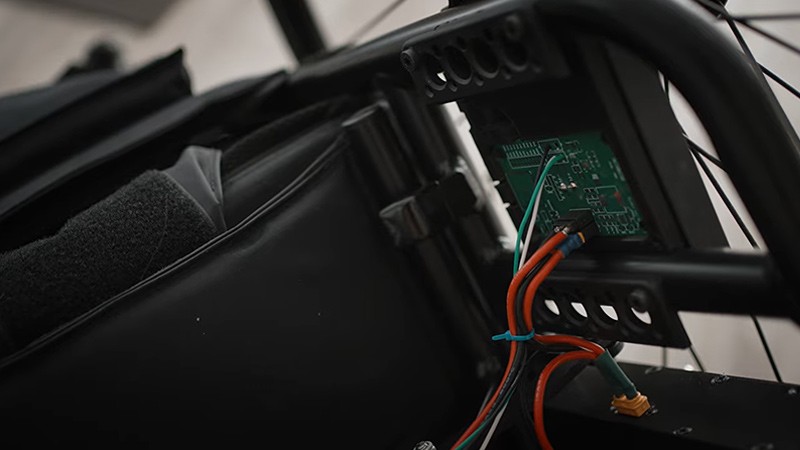
The electric wheelchair developed by Osi primarily consists of a main control unit, drive motors, mechanical structure, and power supply system.
Among these, two ESP32-based wireless microcontrollers serve as the system’s core, responsible for motor control and remote operation; the AKA10-9 KV60 actuators integrated into the left and right wheels provide power output, enabling forward movement, steering, and braking through differential control.
The wheelchair frame supports the user and connects all functional modules, forming a stable mobile platform; the two custom-designed batteries at the bottom provide continuous and stable power to the entire unit, thereby enabling efficient and reliable smart mobility.
In practice, this custom electric wheelchair achieves the following features and performance metrics:
Foldable | Travel Speed | Range | Supports Wireless Operation | Supports Fast Charging |
Yes | 5.3km/h | 12.5km | Yes | Yes |
In practical use, these precise specifications are not merely technical metrics, but also the foundation for Christina to break free from her constraints:
True Freedom of Mobility
By significantly streamlining the mechanical structure through highly integrated actuators, this wheelchair achieves one-touch folding. It is no longer a burden for travel, but a companion that fits easily into a trunk, allowing Christina to embark on a new journey anytime, anywhere.
The Pace of Slow Living
A top speed of 5.3 km/h matches the brisk walking pace of an adult. This not only ensures absolute safety but also allows Christina to walk side-by-side with her family at the most natural rhythm. She is no longer a bystander “being pushed along,” but a true companion in life.
No More Range Anxiety
With a 12.5 km range and fast-charging technology, even spontaneous outings can be handled with ease. For Christina, every extra kilometer gives her the confidence to explore the world.
Control at Your Fingertips
Given Christina’s limited hand strength, the wireless control feature has become the “heart and soul” of the wheelchair. No longer does she need to strain to move a heavy joystick; with just a slight flick of her fingertips, she can precisely steer the wheelchair. In this moment, she has finally reclaimed the long-lost right to determine her own direction.
In the field of rehabilitation and mobility assistance, wheelchairs have undergone a significant shift from manual to electric propulsion. Early manual wheelchairs relied primarily on the user’s upper body strength for movement. Thanks to their simple structure and lower cost, they were widely adopted for basic mobility needs. However, this human-powered approach has clear limitations during prolonged use, on complex terrain, and under heavy loads. Not only does it lead to user fatigue, but it also struggles to meet higher demands for efficiency and comfort.
With advancements in motor technology and control systems, electric wheelchairs have gradually become the mainstream solution. By incorporating motor-driven systems, wheelchairs can achieve automated mobility, significantly reducing the physical exertion required of users while markedly improving the precision and stability of movement control. From an engineering perspective, this shift represents not only an upgrade in propulsion methods but also the evolution of wheelchairs from purely mechanical structures to mechatronic systems.
Comparison of Manual and Electric Wheelchairs
Category | Manual Wheelchair | Electric Wheelchair |
Drive Type | Manual | Electric |
Operational Precision | Low | High |
Long-Term Use | Fatigue-prone | Effortless |
Functionality | None | Supports smart controls and additional features |
As the comparison shows, electric wheelchairs not only offer a significantly enhanced user experience, but their core advantage lies in the performance leap brought about by the drive system. This makes “motor and drive system design” a key factor in determining a product’s competitiveness. The drive system is the core of an electric wheelchair, and as the key component for power output, the motor’s performance directly determines the vehicle’s overall power, handling experience, and range.
As user demands continue to rise, electric wheelchairs are evolving toward greater intelligence, higher integration, greater efficiency, and enhanced safety. Traditional standardized products are increasingly unable to meet the needs of diverse usage scenarios. More and more users are opting for customized electric wheelchairs, primarily due to individual differences and the high diversity of usage environments.
On one hand, users vary significantly in body type, physical condition, and long-term usage needs. Standardized designs often fail to provide ideal support and comfort, whereas customized solutions can effectively enhance ergonomic fit and improve the long-term user experience. On the other hand, users’ environments differ markedly (e.g., indoor, outdoor, or complex terrain), creating distinct demands on the powertrain, handling performance, and stability—a trend that further drives the evolution of drive systems toward “on-demand configuration.” At the same time, with the advancement of smart control and interaction technologies, user demand for personalized feature combinations—such as remote control and data monitoring—continues to grow.
From an industry development perspective, the trend toward customization is also validated by market data. According to the “Wheelchair Market Growth Scenario 2025–2035,” consumer demand for personalized configurations, multifunctionality, and high-comfort products continues to rise, driving companies to continuously introduce adjustable and customized solutions. Furthermore, another industry study indicates that the global wheelchair market is projected to grow from approximately $8.9 billion in 2025 to $21.8 billion by 2033, with a compound annual growth rate (CAGR) of 11.8%. Within this context, “customization and enhanced comfort” have become key drivers of market growth.
Amid this trend, motors are no longer merely actuators but have become the core components determining the overall performance and adaptability of the wheelchair. Their performance in torque output, control precision, and system integration directly impacts the power performance, user experience, and level of intelligence in custom electric wheelchairs.
Technologically, this trend is also driving the evolution of drive systems toward modularization and platform-based designs. Highly integrated actuators are gradually replacing traditional “motor + driver + reducer” separate configurations, which not only reduces system complexity but also significantly improves installation efficiency and reliability. At the same time, distributed control architectures based on CAN bus are becoming mainstream, endowing the entire system with greater scalability and enhanced system stability.
Consequently, this places higher demands on the motor itself. It must not only deliver high torque density and high efficiency but also balance structural compactness, environmental adaptability, and long-term operational reliability. These factors collectively constitute the key challenges in the design of drive systems for custom electric wheelchairs.
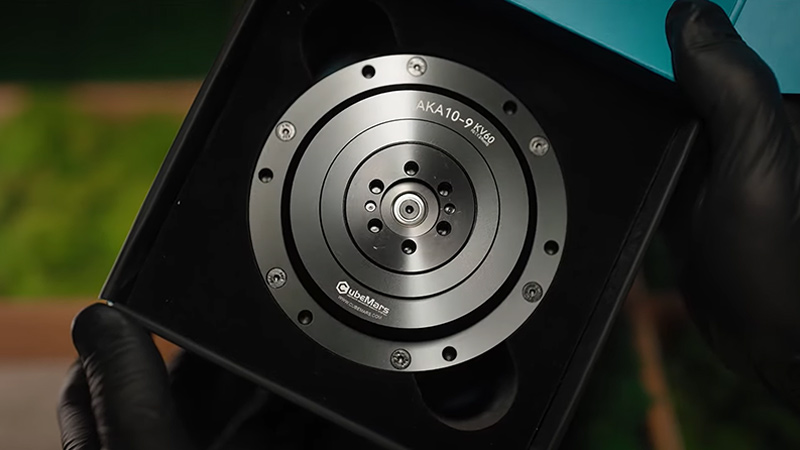
For applications requiring high torque density and highly integrated drive solutions, the AKA10-9 KV60’s integrated actuator provides reliable technical support for electric wheelchairs.
Torque Output Capability
The motor must deliver sufficient torque to support starting, acceleration, and hill climbing, while ensuring stability under varying load conditions.
In terms of torque output capability, the AKA10-9 KV60 features high torque density and outstanding power delivery performance. Combined with its planetary gear reduction design, this actuator provides stable and ample driving force during starting, acceleration, and hill climbing.
Thanks to its robust torque output, this electric wheelchair maintains stable operation across various road conditions and achieves efficient power delivery within limited installation space. This not only facilitates a lightweight design for the entire unit but also significantly enhances the wheelchair’s hill-climbing capability and range performance.
Energy Efficiency and Range
High-efficiency motors effectively reduce energy loss, thereby extending the driving range, making them a key factor in improving overall system performance.
In terms of energy efficiency and range, the high-efficiency brushless motor and optimized drive solution effectively reduce energy loss, helping to extend the wheelchair’s range, minimize heat generation, and improve system reliability, thereby achieving a longer operating range.
Control Precision
Electric wheelchairs have high requirements for low-speed control; the motor must support smooth starts and precise speed adjustment to enhance the user experience.
In terms of control precision, the AKA10-9 V3.0 supports multiple closed-loop control modes, enabling synchronized control of position, speed, and acceleration. This delivers smoother starts and more precise low-speed maneuvering, meeting the comfort and safety requirements of electric wheelchairs.
Communication and Integration Capabilities
Motors that support industrial communication protocols such as CAN bus facilitate system integration and functional expansion, enhancing overall system stability.
In terms of communication and integration capabilities, the AKA10-9 V3.0’s isolated CAN interface design not only enhances interference resistance and communication stability but also provides a solid foundation for system integration and functional expansion. The 2+5-pin plug-in interface design integrates power and signal connections, improving connection reliability and enhancing vibration resistance, making it suitable for long-term operation in mobile devices.
AKA10-9 KV60 Actuator Key Specifications
Model | Motor Dimensions | Motor Weight | Peak Torque | No-Load Speed | Load Capacity |
∅100*70mm | 1060g | 53Nm | 320rpm | 50 kg |
Looking back on this journey of creation from scratch, the significance of this wheelchair has long transcended mere technical achievement.
It is hard to imagine that Osi initially lacked a comprehensive engineering background, yet to restore his wife’s ability to move independently, he chose to start from scratch, delving into control systems and low-level code to build the entire drive solution piece by piece. This was not merely a lengthy manufacturing process, but a courageous choice: when existing standardized products failed to meet the needs of his loved one, he did not compromise but chose to create the solution himself. This pure motivation, born from real life, has imbued cold, lifeless parts with the most genuine and moving power.
From a broader perspective, Osi’s endeavor reflects the evolutionary trajectory of the entire mobility assistance industry. The evolution from manual to electric wheelchairs represents, at its core, a generational leap in propulsion systems. The introduction of electric motors transformed wheelchairs from mechanical tools reliant solely on human power into intelligent electromechanical systems with automated capabilities. This not only significantly reduced the physical burden on users but also, through precise electronic control, opened up boundless possibilities for features such as remote control and automatic obstacle avoidance.
Today, amid an explosion of demand for customization, the role of the motor is undergoing a fundamental shift. It is no longer merely a passive component that executes commands; instead, it is gradually evolving into the core element that determines the overall performance and user experience of the device. As Osie has demonstrated in practice: an integrated actuator featuring high torque density, multi-loop control capabilities, and stable communication interfaces can achieve the most efficient power output within extremely limited space, striking a perfect balance between range, maneuverability, and system reliability.
Standing at the threshold of the future, the evolution of powertrain systems shows no signs of stopping. As intelligent control technology and personalized needs become deeply integrated, electric wheelchair drive systems will continue to evolve toward higher efficiency, greater integration, and stronger environmental adaptability. This is not merely a technological leap but a continuation of compassion—bringing high-performance drive solutions into more households like Osie and Christina’s, and unlocking new possibilities for reshaping freedom through rehabilitation assistive devices.