Create your CubeMars account

With the rapid development of smart wearable devices, rehabilitation assistance, and human-machine collaborative equipment, exoskeleton actuators are becoming important core components in the field of high-end motion control.
Whether in assistive systems, rehabilitation devices, or load-bearing support equipment, actuators directly determine:
Output force
Motion sensitivity
Wearing comfort
Human interaction safety
However, in the field of exoskeletons, there has always been a key technical contradiction:
Higher power density often means greater output torque and a more compact structure; while human safety requires the actuator to possess compliance, controllability, and low-impact characteristics.
So, how exactly can exoskeleton actuators achieve a balance between “high performance” and “high safety”?
An Exoskeleton Actuator is a power unit used to drive human joint movement, typically applied in:
Assistive wearable devices
Rehabilitation assistance systems
Human motion enhancement devices
Human-machine collaborative equipment
It is mainly responsible for providing human joints with:
Torque output
Motion assistance
Dynamic following
Motion control
A complete exoskeleton actuator usually consists of the following parts:
Motor
Reduction mechanism
Encoder
Driver
Control system
Its function is similar to “mechanical muscles,” helping the human body achieve easier and more stable movement.
An Exoskeleton Actuator is the core power device used to drive joint movement in an exoskeleton system, responsible for providing assistive torque, motion control, and dynamic response for human movement.
It is usually installed at the human body's:
Hip joint
Knee joint
Ankle joint
Shoulder joint
Arm joints
and other motion areas, achieving assistance and enhancement of human movement by simulating the working method of human muscles.
A complete exoskeleton actuator usually includes:
Motor
Reduction mechanism
Encoder
Driver
Torque control system
Communication module
Some high-end actuators also integrate:
Force sensors
Temperature monitoring systems
Braking protection modules
forming a highly integrated all-in-one joint drive unit.
1. Medical Rehabilitation Exoskeletons
Help patients with stroke, spinal cord injuries, and similar conditions recover walking and movement abilities.
2. Industrial Assistive Exoskeletons
Used for high-intensity work such as handling and assembly to reduce worker fatigue and occupational injuries.
3. Military/Enhanced Exoskeletons
Enhance human load-bearing capacity, endurance, and operational efficiency.
As the core power unit of the entire system, exoskeleton actuators not only determine the upper limit of output capability, but also directly affect the naturalness of human-machine interaction and the long-term wearing experience. As application scenarios continue to expand from industrial assistance and rehabilitation training to complex human-machine collaboration, their technical requirements are also continuously increasing.
At the design level, exoskeleton actuators are no longer merely components that “provide power,” but comprehensive systems that must simultaneously satisfy high-performance output, human safety control, and compliant interaction experience. Therefore, their key technical characteristics have gradually evolved around multiple core dimensions.
| Technical Category | Core Content | Technical Key Points | Value Brought |
| High power density | Small size with high output capability | High slot fill rate design / High-performance permanent magnet materials / Compact structure | Lighter weight, stronger output, easier to wear |
| Precise torque control | “Force”-centered control method | High-precision current control / Real-time torque feedback / High-bandwidth systems | More natural movement and smoother human-machine collaboration |
| Compliance and backdrivability | Improve the naturalness of human-machine interaction | Low inertia design / Low friction structure / Compliant control algorithms | Reduce stiffness and improve movement comfort |
| High safety control | Human safety-first mechanism | Torque limitation / Current protection / Temperature monitoring / Emergency stop mechanisms | Prevent overload and accidental injury |
| Low inertia and fast response | Rapidly follow human movement | Low inertia motors / High-speed current loops / High-response drivers | Smoother gait and more synchronized movements |
| Highly integrated design | Integrated joint structure | Integration of motor + driver + encoder + sensors | More compact structure and higher reliability |
| Thermal management capability | Guarantee for long-term stable operation | Heat dissipation structure optimization / Temperature monitoring / Current limiting control | Improve endurance and wearing comfort |
| Intelligent human-machine collaboration | Future development direction | Gait prediction / Motion recognition / Adaptive control | Smarter and more natural assistance experience |
Overall, the technological development of exoskeleton actuators has gradually shifted from single “output capability optimization” toward a comprehensive balanced design of “performance + safety + human experience.”
Among them, the relationship between high power density, compliant control, and human safety is particularly critical, as they jointly determine whether the actuator can truly adapt to long-term wearing and complex human-machine interaction scenarios.
The reason exoskeleton actuators are becoming increasingly sensitive to “high power density” is not simply the pursuit of stronger output, but is fundamentally determined by their application target (the human body) and usage method (long-term close-fitting wear).
Compared with ordinary robot motors, exoskeleton actuators must simultaneously satisfy the triple constraints of “power performance + human safety + wearing experience,” making power density a core indicator that determines the success or failure of the system.
Ordinary robot motors are usually used in fixed environments, such as:
Industrial robotic arms
Automated production line equipment
Fixed trajectory motion systems
The characteristics of these scenarios are:
No need for close-fitting wear
Do not directly act on the human body
Allow relatively large weight and volume
Place more emphasis on stable output and lifespan
However, exoskeleton actuators are completely different, as they are directly attached to the human body, and their operating environment is “human.”
This brings three fundamental differences:
| Core Constraint | Specific Requirement | Affected Area | Main Impact | Design Orientation |
| Must be worn close to the body (extremely high weight sensitivity) | Actuators are installed at joint areas (knees / hips / ankles) | Lower limb and upper limb joints | Alters gait, increases energy consumption, accelerates fatigue | Make the system as lightweight as possible while ensuring output capability |
| Must coexist with humans (cannot use rigid driving) | Follow human movement, avoid interfering with natural motion, and prevent forced pulling | Whole-body motion chain | Affects movement naturalness and interaction experience | Improve compliance, reduce impedance, and enhance natural interaction |
| Must operate for long periods (sensitive to heat and comfort) | Long-term wearing, low temperature rise operation, stable output | Entire wearable system | Affects comfort and continuous usage experience | Optimize heat dissipation and energy efficiency to ensure long-term stable operation |
The design of exoskeleton actuators is not simply about pursuing “greater power” or “higher speed,” but about achieving a comprehensive balance between power output and interaction experience under human-body constraints. Since they directly act on human joints, the design objectives must simultaneously consider performance, safety, and long-term wearing experience.
Overall, the core design objectives of exoskeleton actuators can be summarized in the following aspects:
| Design Objective | Core Positioning | Core Requirements | Essential Goal |
| High power density | Fundamental performance objective | Deliver greater torque output within a smaller volume; reduce joint burden; improve structural compactness | Achieve stronger power output with a lighter structure |
| Compliant control | Human-machine interaction objective | Dynamically adjust output according to human movement; smooth torque transitions; avoid rigid impacts | Allow the device to “follow the human” instead of “control the human” |
| Human safety | System constraint objective | Dual torque and current limitations; abnormal protection mechanisms; safe motion range control; real-time temperature and load monitoring | Ensure no uncontrollable risk is caused to the human body under any circumstances |
| Backdrivability | Natural movement objective | Reduce mechanical impedance; reduce friction sensation; improve passive following capability | Allow the human body to naturally drive actuator movement |
| Wearing comfort | Long-term use objective | Low weight burden; low heat output; stable continuous operation; reduced fatigue accumulation | Achieve comfortable long-term wearing without affecting daily movement |
In the design of exoskeleton actuators, high power density is not only a performance indicator, but also a key factor that determines whether the system is “usable, easy to use, and suitable for long-term use.” It directly affects weight control, power output, human safety, and the overall wearing experience, making it one of the core constraints of the entire system design.
From the perspective of practical applications, the importance of high power density is mainly reflected in the following aspects:
| Key Function | Core Issue | Impact of Insufficient Power Density | Improvements Brought by High Power Density |
| Solve the contradiction between lightweight design and output capability | Simultaneously require “strong output + light weight” | Larger motor size, increased weight, increased burden on the human body | Achieve greater power output in a smaller and lighter structure |
| Reduce the burden of human wearing | Joint positions are extremely sensitive to weight (knee/hip/ankle) | Heavier equipment, increased motion inertia, increased energy consumption, easy fatigue | Reduce single-joint load and overall energy consumption |
| Improve compliant control and movement naturalness | Need smooth human-machine collaborative movement | Large inertia, slow response, stiff movement | Lower inertia, faster response, smoother torque output |
| Improve human safety boundaries | Human movement control in dynamic environments | Slow response, high impact risk, control lag | Fast closed-loop control to reduce impact and loss-of-control risks |
| Improve backdrivability and natural interaction experience | The human body needs to naturally drive the actuator | High resistance, strong mechanical sensation, unsmooth movement | Reduce system impedance and improve natural following capability |
| Improve long-term wearing comfort | Requirement for long-term close-fitting operation | Heavy joint burden, rapid fatigue accumulation, poor experience | Lighter, more energy-efficient, and more comfortable continuous usage experience |
The reason why high power density has become a core indicator of exoskeleton actuators is essentially not a single performance improvement, but because it simultaneously solves:
● Power output capability
● Human load control
● Movement naturalness
● Safety response capability
● Long-term wearing experience
Therefore, it is more like a “system-level balance indicator,” directly determining whether exoskeleton actuators can truly achieve:
The unified experience of lightweight design + high output + compliant control + human safety + comfortable wearing.
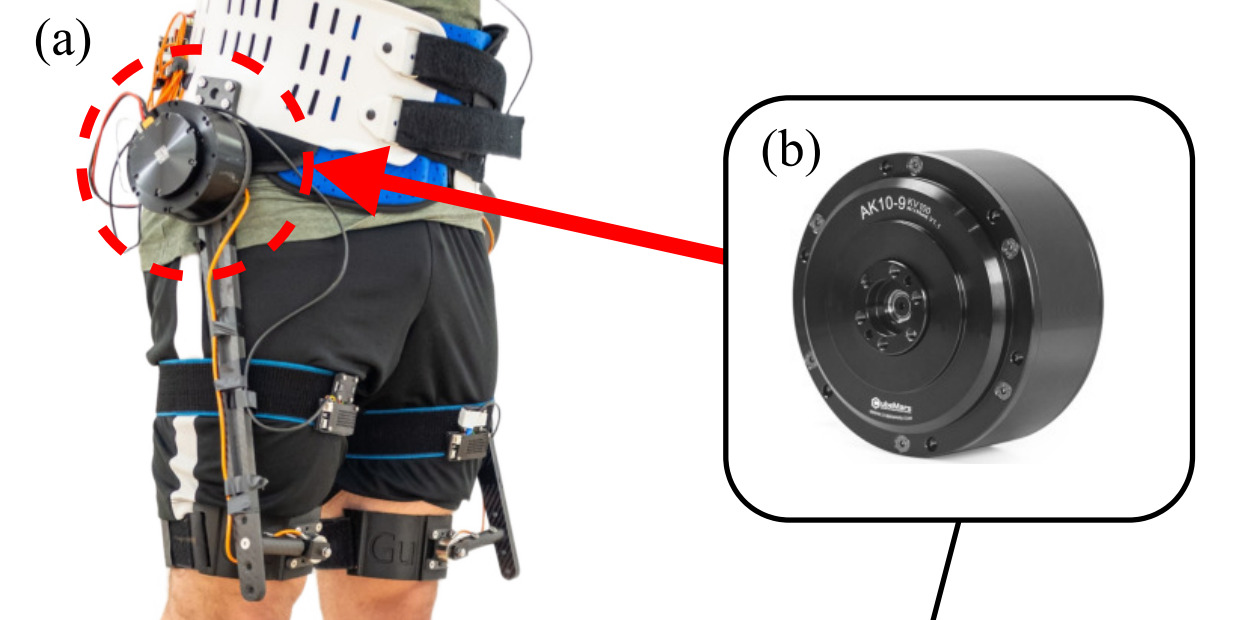
Project Background
In human-machine collaborative exoskeleton systems, “interaction force” is a key parameter affecting control accuracy and wearing comfort. Traditional solutions usually rely on additional force sensors to measure the interaction force between humans and machines, but this approach brings obvious problems:
Increased system weight
Higher overall cost
Increased structural complexity
Reduced integration reliability
Therefore, the industry has begun exploring a lighter and more efficient solution: achieving precise human-machine interaction force estimation without adding extra sensors.
CubeMars Actuator Solution
This project uses CubeMars actuators to build a hip-joint exoskeleton system, realizing interaction force estimation through the dynamic characteristics of the actuator itself.
The core design relies on the following key capabilities:
| Technical Capability | Function |
| High power density | Provide sufficient joint assistance while reducing overall system weight |
| Compliant control capability | Achieve more natural human-machine interaction and force feedback |
| Low mechanical impedance | Reduce movement resistance and improve human active control capability |
| High response performance | Improve control accuracy under dynamic changes |
Project Results
During treadmill walking experiments, test subjects performed movement tests under different assistive torque conditions.
The system demonstrated the following results:
Average error controlled within a relatively low range
Significantly improved torque tracking accuracy
Enhanced human-machine interaction stability
This indicates:
Even without additional force sensors, high-precision human-machine interaction force estimation can still be achieved.
Technical Significance
The core value of this case lies in verifying that:
Through the intrinsic characteristics of high-performance actuators, system structure can be simplified while simultaneously improving control accuracy.
At the same time, it performed outstandingly in the following aspects:
Improve human safety (reduce sudden impacts)
Enhance compliant control capability (more natural movement)
Optimize backdrivability (smoother human movement)
Improve wearing comfort (reduce long-term fatigue)
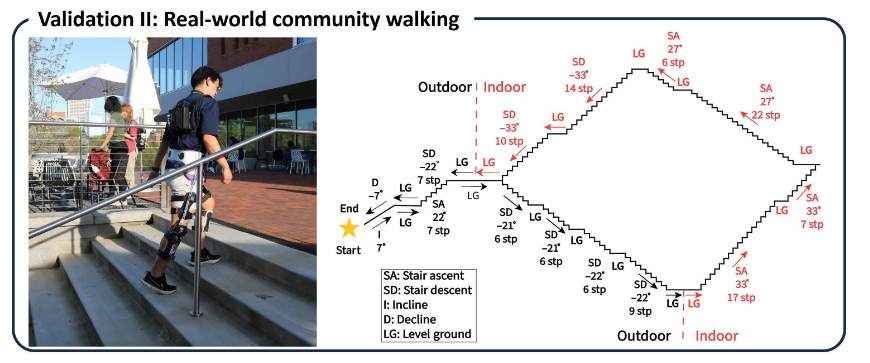
Project Background
With the development of artificial intelligence and motion control technologies, exoskeleton systems are evolving from fixed assistance modes toward adaptive intelligent control.
This project was jointly developed by multiple universities, with the goal of achieving:
Complex terrain adaptation
Real-time gait recognition
Dynamic assistance adjustment
Long-term natural wearing experience
This places higher requirements on actuators.
CubeMars Actuator Solution
The system adopts CubeMars actuators as the core drive unit to support complex dynamic motion control.
Its key technical support includes:
| Technical Capability | Function |
| High power density | Provide stable power output while ensuring lightweight design |
| Compliant control capability | Achieve natural collaborative movement between humans and machines |
| High backdrivability | Improve the freedom of human active movement |
| Low mechanical impedance | Reduce the “mechanical feeling” of movement and improve natural experience |
| High dynamic response | Rapidly adapt to gait changes and environmental changes |
Project Results
The system can automatically adjust assistance strategies according to different motion scenarios, including:
Walking on flat ground
Going up and down stairs
Uphill and downhill movement
Gait speed switching
During dynamic changes, the actuator can rapidly respond to changes in human movement, effectively reducing:
Sense of movement delay
Mechanical dragging sensation
Gait coordination problems
The overall movement performance becomes smoother and more natural.
Technical Significance
This case verifies the core role of exoskeleton actuators in intelligent control systems:
Actuators are not only the source of power, but also the key determining factor of the human-machine interaction experience.
Its core value is reflected in:
Improve human safety boundaries (reduce impact risks)
Enhance compliant control capability (more natural movement)
Optimize backdrivability (easier human-driven movement)
Improve wearing comfort (suitable for long-term use)
Support stable output under high power density
Through the above two cases, it can be seen that the development of exoskeleton actuators no longer simply relies on “greater output,” but is gradually shifting toward:
Power density (lightweight + strong output)
Compliant control (natural human-machine interaction)
Human safety (system bottom-line constraints)
Backdrivability (movement naturalness)
Wearing comfort (long-term usage experience)
This also shows:
The core value of exoskeleton actuators is not to “drive human movement,” but to “allow humans to move more naturally.”
In exoskeleton actuators, motors not only determine the power performance of the equipment, but also directly affect human safety and the wearing experience. Therefore, compared with simply pursuing higher power, human safety has always been the most important core factor in exoskeleton actuator design.
Although high power density can make exoskeleton actuators lighter, more compact, and provide stronger assistance effects, excessively high output capability may also bring:
Excessive movement impact
Uneven joint force distribution
Unstable control
Unsynchronized human-machine movement
Since exoskeleton actuators are devices that directly act closely on human joints, once the motor output loses control or the response becomes unnatural, it may affect human joints, muscles, and even overall movement balance. Therefore, exoskeleton actuators not only need to be “powerful,” but also “safe, stable, and controllable.”
How to Improve Human Safety?
In order to ensure safety under high power density conditions, modern exoskeleton actuators usually adopt the following control and design strategies:
Torque control: Make output softer and more natural, avoiding rigid driving
Impedance control: Reduce mechanical impact and improve movement smoothness
Torque limiting protection: Prevent excessive output under abnormal conditions from causing injury
Low inertia design: Improve response speed and movement stability
The core goal of these strategies is:
While ensuring power output capability, make human-machine interaction more controllable and natural.
Why Is High Power Density Still Necessary?
High power density remains a key development direction for exoskeleton actuators because it directly affects:
Lightweight structural design
Assistive output capability
Compliant control performance
Backdrivability and natural movement experience
Long-term wearing comfort
In other words, high power density determines “how powerful the system can be,” while safety control determines “whether it can be used stably.”
Core Logic of Balance
In exoskeleton actuator design, the relationship between the two can be summarized as:
Power density determines the upper performance limit, while human safety determines the application boundary.
A truly excellent solution is not about choosing between the two, but about fully releasing performance while ensuring safety.
The design objective of exoskeleton actuators is not simply to pursue higher output capability, but to achieve a system-level balance among:
Power output
Control accuracy
Human safety
Wearing comfort
thereby achieving a truly sustainable long-term human-machine collaborative experience.
In exoskeleton actuator systems, different joint positions (hips, knees, ankles, etc.) and different application scenarios have very different requirements for motor performance. During selection, the following key factors usually need to be comprehensively evaluated:
Power density
Torque output capability
Human safety
Overall weight
Control accuracy
Compliant control capability (Backdrivability)
Among them, high power density and compliant control capability are becoming the core trends in exoskeleton actuator motor selection, ensuring that the system is both “powerful” and “lightweight and safe.”
| Model | Recommended Application | Core Features | Applicable Area |
| AK10-9 V3.0 KV60 | High-load exoskeletons / Lower-limb assistive systems | High torque output, high power density, dual-encoder structure | Hip joint / Knee joint |
| AK80-9 V3.0 KV100 | AI intelligent exoskeletons / Gait assistive systems | High response speed, low mechanical impedance, strong compliant control capability | Knee joint / Ankle joint |
| AK80-6 KV100 | Lightweight exoskeleton systems | High integration, lightweight, stable operation | Lower-limb assistive structures |
| AK70-10 KV100 | Industrial assistive exoskeletons | High torque load capacity, strong impact resistance | Hip joint |
| AK60-6 V3.0 KV80 | Portable exoskeleton devices | Miniaturized design, high efficiency, low inertia | Ankle joint / Small assistive modules |
| AKE Series | Rehabilitation and augmentation exoskeleton systems | High compliance control, excellent backdrivability, natural human-machine interaction | Lower-limb joint systems |
Recommended Selection Directions (By Application Scenario)
| Application Scenario | Recommended Motor Direction | Key Requirements |
| Medical rehabilitation exoskeletons | High compliance control + high-precision control | Human safety priority, natural movement |
| Industrial handling exoskeletons | High torque + high stability | Long-duration continuous output, load resistance |
| AI intelligent exoskeletons | High response + high-bandwidth control | Dynamic gait recognition and real-time adjustment |
| Lightweight wearable devices | High power density + miniaturized design | Reduce human burden and improve comfort |
With the development of robotics technology, AI control algorithms, and high-performance actuators, exoskeleton actuators are gradually moving from laboratories into practical application scenarios such as medical rehabilitation, industrial assistance, and intelligent wearables. As the core power source of the system, actuator selection and performance directly determine overall experience, safety, and usability.
1. Exoskeleton actuators not only determine power performance but also affect human safety and wearing experience:Unlike traditional industrial motors, exoskeleton actuators directly interact with human joints for long periods, so they emphasize compliant control, human-machine collaboration, and long-term comfort in addition to output capability.
2. High power density is an important development direction for exoskeleton actuators:Higher power density means achieving stronger assistive output within smaller size and lighter weight, helping improve flexibility, reduce human burden, and optimize overall system integration.
3. Human safety always takes priority over extreme power output:Since exoskeleton actuators directly interact with human joints, their design must ensure safety boundaries through low mechanical impedance, torque limiting protection, compliant control, and related capabilities to avoid rigid impacts and motion imbalance.
4. Compliant control and backdrivability are the key foundations of human-machine collaboration:Excellent exoskeleton actuators should not only “provide power” but also “adapt to human movement.” By reducing impedance and improving backdrivability, the human body can naturally drive the system, creating a smoother interaction experience.
5. Future development direction: lighter, smarter, and safer:With advancements in AI control algorithms and highly integrated actuator technologies, exoskeleton actuators will continue evolving toward higher power density, greater control precision, and more natural human-machine interaction, further enhancing real-world application value and commercialization potential.
The development of exoskeleton actuators is shifting from “simply pursuing power performance” toward a system-level balance of “power density, control precision, safety, and human experience.”
In the future, achieving a better integration between high-performance output and human safety will become the key to advancing exoskeleton technology toward mature real-world applications.


