Create your CubeMars account

Rehabilitation Robots Are Reshaping Modern Medical Rehabilitation
With the acceleration of population aging and the increase in sports injuries, the traditional rehabilitation method relying on manual physiotherapy is shifting towards an intelligent, automated, and personalized direction. Consequently, rehabilitation robots have become one of the fastest-growing applications in the medical robotics field.
These devices use motor-driven and control systems to achieve repetitive, controllable, and safe training movements for human joints or muscles, and are widely used in:
Joint rehabilitation training (knee joint, ankle joint)
Muscle stretching and traction
Gait training and walking assistance
Postoperative functional recovery
However, unlike industrial robots, rehabilitation robots directly interact with the human body. Therefore, the core requirement is not just "precision," but smoothness, safety, and impact-free sensation.
A rehabilitation robot is a type of intelligent device used to assist patients in recovering motor functions. Common applications include:
Limb training after stroke
Spinal cord injury rehabilitation
Motor recovery for the elderly
Postoperative joint training
It can help patients gradually restore muscle strength and neural control capabilities through repetitive, precise, and controllable action training.
A rehabilitation robot motor is the core component that drives the robot's joint movement, undertaking three major functions:
1. Provide Power
Drives joints to complete flexion, extension, rotation, and other actions
2. Precise Control
Achieves closed-loop control of position, speed, and torque
3. Human-Robot Interaction
Dynamically adjusts output based on the patient's force application
Essentially, it is a "drive + sensing + control integrated system"
A rehabilitation robot motor is a drive device specifically applied in rehabilitation equipment, responsible for:
Driving joint movements (e.g., knee joint, elbow joint)
Controlling movement speed, force, and angle
Achieving safe human-machine interaction
Unlike ordinary industrial motors, it places greater emphasis on:
Safety + Precise Control + Human-Robot Interaction Friendliness
Core Feature | Specific Performance | Application Value |
High-Precision Control | High angle control accuracy; supports position/speed/torque multiple control modes | Ensures standardization of rehabilitation training actions; improves training consistency |
High Torque Density | Small volume outputs high torque | Suitable for wearable devices like exoskeletons; reduces weight while ensuring power |
Compliant Control (Force Control) | Can sense force applied by the human body and respond in real time | Enhances human-robot interaction safety; avoids secondary injury to the patient |
Low Noise and Smoothness | Low operating noise; smooth and natural movement process | More suitable for medical environments, improves patient comfort, actions are closer to natural human movement |
High Safety | Equipped with torque limitation, overload protection, emergency stop mechanisms | Multiple safety guarantees, reduces equipment risks, ensures patient safety during use |
1. Patient Safety and Comfort
Rehabilitation training often involves damaged limbs or spastic muscles. If the motor exhibits torque pulsation during extremely low-speed operation (0.1~5rpm), even a fluctuation of only ±0.01Nm can be perceived by a sensitive patient as "stiffness" or "slipping," triggering a conditioned reflex of counter-movement and leading to secondary injury.
2. Force Control Precision and Intention Recognition
Modern rehabilitation robots commonly use current-loop-based force/torque control to perceive the patient's active intention. The periodic torque disturbance caused by the motor's cogging torque directly contaminates the current feedback signal, making it difficult for impedance control and assistive adaptive algorithms to converge, manifesting as:
Unsmooth training trajectory
Stuttering sensation during assistive startup
Obvious speed fluctuation in passive mode
3. Low Noise and Psychological Acceptance
Rehabilitation equipment typically operates for long periods in quiet environments like hospitals or homes. The medium-to-high frequency vibration noise generated by the cogging effect not only causes user irritation but also reduces the patient's "trust" in the device.
I. What is the Cogging Effect?
The cogging effect is a "stuttering sensation" caused by the periodic change in magnetic attraction between the stator teeth and the rotor magnetic poles of the motor.
Manifestations:
Discontinuous rotation (stuttering)
Low-speed jitter
Increased control difficulty
II. Negative Impact in Rehabilitation Equipment
In rehabilitation scenarios, this effect is significantly amplified:
During traction training → Uneven force output
During joint movement → "Stuttering sensation" occurs
During passive rehabilitation → Poor patient experience
Especially in scenarios involving slow stretching and fine angle control, low cogging design is almost a "rigid requirement."
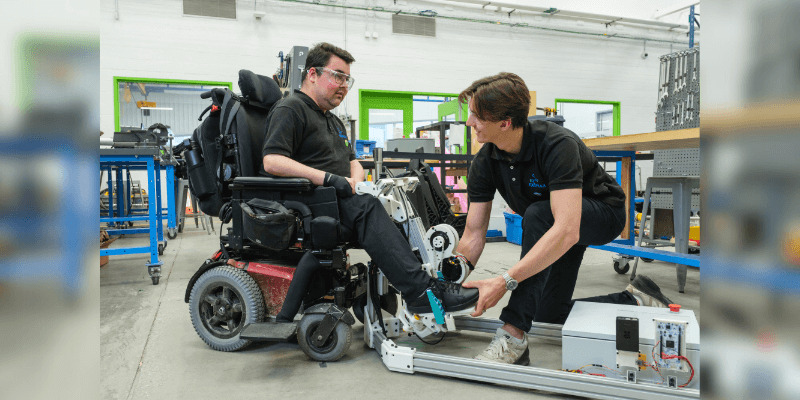
This project was developed by Michaël, a patient with muscular atrophy, and his team, aiming to achieve automated stretching rehabilitation training for calf muscles. By using automation to replace traditional manual assistance, patients can perform rehabilitation training more safely and with higher frequency, while improving training standardization.
In this system, the CubeMars robot actuator serves as the core power unit, providing stable and controllable driving force for the stretching mechanism.
Application Challenges
This rehabilitation device faced several key technical requirements during design:
Traditional rehabilitation relies on manual assistance, resulting in low training efficiency and lack of continuity
Stretching force is difficult to standardize, potentially affecting rehabilitation outcomes
The device must have high safety to avoid overstretching or impact risks
Additionally, the system needs to maintain stable output over long periods and adapt to individual patient differences.
CubeMars Solution
In this application, the CubeMars robot actuator provided key motion control capabilities:
High torque output to drive the stretching mechanism stably
High-precision position control for angle-level precise stretching
Support for torque control mode for compliant and safe contact experience
Closed-loop control system to ensure movement smoothness and repetitive consistency
Through high-precision motor control, the device delivers a compliant stretching experience close to "therapist manual control."
Application Results
In practical application, this solution significantly improved rehabilitation efficiency and user experience:
Patients can independently perform standardized stretching training
Consistency of each training action is greatly improved
The device has an automatic protection mechanism to enhance safety
Supports training data recording to assist doctors in optimizing rehabilitation plans
Overall, it achieves an upgrade from "manual-assisted rehabilitation" to "intelligent autonomous rehabilitation."
Core Embodiment
High-precision motion control capability
High torque stable output capability
Compliant force control and safety assurance capability
Support for personalized rehabilitation training
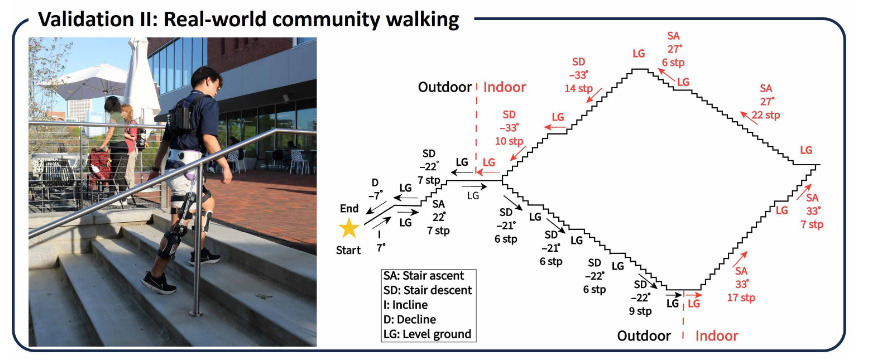
This project is led by the research team at Georgia Tech, combining AI control algorithms with a lightweight exoskeleton system to improve human gait movement capability. The system uses intelligent control strategies to provide assistive torque support for lower limb movement, suitable for both rehabilitation training and daily walking assistance scenarios.
In this system, the CubeMars robot actuator provides key power output for the exoskeleton joints, achieving high-precision, low-latency motion control capabilities.
Application Challenges
This AI exoskeleton system places extremely high demands on robot actuator performance:
Real-time recognition of gait changes and rapid response to control commands
Maintaining stable assistive support while walking on complex terrains such as level ground, slopes, and stairs
High synchrony and consistency required for multi-joint cooperative control
Control latency must be maintained at the millisecond level, otherwise gait naturalness is affected
At the same time, the system must also balance lightweight design with long-term wearing comfort.
CubeMars Solution
The CubeMars robot actuator provides stable power and fine control capabilities for this AI exoskeleton:
High-response torque output for immediate assistive feedback
High-precision closed-loop control supporting complex gait trajectory tracking
Low-latency control architecture ensuring real-time dynamic response
Lightweight integrated structure suitable for wearable exoskeleton design
Through high-frequency control (approximately 100Hz level), it achieves natural, continuous human-robot collaborative motion control experience.
Application Results
This solution significantly enhanced the practical application capabilities of the exoskeleton system:
User walking energy consumption is significantly reduced, improving movement efficiency
Stable assistance is maintained even on complex terrains (ramps/stairs)
Natural movement transitions improve wearing comfort
Supports AI adaptive control for personalized assistance strategies
Overall, it pushes the exoskeleton from "lab device" towards "real-world environment application."
Core Embodiment
AI-driven real-time motion control capability
High-precision multi-joint cooperative control capability
Millisecond-level dynamic response capability
Lightweight wearable actuator support
What Can We See from the Cases?
In the autonomous stretching rehabilitation device and the Georgia Tech AI exoskeleton project, the CubeMars robot actuator supports two typical types of medical and human-robot collaboration scenarios: passive rehabilitation training and active movement assistance.
In the rehabilitation stretching device, the system emphasizes stability, safety, and controllability, achieving autonomous patient rehabilitation training through high-precision position control and compliant torque output, improving training consistency and safety.
In the AI exoskeleton system, the focus shifts to real-time response and dynamic coordination, requiring the actuator to quickly follow human gait changes, provide immediate assistance in complex movement scenarios, and achieve a natural human-robot integrated movement experience.
Although the application directions differ, both share highly consistent core requirements for the robot actuator:
High-precision motion control capability
High-response dynamic output capability
Stable closed-loop control performance
Safe, reliable human-robot interaction characteristics
These applications collectively demonstrate CubeMars' key value in the medical rehabilitation and intelligent wearable fields.
Core Principle for Selecting Rehabilitation Robot Motors: For all rehabilitation applications, prioritize motor solutions that clearly specify measured cogging torque values and support low-latency torque control modes.
Application Scenario | Recommended Motor Model | Core Selection Justification | Suitable Device Types |
Small Rehab Training (Hand/Wrist) | High response, ultra-low inertia, minimal torque pulsation, ideal for distal joint training requiring the highest force control precision. | Hand rehabilitator, finger joint training device | |
Medium Rehab Equipment (Lower limb stretching/passive training) | Provides high torque density while maintaining excellent low-speed smoothness. Torque control mode is compliant and safe, making it ideal power for standardized stretching. | Calf stretching device, rehabilitation bed, CPM device | |
Exoskeleton/AI Walking Aid System (Dynamic assistance) | Extremely low cogging torque and backdrive torque (approx. 0.8Nm) ensure absolute smoothness when pushed externally, key to achieving natural, transparent human-robot collaboration. | Lower limb exoskeleton, gait training system | |
High-Load Medical/Exoskeleton (Heavy-load rehab) | Maintains industrial-grade stability and controllability even under high torque output (peak 120Nm). Low cogging design ensures safety in heavy-load, low-speed conditions. | Heavy-load exoskeleton, intensive rehabilitation device | |
Compact Precision Joint (e.g., humanoid hand/wrist) | Achieves low cogging torque design in an ultra-compact structure, suitable for end effectors with demanding requirements for both space and force control precision. | Humanoid robot hand/wrist joint, precision surgical assistance |
Table of Important Related Parameters for Rehabilitation Robot Motors
Motor Model | No-Load Speed (RPM) | Rated Torque (Nm) | Rated Speed (RPM) | PeakTorque (Nm) | Gear Ratio |
AK60-6 V3.0 KV80 | 320/640 | 3 | 233/490 | 9 | 6∶1 |
AK80-9 V3.0 KV100 | 570 | 9 | 390 | 22 | 9:1 |
AK10-9 V3.0 KV60 | 320 | 18 | 235 | 53 | 9∶1 |
AK80-64 KV80 | 37/75 | 48 | 23/48 | 120 | 64:1 |
AK45-36 KV80 | 52 | 8 | 40 | 24 | 36:1 |
Key Focus Areas When Selecting Rehabilitation Robot Motors:
Torque Density → Determines support capability
Control Mode (MIT / Torque Control) → Determines compliance
Encoder Precision → Determines action accuracy
Low-Latency Response → Determines human-robot synergy experience
Safety Torque Limiting Capability → Prevents overstretching
Rehabilitation robots are propelling medical rehabilitation from "manual assistance" towards "intelligent autonomy." The selection of their core power source – the motor – directly determines the device's safety, compliance, and rehabilitation effectiveness.
1. Smooth torque is the foundation of rehabilitation safety: In extremely low-speed, variable-load rehabilitation scenarios, even minor torque fluctuations can be perceived by the patient, causing discomfort or counteractive reactions that affect treatment outcomes. Only extremely smooth torque output enables truly compliant human-robot interaction.
2. The cogging effect is a primary obstacle to smoothness: The "stuttering sensation" caused by cogging torque is significantly amplified during core rehabilitation actions like slow stretching and fine angle control, reducing force control precision, generating noise, and damaging patient trust. Therefore, low cogging design has become a "rigid requirement" for rehabilitation robot motors.
3. Real-world cases validate the selection direction: From the CubeMars motor empowering the "Autonomous Stretching Rehabilitation Device" and the "Georgia Tech AI Exoskeleton" projects, it is evident that whether for passive rehabilitation training or active movement assistance, high-precision position control, compliant torque output, high dynamic response, and closed-loop stability are all core capabilities jointly relied upon for successful application.
4. Selection requires scenario-based matching: Different rehabilitation devices (e.g., hand trainers, lower limb stretchers, exoskeleton robots) have different priorities regarding motor torque, response speed, weight, and control modes. When selecting, key considerations should include torque density, control mode (supporting MIT/torque control), encoder precision, low-latency response, and safety torque limiting capability.
In summary, when selecting a motor for a rehabilitation robot, one must look beyond conventional parameters like peak torque and prioritize smoothness, compliance, and safety. A genuine measured cogging torque curve and low-speed torque ripple data are far more valuable than a beautiful parameter sheet. As rehabilitation devices evolve towards home use, lightweight design, and intelligence, motor solutions featuring low cogging and integrated design will become the key success factor for product realization.


