Create your CubeMars account

In the field of robotics development, designing a robotic arm with six degrees of freedom serves as a bridge between theory and practical application. Whether the goal is a precision-oriented desktop laboratory solution or an industrial application requiring high payload capacity and long reach, the core challenge lies in balancing the trade-offs between end-effector payload, structural self-weight, and joint output torque.
Actuator selection is no longer merely a matter of choosing a single motor; it directly determines the system’s dynamic limits, control bandwidth, and integration efficiency. This article will systematically analyze the logic behind actuator selection for full-scale robotic arms and explore how to establish a scientific joint power allocation strategy.
As robotic arms transition from simple demonstration models to real-world applications, system complexity increases rapidly. Developers must no longer focus solely on whether the arm “can move,” but also on whether it is “stable, efficient, and controllable.” Among these, the following three types of issues represent core challenges faced by virtually all medium- and large-scale robotic arms.
Torque Amplification Caused by the Lever Effect
A robotic arm is essentially a typical multi-stage lever system. As the reach increases, the distance between the payload and the joints lengthens, causing torque to amplify significantly. More critically, this increase is not driven by a single factor.
On one hand, increased arm length directly amplifies the torque generated by the payload; on the other hand, to ensure structural rigidity, the arm itself often requires thicker or reinforced sections, thereby further increasing its own weight. This means that the proximal joints must not only bear the payload at the end effector but also the cumulative weight of the entire robotic arm.
In engineering practice, this effect typically manifests as follows:
A motor that appears sufficient during the initial design phase may, once the entire machine is assembled and fully extended, exhibit insufficient torque, labored operation, or even an inability to lift the load.
Dynamic Loads and Inertial Impacts
Static loads are only part of the problem. In practical applications, robotic arms rarely operate in a stationary state for extended periods; most tasks involve frequent starts, stops, and changes in direction.
During these dynamic processes, the joints must additionally overcome the inertial effects caused by acceleration and deceleration. Especially during high-speed motion or under heavy loads, these instantaneous loads are often far greater than those under static conditions.
Typical manifestations include:
Smooth operation during no-load running, but noticeable delays, jitter, or tracking errors once a load is applied;
Impacts generated during rapid stops, causing mechanical structure vibration and even affecting service life and reliability.
If dynamic factors are not fully considered during the selection phase, the system often faces a situation where it is “theoretically feasible but practically unusable” during actual operation.
Cumulative Amplification of End-Effector Accuracy
The accuracy of a robotic arm does not depend solely on the performance of individual joints, but rather on the cumulative error of the entire drive chain.
Every joint has a certain degree of backlash, elastic deformation, and control error. In short-arm structures, these errors may not be noticeable, but as the reach increases, these minor deviations are amplified step by step, ultimately resulting in significant positioning errors at the end effector.
In engineering practice, this typically manifests as:
Decreased repeatability
Deviations in end-effector trajectories
Instability during force-controlled or contact-based tasks
Particularly in scenarios requiring precise manipulation—such as assembly, grasping, or human-robot collaboration. This amplification of errors directly impacts system usability.
Based on load requirements and application boundaries, actuator solutions can be categorized into four mainstream approaches:
Actuator Architecture | Key Advantages | Technical Limitations | Recommended Load Range |
Integrated Servo / Stepper Systems | Very low cost, short development cycle | Low power density, limited lifespan, lack of transparent force control | < 2 kg (education / consumer-grade) |
Integrated Robotic Actuators | High torque density, highly compact design, simplified bus-based wiring | Higher unit cost compared to modular solutions | 2 kg – 20 kg (collaborative / mobile robots) |
Traditional Industrial Servo + RV / Harmonic Drive | Extremely high stiffness, high maturity, suitable for high power applications | System redundancy, complex wiring, heavy weight | 20 kg – 500 kg+ (industrial manufacturing) |
Quasi-Direct Drive Actuators | High bandwidth, excellent impact resistance and force feedback | Limited continuous high torque output | Dexterous hands, legged robot joints |
In a typical six-degree-of-freedom robotic arm system, the roles of each joint within the power chain differ significantly. From the base to the end effector, the system exhibits characteristics of progressively decreasing torque, gradually increasing velocity requirements, and growing sensitivity to inertia. Therefore, actuators should not be selected based on uniform specifications but rather configured in a hierarchical manner according to joint location.
Base and Shoulder Joint (Proximal Joint)
This tier marks the starting point of the robotic arm’s power chain and serves as the “torque center” of the entire system. Its primary task is to withstand the maximum torque resulting from the combined weight of the robotic arm and the end-effector load, while ensuring structural stability.
In practical engineering, this tier often determines whether the robotic arm possesses basic load-bearing capacity. If the selection is inadequate, even high-performance joints in other parts cannot compensate for the overall output deficiency.
When selecting components, the following aspects require particular attention:
Continuous torque capacity, not just peak torque
Reducer rigidity and shock resistance
Thermal stability and power decay during prolonged operation
The core objective of this level is to ensure the robot arm can “lift the load, sustain it, and operate stably over the long term.”
Elbow Joint and Mid-Section Joints (Intermediate Power Level)
The mid-section joints constitute the primary motion execution component of the robot arm, handling most trajectory tracking and load transfer tasks. Compared to the proximal joints, this tier demands higher dynamic performance.
In engineering practice, this tier often presents the greatest challenge during system debugging. It is necessary to ensure sufficient torque output while avoiding response lag caused by excessively high reduction ratios.
When selecting components, a balance between torque and speed should be achieved, with a focus on:
The relationship between torque output and rotational speed
Dynamic response capability and control stability
Consistent performance under different load conditions
This level directly influences the robotic arm’s motion quality—specifically, “smoothness and controllability.”
Wrist and End-Effector (Distal Joint)
The distal joint is located at the very end of the robotic arm and serves as the “center of sensitivity” for the entire system. Its most notable characteristic is that its own mass is amplified by preceding joints, thereby creating a chain reaction that affects the overall performance of the system.
In practical design, if the end-effector is too heavy, it will significantly increase the load on the elbow and shoulder joints while reducing overall response speed.
Therefore, the design focus at this level is not on increasing torque, but on reducing inertia and improving responsiveness.
When selecting a model, it is recommended to prioritize:
Lightweight and compact structural design
High power density (output capability per unit weight)
High response speed and control bandwidth
As robotic arm systems evolve from experimental validation to real-world applications, the overall design paradigm is shifting from the traditional architecture of “discrete motor + reducer + driver” toward more highly integrated, joint-level solutions.
Within this context, integrated actuators are increasingly becoming the preferred choice for engineering teams.The key shift is not structural integration alone, but a change in design logic: from “component-level selection” to “joint-level performance definition.”
Reduced System Complexity Improves Design Efficiency
In conventional designs, each joint typically requires independent selection and integration of the motor, reducer, encoder, driver, as well as mechanical mounting and alignment structures.
This distributed architecture often introduces a range of engineering challenges, including:
Accumulated mechanical misalignment errors during assembly
High complexity in wiring and interface design
Extended system debugging and tuning cycles
Difficulty in maintaining consistency across different components
In contrast, integrated actuators consolidate these functions into a single joint unit, significantly reducing overall system complexity.
As a result, developers can shift their focus from multi-component integration and matching to optimizing joint-level motion performance and control strategies.
Torque Density and Structural Efficiency Become Key Metrics
For a 6-degree-of-freedom robotic arm, load requirements vary significantly across different joints:
Distal joints: prioritize low inertia and fast response
Intermediate joints: require a balance between torque and dynamic performance
Proximal joints: demand high static torque and structural load capacity
Within this hierarchical structure, the advantage of integrated actuators lies in their ability to cover the entire kinematic chain through different torque classes.
From lightweight distal joints to high-load base joints, they enable a continuous engineering distribution without relying on complex external reduction systems or customized transmission mechanisms.In practical design, this hierarchy can typically be understood through several representative joint configurations:
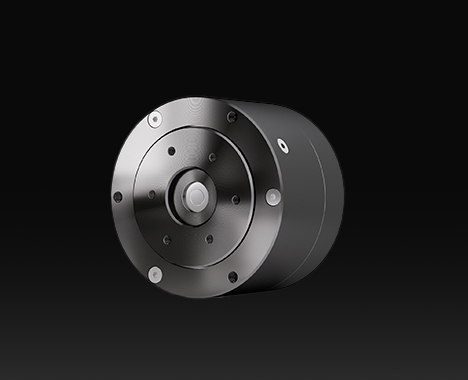
Lightweight End-Effector and High-Dynamic Joints
This segment primarily corresponds to the end-effector or wrist structure of the robotic arm. The core objective is to reduce inertia, improve dynamic response, and minimize the load imposed on upstream joints.
Represented by models such as AK40-10 KV170 and AK45-10 KV75, this class of actuators features high speed capability and low rotational inertia, making them well-suited for end joints that require fast trajectory tracking or high-frequency adjustments.
In practical systems, this layer directly influences the overall “feel” and control bandwidth of the robot. If the end-effector mass is too large, even joints with sufficient upstream torque will experience a noticeable degradation in dynamic performance.
Therefore, in 6-DOF robotic arm design, end joints typically prioritize lightweight, high-dynamic actuators rather than pursuing excessive static torque.
Intermediate Joints and the Primary Motion Chain
This segment represents the main working region of the robotic arm’s power system, responsible for the majority of trajectory execution and load transmission.
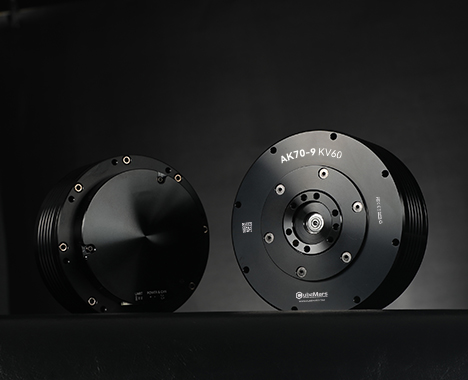
Typical configurations include AK70-9 KV60 and AK80-9 V3.0 KV100, which provide a balanced trade-off between torque output and motion speed, making them suitable for elbow joints and intermediate kinematic links.
The AK80-9 V3.0 KV100 is integrated into key joints within the primary motion chain, serving as the core drive unit. It delivers stable torque output under high-load conditions while enabling coordinated dynamic control across multiple joints, supporting the overall motion performance and control precision of the system.
In this layer, the design focus shifts from simply increasing torque to ensuring consistent and stable control performance under varying loads and dynamic conditions.
High-Load Shoulder Joints and Base Drive
This segment is responsible for handling the overall structural torque and static loads of the robotic arm, forming the foundational support of the entire power system.
In engineering practice, the AK10-9 V3.0 KV60 is commonly used for proximal joints requiring higher output capability, while the AKH70-48 V1.0 KV41 is better suited for high-load base joints or long-reach structures, where high torque and high reduction ratios are essential for sustained structural loading.
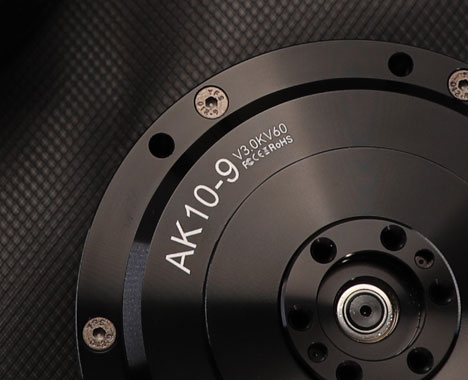
The AK10-9 V2.0 KV60 is also used in base axis drive applications for medium-to-high load robotic arms, particularly in scenarios requiring a balance between torque capability and compact design. For example, a six-axis robotic arm developed by the DIODE team at Donghua University utilizes two AK10-9 V2.0 KV60 actuators.
The core value of this hierarchical approach lies in transforming robotic arm design from “single-point motor selection” into a “joint-level power distribution problem.”
Developers can directly select actuators based on joint position and load requirements, matching appropriate torque ranges to each segment. This significantly reduces uncertainty in transmission system design while improving overall system consistency and predictability.
The design of a six-degree-of-freedom robotic arm’s power system is, at its core, a problem of joint-level torque distribution and structural optimization, rather than a simple matter of motor selection. As the arm’s reach increases and the payload rises, the combined effects of leverage, dynamic inertia, and structural stiffness will determine the system’s performance limits.
In engineering practice, establishing a simplified mechanical model to reasonably estimate static loads and dynamic torques, and selecting components based on safety factors, is the foundation for ensuring stable system operation. At the same time, the functional differences among joints in the power train necessitate a hierarchical design strategy: the end-effector joint prioritizes reducing inertia to improve responsiveness; intermediate joints balance torque and dynamic performance; while the proximal and base joints bear the primary structural loads.
Compared to traditional split-type solutions, integrated actuators effectively reduce system complexity and enhance overall consistency and development efficiency by integrating the motor, reducer, encoder, and driver within a single joint. Given the current trend toward modularization and lightweight design, such solutions are gradually becoming the mainstream choice in the design of six-degree-of-freedom robotic arms.
Overall, the selection of an appropriate actuator should be based on payload, reach, and motion requirements, involving a comprehensive trade-off at the system level to balance performance, structure, and complexity, thereby achieving a reliable and efficient robotic arm design.
.png)

