Create your CubeMars account

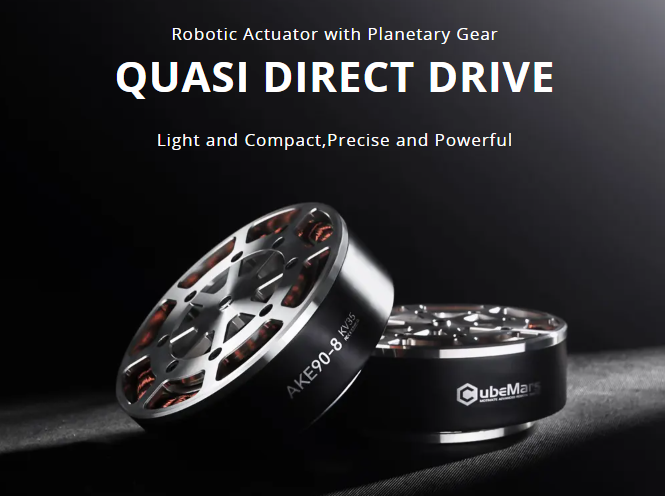
Robotic motors usually fall into two extremes: fully direct drive systems with no gearbox, or high-ratio geared motors that rely heavily on mechanical amplification. Quasi Direct Drive(QDD) motors were introduced as a structural middle ground, redistributing torque generation between the motor and the transmission stage.
The idea of "quasi" is subtle but important. It reflects a deliberate compromise between two design extremes, aiming to preserve responsiveness while keeping the actuator compact and practical.
The Concept of "Quasi" Direct Drive
Why not use a pure direct drive motor? Eliminating the gearbox entirely would require the motor to generate all torque electromagnetically, demanding larger size, higher current, and more intensive thermal management.
Conversely, why not rely on a high reduction ratio? Extreme gearing alters the joint's mechanical behavior, making it less responsive and more isolated from external forces.
QDD addresses both limitations by keeping a modest reduction stage while allowing the motor to provide most of the torque. The result is a drivetrain that behaves closer to direct drive, delivering both compactness and mechanical practicality.
How QDD Differs from Traditional Geared Motors
In conventional high-ratio systems, torque is created primarily through mechanical multiplication. A small motor spins at high speed, and the gearbox amplifies torque dramatically before it reaches the joint.
QDD systems invert that relationship.Here, the motor is designed to deliver substantial torque directly. The gearbox no longer dominates output behavior; instead, it fine-tunes torque delivery and supports structural integration.
This shift changes three fundamental characteristics:
Reflected inertia at the joint
Ease of mechanical feedback (backdrivability)
Immediate torque responsiveness
The gearbox becomes a supporting element rather than the defining feature of the motor.
Typical Reduction Ratios in QDD Systems
QDD is not defined by a specific number, but most implementations fall within a 6:1 to 10:1 reduction range.
This range is not arbitrary—it represents an engineering equilibrium.
Below it, motor size and electrical demand increase sharply
Above it, the system begins to inherit high-ratio limitations, such as slower response and reduced backdrivability
The selected reduction ratio preserves dynamic behavior while keeping motor size and current within practical limits.
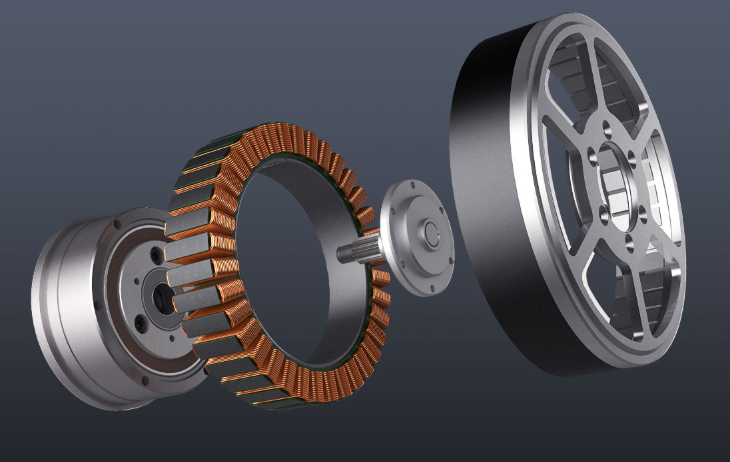
Every QDD motor begins with a brushless motor. Motors naturally operate at high rotational speeds but generate relatively low torque. If connected directly to a robotic joint, the system would move quickly but struggle under load.
To convert speed into usable torque, QDD systems introduce a low reduction gearbox, typically around 5:1 to 10:1. This means that when the motor rotates multiple times, the joint rotates once. Speed decreases moderately, and torque increases proportionally.
Unlike traditional motors that rely on very high reduction ratios (50:1 or higher), QDD adjusts this balance only slightly. It amplifies torque without heavily isolating the motor from the joint. And this limited reduction is what defines the “quasi-direct” concept.
Low gear ratios allow bidirectional force transmission:
Forward: Motor drives the joint
Backward: External forces at the joint travel back through the gearbox and are sensed by the motor
This property — known as backdrivability — is a key differentiator. In high-ratio systems, gears often block reverse force transmission, making joints mechanically stiff. In contrast, QDD maintains mechanical transparency.
Preserved feedback keeps the motor mechanically coupled to the joint, rather than isolating it behind excessive gearing.
With this mechanical transparency, torque control becomes significantly more straightforward. Since the relationship between motor torque and joint torque remains predictable (after simple scaling), the controller can estimate output force accurately using encoder feedback and current sensing.
Instead of only commanding position — "rotate to this angle," the system can command torque directly — "apply this level of force." This capability is critical for robots that must interact with their environment, absorb impacts, or perform dynamic movements.
By combining moderate torque amplification with preserved responsiveness, QDD motors achieve a balance between strength and control — making them especially suitable for legged robots, humanoids, collaborative systems, and wearable robotics.
Key Takeaway:
A QDD motor works by slightly reducing motor speed to increase torque while preserving mechanical feedback, enabling both power output and dynamic responsiveness.
1. The Shift from Position Control to Force Control
Dynamic robots cannot rely solely on position control; high-speed motion requires joints to adapt to external forces.
QDD's low gear ratio and mechanical transparency allow motors to directly sense joint torque, enabling precise force-based control.
This capability is essential for robots performing agile or unpredictable movements.
2. The Importance of Low Inertia in High-Speed Motion
High reduction ratios amplify motor inertia, which slows down joint response and reduces agility.
QDD maintains low reflected inertia, keeping joints responsive and enabling fast, precise movements.
3. Energy Efficiency in Mobile Robots
High-ratio gearboxes increase friction losses and energy consumption.
QDD's compact, low-friction design reduces energy waste, improving battery life and operational efficiency in mobile platforms.
4. Structural Weight Constraints in Multi-DOF Systems
Multi-joint robots are sensitive to joint weight; heavy actuators compromise dynamics and efficiency.
QDD actuators are lightweight and compact, allowing integration into dense multi-DOF systems without sacrificing performance.
The architectural characteristics of QDD motors : low gear ratio, low reflected inertia, and torque transparency, are not merely mechanical design choices. They translate directly into performance advantages when implemented in legged robots.
While humanoid and quadruped platforms differ in morphology and locomotion strategy, both rely on rapid force control, dynamic balance, and energy-efficient motion. The table below summarizes how QDD characteristics convert into practical benefits across these two robot categories. The contrast becomes more evident when these two platforms are viewed side by side.
Performance & Benefit Mapping:
| QDD Characteristic | Humanoid Robots | Quadruped Robots | System-Level Benefit |
| Low Reflected Inertia | Faster balance recovery & stability during single-leg support and external disturbances | Rapid leg acceleration & smoother high-speed gait transitions | Greater dynamic stability under real-world disturbances |
| Backdrivability | Active compliance for safer human interaction and collaborative environments | Excellent shock absorption from repeated ground impacts | Reduced structural stress and improved durability |
| Precise Torque Control | Accurate coordination of hip–knee–ankle joints in complex movements like stair climbing or squatting | Real-time terrain force adaptation across multiple legs | Higher control bandwidth and motion smoothness |
| Low Gear Ratio & Reduced Friction | Lower overall power consumption during walking & posture shifts | Increased locomotion efficiency and reduced actuator heating | Extended operational time and improved energy economy |
Why the Benefits Manifest Differently
Although the actuator architecture remains the same, the resulting advantages express themselves differently due to structural and locomotion differences.
In Humanoid Robots
Humanoid stability is fundamentally a balance problem. With a high center of mass and repeated single-leg support phases, even small disturbances can create significant rotational moments around the ankle and hip joints.
In this context, motor responsiveness becomes a stability determinant rather than just a performance parameter.
QDD architecture reduces reflected inertia, enabling rapid corrective acceleration during balance recovery. Rather than resisting disturbances due to drivetrain stiffness, the system remains dynamically adaptive. Backdrivability further enables active compliance — meaning the robot can yield when necessary, rather than fight against unexpected forces.
In practical terms, this translates into:
Faster push recovery during walking
Smoother weight transfer between legs
More natural multi-joint coordination
Rather than moving like a rigid machine, the humanoid behaves with controlled flexibility — a critical characteristic for robots designed to operate near humans.
In Quadruped Robots
Quadruped locomotion is not primarily a balance problem — it is a cyclic impact and propulsion problem.
Each stride involves:
1. A rapid swing phase
2. Ground contact with impulsive force
3. Load transfer across the body
4. Immediate preparation for the next step
During these high-frequency cycles, motor inertia and friction directly affect gait efficiency and shock tolerance. QDD' low drivetrain impedance enables real-time impact sensing and compensation. At the same time, reduced limb inertia enables quicker leg retraction and repositioning during high-speed motion.
The result is not just smoother movement, but improved locomotion dynamics:
More stable high-speed trotting and running
Better terrain adaptation under uneven ground conditions
Reduced energy loss during repeated impact cycles
For mobile robots operating outdoors, these characteristics directly enhance endurance and terrain robustness.
From Mechanical Design to Performance Advantage
The key strength of QDD architecture lies in its balance: it amplifies torque without isolating the motor from the joint. By avoiding extreme gearing while retaining torque density, the actuator preserves both strength and agility.
In humanoid systems, this translates directly into improved stability and safer interaction with the environment.
In quadruped systems, it translates into speed, adaptability, and efficiency.
In both cases, QDD does more than improve actuator performance — it enables a higher class of dynamic robotic behavior.
QDD benefits such as responsiveness, transparency, and efficiency become meaningful only when the actuator matches the joint's functional role.
Selection therefore follows a clear sequence: define force demand, shape transmission behavior, and confirm sustainable output.
Selection starts with what the joint must physically deliver.
Hips and knees require higher continuous torque for support and propulsion. Distal joints prioritize acceleration and low inertia.
Key evaluations include:
Peak torque
RMS torque over duty cycles
Required acceleration bandwidth
Since QDD systems use moderate gear reduction, torque density must come primarily from the motor. Proper sizing balances performance and mass. With torque defined, the next step is determining how it is transmitted.
In QDD architecture, the reduction ratio controls both torque output and mechanical transparency. Lower ratios make joints more responsive and reduce reflected inertia, while slightly higher ratios increase support for sustained loads and reduce motor stress. The right ratio depends on whether a joint prioritizes dynamic motion or continuous load-bearing.
Essentially, the reduction ratio acts as a mechanical lever, translating motor torque into joint behavior. Next, evaluate how the joint should respond to external forces.
Backdrivability defines how easily a joint reacts to forces from the environment. Joints that encounter impacts or need safe interaction with humans perform better with higher transparency, while joints mainly supporting structure can tolerate stiffer behavior.
The joint's responsiveness to external forces depends on the interplay between motor inertia and gear ratio, which can be adjusted to suit the robot's intended tasks. Once the desired interaction behavior is established, engineers can then verify thermal performance and continuous output to ensure reliable operation over the long term.
Because QDD relies heavily on motor-generated torque, thermal capacity is critical.
Engineers should prioritize:
Continuous torque ratings
RMS current under real duty cycles
Cooling limits within the mechanical envelope
Thermal alignment ensures dynamic performance can be sustained without degradation.
Transition to Implementation
When these considerations are addressed together, QDD motors can be precisely tailored to the functional demands of humanoid and quadruped robotic joints, enabling dynamic performance that aligns with system-level requirements.
When designing hip and knee joints for dynamic humanoids, engineers face a clear challenge: delivering high continuous torque while preserving fast corrective response.
For high-speed quadruped locomotion, the priority shifts toward rapid leg swing, impact tolerance, and efficient cyclic force control.
The CubeMars AKE series was developed precisely for these real-world joint demands.
QDD Architecture in the AKE Series
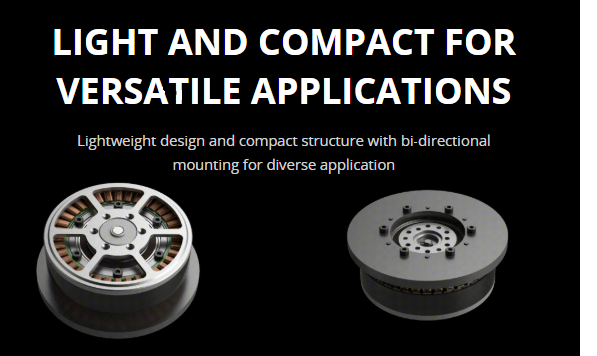
Rather than merely adopting low-ratio gearing, the AKE series integrates QDD principles at the structural level:
Low Reduction Ratio – minimizes reflected inertia, keeping joint response fast and smooth
High Torque Density – delivers substantial torque in a compact form factor, optimizing motor efficiency
Force Feedback Capability – maintains mechanical transparency for precise torque control and dynamic interaction
These design choices ensure that the AKE actuators not only retain the key benefits of QDD but also remain practical for integration, thermal management, and structural constraints.
Matching Motor Size to Joint Function
In a humanoid robot:
Hip and knee joints must handle continuous load-bearing and propulsion
Distal joints prioritize responsiveness and low inertia
In a quadruped platform:
Proximal joints stabilize body mass
Distal joints execute high-frequency swing cycles
The AKE series provides scalable actuator sizes to align with these functional roles:
| Model | QDD-Relevant Parameter | Typical Application | Performance Focus | Key Benefit |
| AKE90-8 KV35 | Max Continuous Torque: 90 Nm / Reflected Inertia: 0.08 kg·m² / Gear Ratio: 8:1 | Hip / Knee | High continuous torque | Supports stable walking, push recovery, and heavy load-bearing |
| AKE80-8 KV30 | Max Continuous Torque: 40 Nm / Reflected Inertia: 0.04 kg·m² / Gear Ratio: 8:1 | Mid-size joints | Balanced torque & responsiveness | Smooth multi-joint coordination for complex motion |
| AKE60-8 KV80 | Max Continuous Torque: 15 Nm / Reflected Inertia: 0.015 kg·m² / Gear Ratio: 8:1 | Lightweight distal joints | Low inertia & high responsiveness | High-speed adaptation, impact absorption |
Instead of adapting one motor across all joints, engineers can distribute performance characteristics according to mechanical role.
Designed for Humanoid and Quadruped Platforms
Beyond single-joint performance, the AKE series supports full system integration:
Dynamic Control Ready – low reflected inertia and high transparency improve balance and fluid motion
Torque Control Compatible – precise force control supports safe human-robot interaction and environmental responsiveness
Modular Integration – multiple motor models can be combined to cover entire robot kinematics, seamlessly adapting to both Humanoid and Quadruped designs
From QDD Advantage to Practical Implementation
The QDD characteristics discussed earlier—low reflected inertia, responsiveness, and torque transparency—are fully realized in the AKE series:
Humanoid Robots: enhanced single-leg support stability, improved multi-joint coordination, and safer physical interactions
Quadruped Robots: high-speed gait stability, better terrain adaptability, and lower energy consumption
By translating theoretical QDD advantages into tangible actuator design, the AKE series enables robots to achieve a higher level of dynamic performance in both legged platforms.
Quasi Direct Drive (QDD) motors represent a structurally balanced approach to robotic joint design. By integrating moderate gear reduction with high torque density, they preserve mechanical transparency while maintaining precise control accuracy. Rather than pursuing extreme reduction ratios or eliminating gearing altogether, QDD architecture establishes a more measured distribution of torque generation and transmission within the joint.
For humanoid and quadruped robots operating in dynamic environments, this structural balance translates into improved responsiveness, stable force interaction, and reliable motion control. In summary, Quasi Direct Drive (QDD) motor is not merely a component-level decision; it serves as a foundational factor that directly influences overall robotic performance.


