How to Reduce Noise in Robot Joints
What Causes Noise in Robot Joints?
Before attempting to reduce noise, it is essential to identify its origin. In most robotic systems, joint noise does not stem from a single source but rather from the interaction of multiple factors.
One of the most common contributors is gear transmission. Backlash, imperfect meshing, and manufacturing tolerances can introduce periodic impacts and vibrations, particularly in high-ratio gear systems used for torque amplification. Over time, wear further increases these effects, making the noise more pronounced.
Motor behavior is another significant factor. In BLDC and servo systems, torque ripple and electromagnetic forces can generate vibrations that propagate through the structure. In many cases, what appears to be mechanical noise is actually rooted in control or commutation characteristics.
Structural resonance also plays a critical role. Lightweight designs, while beneficial for efficiency, often reduce stiffness and make the system more susceptible to vibration amplification at specific frequencies. When the excitation frequency aligns with a natural mode, even small disturbances can produce noticeable noise.
Assembly quality should not be overlooked. Misalignment of shafts, insufficient lubrication, and tolerance accumulation can all introduce friction and irregular motion. These issues often manifest as noise under dynamic conditions, even when individual components meet specifications.
Finally, instability in the control system can produce oscillatory behavior. Poorly tuned PID parameters or overly aggressive torque commands may lead to continuous micro-adjustments, which are perceived as audible noise.
How to Reduce Noise in Robot Joints
Reducing noise effectively requires a coordinated approach across multiple domains rather than a single isolated fix.
Improving the transmission system is often the most direct step. Using low-backlash, high-precision transmission architectures can significantly reduce mechanical play, while higher manufacturing accuracy and proper preload help improve force transmission smoothness. When noise originates from gear engagement, mechanical optimization is typically unavoidable.
Attention should also be given to motor characteristics, particularly torque ripple. Techniques such as Field-Oriented Control (FOC), combined with high-resolution encoders and optimized electromagnetic design, can greatly improve smoothness. Well-engineered systems, such as those seen in MIT Mini Cheetah, demonstrate how minimizing torque ripple contributes to both performance and acoustic quality.
Structural improvements provide another layer of optimization. Increasing stiffness at the joint level and reducing compliance in mounting interfaces can prevent vibration amplification. Modal analysis is often useful for identifying critical frequencies and ensuring that the system avoids operating in resonance-prone regions.
Assembly practices also have a substantial impact. Ensuring precise alignment, using high-quality bearings, and applying appropriate preload and lubrication can eliminate many sources of friction-induced noise. In practice, issues attributed to motors are frequently traced back to assembly inaccuracies.
Control strategy refinement further enhances noise reduction. Careful tuning of PID parameters can eliminate oscillations, while incorporating damping, impedance control, or feedforward compensation helps stabilize system response. A well-tuned controller often reduces noise without requiring any hardware changes.
Integrated Actuators as a Noise Reduction Strategy
In traditional architectures, the separation of motor, gearbox, and driver introduces multiple interfaces where misalignment and inconsistency can occur. These interfaces not only complicate integration but also increase the likelihood of vibration and noise.
Integrated actuators address this challenge by combining these elements into a single, optimized unit. This approach reduces mechanical interfaces, improves alignment, and enables tighter coordination between control and hardware. As a result, both vibration and acoustic output can be significantly reduced.
Solutions such as those developed by CubeMars exemplify this trend. By integrating transmission design, motor control, and structural layout, these actuators are engineered to deliver smoother motion and lower noise levels in robotic applications.
Additional Noise Mitigation Approaches
When noise cannot be entirely eliminated at its source, secondary measures can help limit its propagation. The use of damping materials, vibration isolation mounts, and acoustic shielding can reduce the transmission of sound through the structure. However, these methods are most effective when applied in conjunction with fundamental design improvements rather than as standalone solutions.
Choosing the Right Actuator for Low-Noise Robotics
Selecting a low-noise robot actuator requires a system-level engineering evaluation rather than focusing on a single performance metric. Factors such as torque ripple, transmission backlash, control bandwidth, and structural integration all collectively influence the final acoustic performance.
From an engineering perspective, the core of a low-noise actuator is not about “reducing the noise of a single component,” but about reducing the generation and amplification of vibration sources through system-level design. For example, the smaller the torque ripple, the smoother the motor output and the weaker the excitation transmitted to the structure; the smaller the backlash, the fewer mechanical impacts occur; and the more reasonable the control bandwidth, the less likely the system is to enter oscillation.
Modern integrated actuator solutions are designed based on this principle. Taking CubeMars integrated actuators as an example, their design typically integrates the motor, gearbox, and drive control system into a unified optimization architecture. This reduces assembly errors and alignment deviations at the structural level, reduces torque ripple at the motor level, and improves dynamic response consistency through a unified control architecture.
In practical applications, such actuators are commonly used in robotic systems with high requirements for noise and smooth motion, such as robotic arm joints, quadruped robot leg joints, and humanoid robot lower-limb actuators. In these scenarios, where continuous motion stability is critical, system noise often directly reflects overall dynamic performance.
Quadruped Robot Stability Test Case
A 15-year-old engineering enthusiast, Arsenii Mironov, independently designed and built a quadruped robot and conducted a highly representative balance test. He placed the robot on a tiltable wooden board and gradually raised one side to create a slope. Despite the continuously changing incline, the robot was able to remain steadily standing without slipping or tipping over, demonstrating excellent posture control capability.
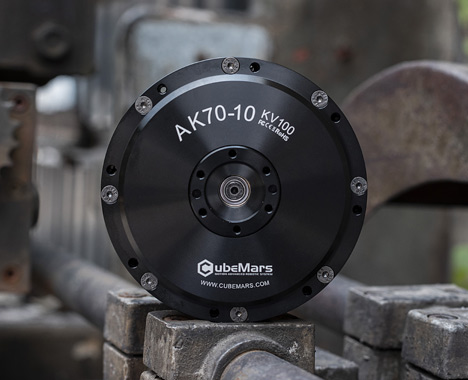
All 12 joints of the system are driven by CubeMars AK70-10 KV100 integrated robotic actuators. This actuator demonstrates the following key characteristics in dynamic load scenarios:
High torque density: peak torque up to 24.8 Nm, capable of handling rapid dynamic load changes
Fast dynamic response: low-latency control capability supporting high-frequency posture adjustments
High-precision feedback system: built-in 14-bit encoder enabling sub-millimeter-level motion control accuracy
Highly integrated structure: motor, planetary gearbox, and driver integrated into a compact form factor, reducing mechanical error sources

This case demonstrates the direct relationship between low noise and high stability: when an actuator exhibits high response consistency, the system does not need frequent posture corrections, thereby reducing vibration and structural noise generation.
Dual-Axis Stabilized Robotic Arm Case
Another developer, Cameron Coward, developed an open-source project called CamRo, a dual-axis stabilized robotic camera arm with full programmability and remote control capability. The system is primarily used to achieve smooth, professional-grade motion stabilization.
The core actuation units of this system use CubeMars AK80-64 and AK60-6 V1.1 integrated actuators, providing stable torque output and motion precision under high dynamic control conditions.
Model | Peak Torque | Reduction Ratio | Maximum Torque Density |
120Nm | 64:1 | 141.2 Nm/kg | |
9Nm | 6:1 | 24.46 Nm/kg |
This combination achieves a balance between high stiffness and high dynamic response, allowing the gimbal system to maintain low jitter output during fast motion, thereby reducing visual vibration and structural noise.

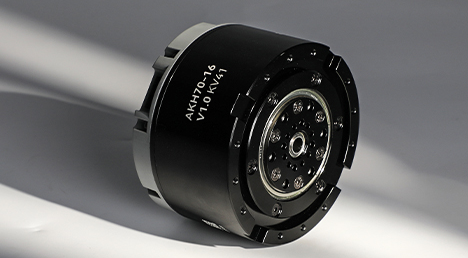
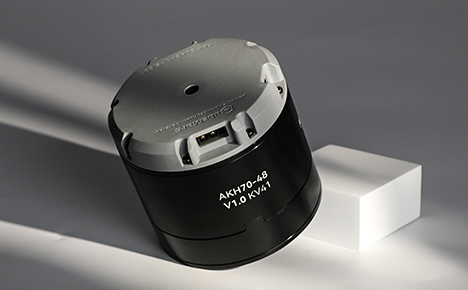
For robotic systems requiring even higher integration, CubeMars has also introduced the AKH Series Hollow Shaft Planetary Actuator.
This series is a hollow-shaft integrated planetary actuator module designed for compact, high-torque robotic joints and automation systems. Its core architecture integrates a brushless motor, precision planetary gearbox, dual high-resolution encoders, and an FOC drive system, achieving high torque density output in a lightweight structure.

Its design advantages include:
Hollow-shaft structure enabling cable routing and mechanical pass-through integration
Dual-encoder architecture improving closed-loop control accuracy and stability
Planetary gearbox providing high torque density and compact structure
FOC drive optimizing motor output smoothness and reducing torque ripple
This series is particularly suitable for next-generation robotic joint systems that require simultaneous optimization of mechanical space, system integration, and low-noise operation.
Conclusion
Noise reduction in robot joints is inherently a system-level challenge. Effective solutions require coordinated improvements in transmission design, motor control, structural stiffness, and integration quality.
By addressing these factors at their source, engineers can achieve not only quieter operation but also improved precision, efficiency, and long-term reliability.