Create your CubeMars account

When designing motion systems, many engineers run into the same challenges: excessive maintenance caused by brushes, limited efficiency at high speed, and difficulty achieving precise control.
These limitations often lead designers to ask a simple question: is there a better alternative to traditional DC motors?
This is where the Brushless DC (BLDC) motor comes into the picture.
A Brushless DC (BLDC) motor is an electric motor powered by direct current (DC) that generates rotation without the use of mechanical brushes. Instead of brushes, it relies on an electronic controller to manage the timing of current flowing through the motor windings. This allows the motor to run smoothly and reliably.
The main components of a BLDC motor are the rotor, typically made of permanent magnets; the stator, which holds the stationary windings; and the electronic controller, which determines the correct timing of current based on the rotor's position. Sensors, such as Hall effect sensors, are often used to provide rotor position feedback to the controller, enabling precise electronic commutation.
With a basic understanding of the structure of a BLDC motor—its permanent magnet rotor, stationary windings, and electronic control—it becomes easier to understand why this technology has gained such widespread adoption in modern motion systems. This fundamental design gives engineers more freedom when balancing reliability, efficiency, and controllability, especially in applications where performance expectations continue to rise.
However, these benefits are not simply the result of removing mechanical brushes. They are closely tied to how torque is generated, how current is controlled, and how motion is managed inside the motor. To fully appreciate why BLDC motors deliver these advantages—and why they behave so differently from traditional brushed DC motors—it helps to first look at how a BLDC motor works at a functional level.
A BLDC motor generates motion through the interaction between a rotating magnetic field in the stator and permanent magnets on the rotor. Unlike brushed DC motors, this process is controlled electronically rather than through mechanical contact.
How it works in practice:
An electronic controller energizes the stator windings in sequence, creating a rotating magnetic field.
The rotor's position is detected using sensors or sensorless methods to ensure correct timing.
Current switching is handled electronically, replacing brushes and a commutator.
Magnetic interaction between the stator field and the rotor produces continuous torque and rotation.
This electronically controlled process is the foundation of how BLDC motors operate—and it is also what distinguishes them from traditional brushed DC motors.
While BLDC motors and brushed DC motors are both widely used in motion systems, the way they handle commutation leads to clear differences in performance, maintenance, and controllability. Understanding these differences helps explain why BLDC motors are increasingly chosen in applications that demand higher reliability and more consistent operation.
| Aspect | BLDC Motor | Brushed DC Motor |
| Commutation | Electronic commutation via controller | Mechanical commutation using carbon brushes |
| Mechanical wear | No brushes, minimal wear | Brushes and commutator wear over time |
| Efficiency | Generally higher due to reduced losses | Lower due to friction and sparking |
| Speed capability | Stable operation at higher speeds | Limited by brush wear and arcing |
| Control precision | Supports precise speed and position control | Limited precision, especially at high speed |
| Maintenance | Low maintenance requirements | Regular brush replacement required |
| Electrical noise | Lower | Higher due to brush contact |
At the heart of a BLDC motor's performance is its electronically controlled, brushless design. This structure directly influences how efficiently the motor operates, how much torque it can deliver, and how precisely it can be controlled in real-world systems.
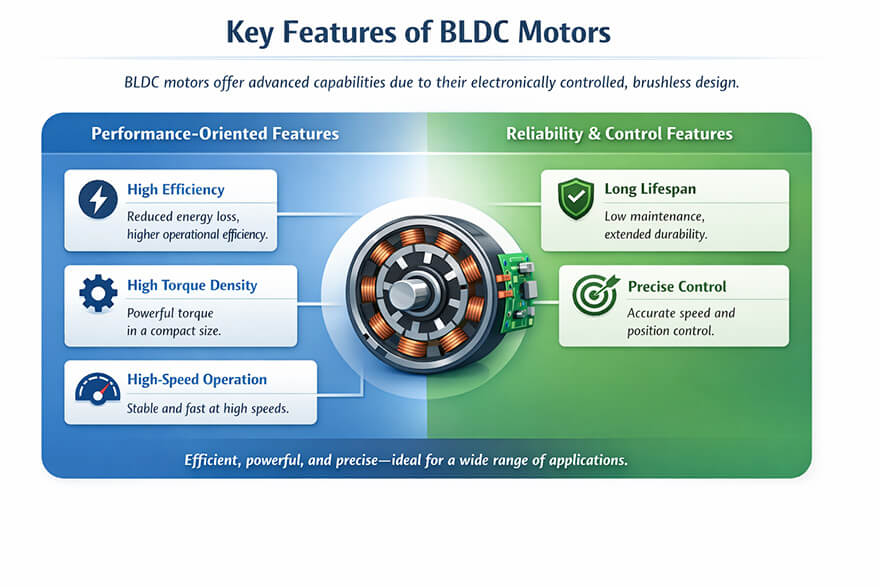
BLDC motors are widely used wherever precise, reliable, and efficient motion is required. Their combination of high torque, fast response, and long lifespan makes them suitable for a variety of real-world applications:
Robotics – Humanoid joints, exoskeletons, and quadruped robots all require coordinated, responsive movement. Motors with high torque and compact design are essential in these systems. CubeMars AK Series Robotic Actuator is often selected to meet these requirements seamlessly.
Industrial Automation – Conveyor systems, collaborative robot arms, and AGVs demand consistent performance and precise control. BLDC motors designed for high efficiency and durability make these processes reliable, with CubeMars RI Series Frameless Inrunner Torque Motor frequently powering such setups.
Medical Devices – Rehabilitation robots, surgical tools, and diagnostic equipment need quiet, smooth, and repeatable motion. BLDC motors ensure these devices operate dependably without interruption.
Gimbals & Sensor Platforms – Camera stabilization and rotating sensor units require minimal vibration and exact positioning. Lightweight, responsive BLDC motors enable smooth orientation adjustments and precise control.
Across all these applications, BLDC motors combine reliability, precision, and efficiency, making them an essential component in modern motion systems.
Based on the applications discussed above, here are specific CubeMars products that are commonly used to achieve optimal performance:
AK60-6 V3.0 KV80 Robotic Actuator – Compact, high-torque motor ideal for robotic joints, exoskeletons, and quadrupeds. Features precise position control and long lifespan for continuous operation.
AK45-36 KV80 Robotic Actuator – High-efficiency motor designed for industrial automation, including AGVs and collaborative robot arms. Delivers stable torque, smooth motion, and minimal maintenance.
GL100 KV10 Gimbal Motor – Lightweight, low-cogging motor for gimbals and sensor platforms. Provides precise orientation control and smooth rotation for stabilization systems.
BLDC motors have become a cornerstone in modern motion systems, offering efficiency, precise control, high torque, and long lifespan across robotics, industrial automation, medical devices, and stabilization platforms. Understanding their advantages, differences from brushed DC motors, and key features can help designers make informed choices for their projects. For those who want to dive deeper into BLDC motors and learn more about how they work, Brushless DC Motors: A Comprehensive Overview can provide a detailed guide and additional insights.


