Create your CubeMars account

Today, Brushless DC (BLDC) motors are widely employed in robotics, automation, and wearable systems due to their high efficiency, precise controllability, and operational reliability. To facilitate a better understanding, selection, and application of BLDC motors, this article serves as a comprehensive and practical guidance. Let's explore in details now:
The operation of a brushless DC motor is fundamentally based on electromagnetic principles, where the interaction between magnetic fields generates torque to drive motion. Unlike brushed motors, BLDC motors rely on an electronic commutation system to control current flow, creating a rotating magnetic field that drives the rotor. The process can be summarized in three main steps:
Magnetic Interaction:The rotor contains permanent magnets, while the stator is wound with multiple coils. When current flows through the stator windings, it generates a magnetic field. This field interacts with the rotor's permanent magnets, producing torque that causes the rotor to turn.
Electronic Commutation: An electronic controller monitors the rotor's position using sensors such as Hall-effect devices or encoders. Based on this feedback, the controller switches the current in the stator coils in a precise sequence, ensuring continuous and smooth rotation of the rotor without the need for mechanical brushes.
Feedback Control: Most BLDC motors use position sensors to detect rotor position in real time. This feedback allows the controller to adjust both the direction and magnitude of the current, providing precise speed and position control. Advanced control methods, such as PWM (Pulse Width Modulation), can further optimize motor performance for applications requiring high precision or dynamic responsiveness.
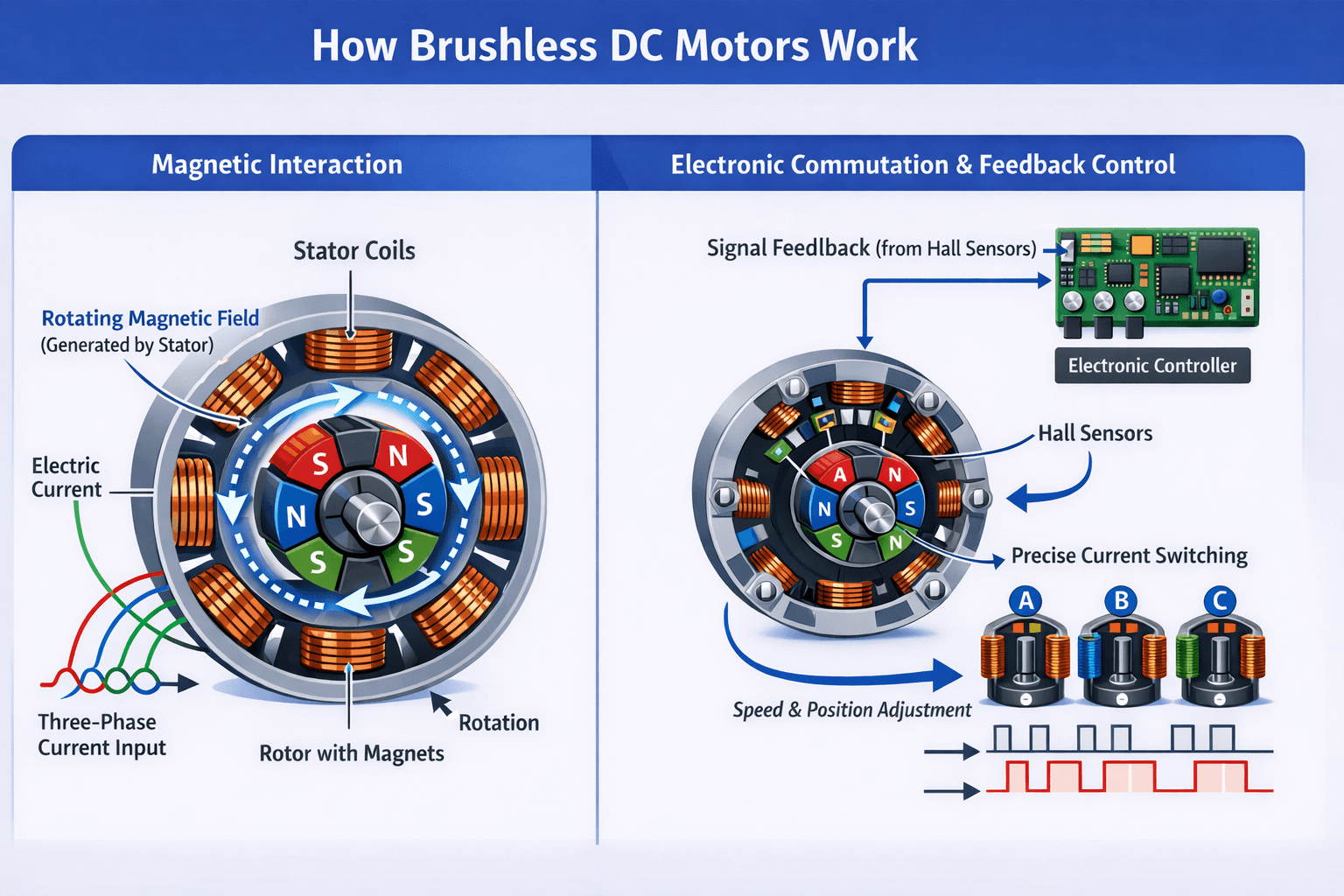
Based on their operating principles, brushless DC (BLDC) motors primarily comprise three core elements: the rotor, the stator, and the electronic controller. Each of these components plays a crucial role in ensuring the motor's performance, efficiency, and reliability.
Rotor: The rotor typically consists of a core embedded with permanent magnets. It serves as the rotating element of the motor, generating torque through the interaction between the magnetic field of the permanent magnets and the electromagnetic field produced by the stator. The brushless design eliminates mechanical wear associated with traditional brushed motors, thereby enhancing operational lifespan and reliability.
Stator: The stator is composed of multiple electromagnetic coils, or windings, which generate a rotating magnetic field that drives the rotor. This configuration provides high efficiency, low operational noise, and minimal heat generation, making it suitable for precision and long-duration applications.
Electronic Controller: The electronic controller integrates power switches, microcontrollers, and position sensors (such as Hall sensors) to manage current timing and direction. It performs electronic commutation and ensures precise control of the motor's speed and position. Advanced controllers also offer fast response times and programmable features, enabling flexible adaptation to a wide range of operational requirements.
.png "components-of-brushless-dc-motors-en (2).png")
Brushless DC motors can be categorized according to several criteria, reflecting differences in structural design, winding configuration, sensor integration, and operational focus. Understanding these classifications is essential for selecting the optimal motor for a given application.
Table: Classification of Brushless DC Motors
| Classification Basis | Type | Key Features | Typical Applications |
|---|---|---|---|
| Rotor Configuration | Outrunner (External Rotor) | Rotor surrounds stator; higher torque at lower speeds; larger diameter | Robotic joints, wearable devices, direct-drive systems |
| Inrunner (Internal Rotor) | Rotor inside stator; higher speed capability; compact structure | High-speed tools, fans, pumps | |
| Winding Topology | Star (Y) Connection | Balanced phase current; smoother operation; lower starting current | General-purpose industrial motors |
| Delta (Δ) Connection | Higher current per phase; increased torque output | High-performance and high-load applications | |
| Sensor Integration | Sensored BLDC Motor | Equipped with Hall sensors or encoders; precise closed-loop control | Robotics, CNC systems, positioning equipment |
| Sensorless BLDC Motor | Uses back-EMF detection; simpler structure; lower cost | Fans, pumps, household appliances | |
| Application-Oriented Design | High-Speed Motor | Optimized for rapid rotation; low inertia | Spindles, compressors |
| High-Torque Motor | Designed for strong torque at low/medium speeds | Robotic arms, automation systems | |
| Precision Positioning Motor | High-resolution feedback for accurate motion control | Medical devices, semiconductor equipment |
By considering these classification criteria, engineers can make informed choices that balance torque, speed, efficiency, control precision, and application requirements.
Brushless DC (BLDC) motors offer a range of performance advantages that make them particularly well-suited for applications in robotics, automation, and wearable systems, including exoskeletons and collaborative industrial robot arms. These advantages stem from both their structural design and the precise control afforded by electronic commutation.
High Power Density: BLDC motors deliver high power output relative to their size and weight, enabling compact designs without sacrificing torque. This characteristic is especially valuable in applications with strict space or payload constraints.
High Efficiency and Energy Saving: The efficient conversion of electrical energy into mechanical motion reduces power consumption and extends battery life, supporting continuous and long-duration operation in mobile or wearable systems.
Smooth Operation and Low Noise: The absence of brushes minimizes mechanical friction, resulting in smooth rotation and reduced acoustic noise. This improves both the user experience and the operational environment, particularly in settings where quiet performance is essential.
Precise Control: Through electronic commutation and feedback from position sensors, BLDC motors can achieve highly accurate speed and position control, meeting the demands of complex and dynamic motion profiles.
Low Maintenance Requirements: The brushless design eliminates brush wear, reducing the need for routine maintenance and lowering long-term operational costs, while enhancing reliability and lifespan.
Brushless DC (BLDC) motors have been broadly adopted across a diverse range of robotic and automation systems owing to their high efficiency, precise controllability, and dependable performance. Their versatility makes them suitable for both sophisticated mechanized platforms and specialized motion applications, and this section highlights key domains where BLDC motors demonstrate clear technical and functional advantages.
1. Humanoid and Exoskeleton Robotics:
BLDC motors serve as the core actuation units in humanoid robots and wearable exoskeletons. Their high torque density and precise position control allow smooth, coordinated limb movements, essential for rehabilitation, mobility assistance, and strength augmentation. These motors are often integrated into joint modules for upper and lower limbs, providing both compact design and dynamic responsiveness.
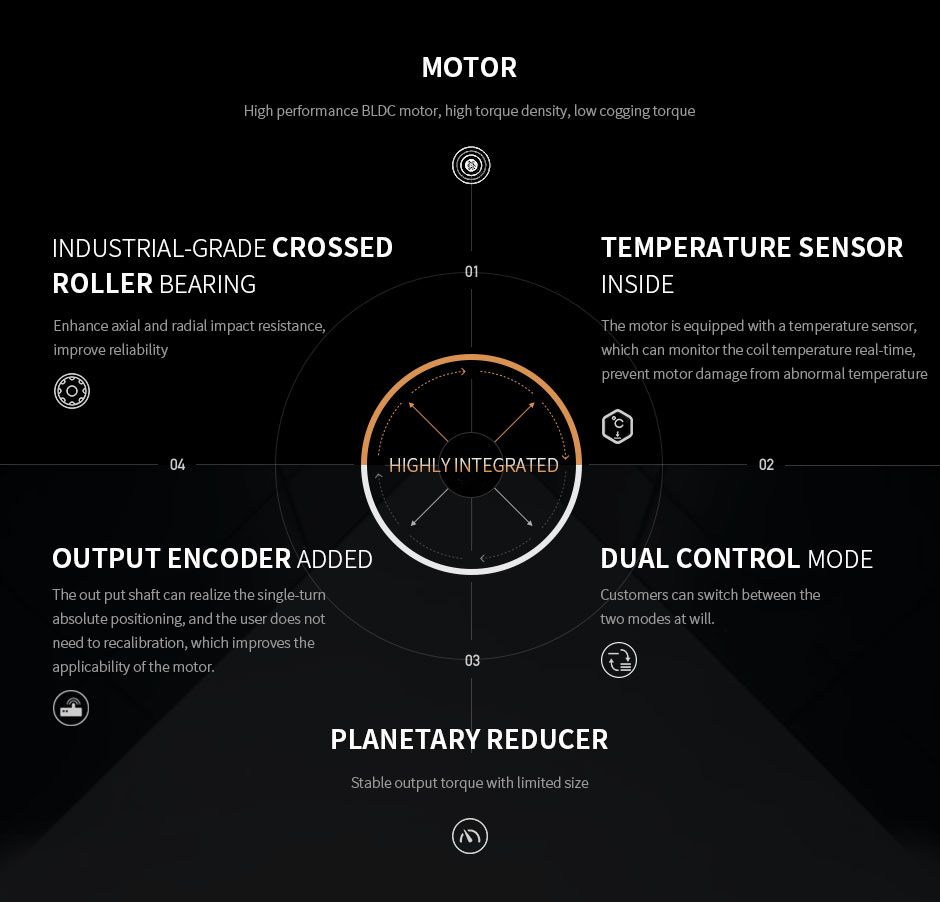
Actuators such as the CubeMars AK80-8 KV60 and AK80-9 V3.0 KV100 are widely applied in robotic joint modules due to their integrated motor-driver architecture and dual encoder configuration. Their compact structure and high torque output make them suitable for upper- and lower-limb actuation systems where space constraints and dynamic performance are critical.
2. Collaborative and Industrial Robotics:
BLDC motors power collaborative robotic arms and industrial automation equipment, where accurate, repeatable motion is critical. High efficiency, low noise, and reliable torque control make these motors ideal for tasks such as assembly, pick-and-place, and precision handling in environments shared with human operators.
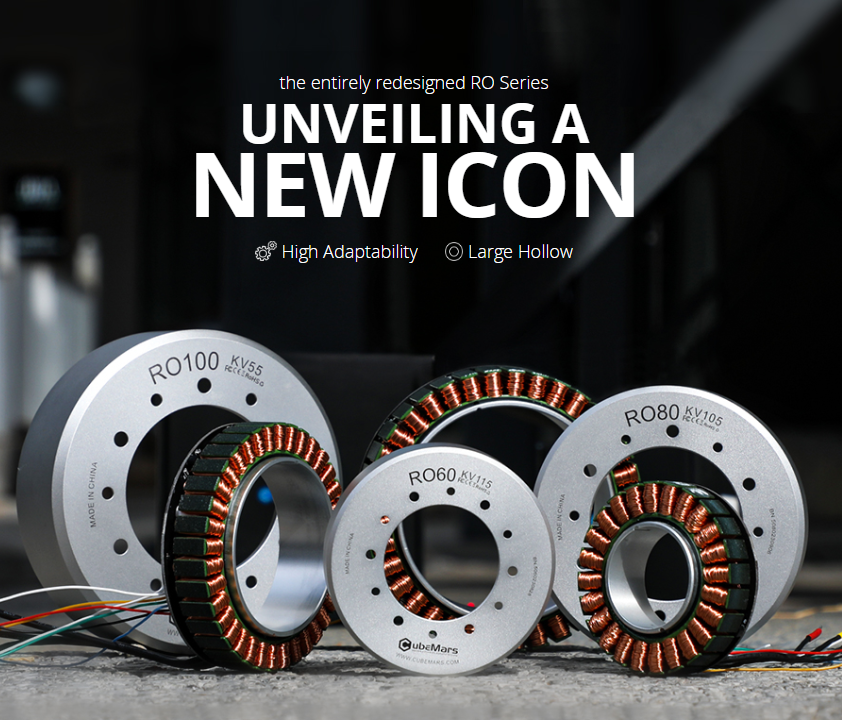
Frameless torque motors such as the CubeMars RO80 KV105 and RO100 KV55 are commonly integrated into robotic joint assemblies for mid- to high-torque applications. Their low cogging characteristics and adaptable mounting structures enable stable trajectory tracking and continuous operation in industrial automation environments.
3. UAVs, Drones, and Aerial Platforms:
Beyond ground robotics, BLDC motors are fundamental in UAVs and drones, providing lightweight, high-speed, and precise thrust control. Their efficiency and responsiveness are critical for flight stability, maneuverability, and payload handling, making them indispensable in aerial photography, surveying, and delivery applications.
4. Electric Vehicles and Personal Mobility Devices:
BLDC motors are also widely used in electric bicycles, scooters, and light electric vehicles. Their high efficiency, compact form factor, and controllable torque allow efficient propulsion, smooth acceleration, and extended battery life, making them ideal for urban mobility and portable transport solutions.
Across these domains, BLDC motors combine performance, efficiency, and reliability, enabling engineers to design systems that meet demanding operational requirements while optimizing energy consumption and motion precision.
Selecting an appropriate BLDC motor requires a systematic evaluation of mechanical requirements, electrical parameters, and application constraints. The following step-by-step approach can help ensure optimal performance and reliability.
Step 1: Define Load Requirements (Torque and Power)
Begin by determining the required torque and power under both rated and peak operating conditions. Consider continuous torque for steady operation and peak torque for acceleration or load fluctuations. Proper torque estimation is fundamental to preventing overload and ensuring long-term reliability.
Step 2: Determine Speed Range
Identify the required operating speed, including minimum, rated, and maximum RPM. The motor’s speed constant (Kv) and back-EMF characteristics should align with the intended application to ensure stable and efficient operation across the desired range.
Step 3: Evaluate Voltage and Current Constraints
Confirm the available power supply voltage and allowable current limits. The motor's rated voltage must match the system supply, while peak current capability should accommodate transient loads without overheating.
Step 4: Consider Control Method and Feedback Requirements
Determine whether the application requires sensored or sensorless control. High-precision positioning applications (e.g., robotics joints) typically require Hall sensors or encoders for closed-loop feedback, while simpler or cost-sensitive systems may adopt sensorless solutions.
Step 5: Assess Mechanical Constraints (Size and Weight)
Installation space, mounting configuration, shaft type, and weight limitations must be considered. Applications such as exoskeletons or UAVs often prioritize compact size and high torque density.
Step 6: Review Thermal Management and Duty Cycle
Evaluate heat dissipation capability under expected duty cycles. Continuous operation or high-load environments require motors with effective thermal design to prevent performance degradation or premature failure.
Step 7: Verify System Compatibility
Ensure compatibility with the selected controller, gearbox (if applicable), and overall system architecture. Electrical matching and communication interfaces should be confirmed to achieve optimal control performance.
By following this structured selection process, engineers can balance torque, speed, efficiency, thermal stability, and control precision to identify the most suitable BLDC motor for their specific application.
To ensure stable performance, long service life, and safe operation, proper installation and operational management of BLDC motors are essential. The following recommendations can help maximize system reliability and efficiency:
1. Ensure Proper Installation
Verify that the motor and controller are correctly connected and securely mounted. Electrical wiring should be firm and properly insulated to prevent loose connections, signal interference, or short circuits. Mechanical alignment should also be checked to avoid unnecessary vibration or bearing stress.
2. Conduct Periodic Inspection and Maintenance
Although BLDC motors require less maintenance than brushed motors, routine inspection remains important. Regularly examine windings, connectors, cables, and sensors to detect wear, loosened terminals, or signal abnormalities that may affect performance.
3. Maintain Suitable Operating Environment
Operate the motor within its specified temperature and humidity range. Excessive heat, moisture, or dust can degrade insulation performance and electronic components. In demanding environments, additional protective measures such as sealing or active cooling may be necessary.
4. Avoid Prolonged Overload Operation
Continuous operation beyond rated torque or current limits can accelerate thermal buildup and reduce motor lifespan. Proper load matching and system calibration help maintain reliable long-term operation.
5. Optimize Control Parameter Settings
Control parameters—including current limits, speed range, acceleration profiles, and feedback gains—should be configured according to application requirements. Proper parameter tuning enhances responsiveness, stability, and overall motion quality.
By following these recommendations, users can improve operational stability, extend service life, and ensure consistent performance of BLDC motor systems across diverse applications.
Brushless DC motors provide an efficient, precise, and reliable solution for modern motion systems. With proper understanding, selection, and application, they enable optimized performance across a wide range of engineering scenarios.If you have any further questions about brushless DC motors, feel free to consult us!