Create your CubeMars account

Against the backdrop of continuous technological evolution, humanoid robots are advancing from "function realization" to "performance optimization." Among all core modules, the robot joint motor is undoubtedly the key factor determining the operational capabilities of humanoid robots.What is a Humanoid Robot Joint Motor?
Before understanding humanoid robot joint motors, we should first fully understand what humanoid robots are and which ones are currently popular.
Humanoid robots, also known as "androids" or "human-like robots," are intelligent robots that attempt to mimic humans in appearance, structure, and behavior. They typically have a head, torso, arms, and legs, enabling them to walk like humans, grasp objects, and interact with their environment. The development of humanoid robots is not merely for "showing off skills" or pursuing a sci-fi aesthetic; behind it lies a very pragmatic core logic: adapting to the human world. Our living environment—from the height of stairs and the spacing of door handles to the way tools are used—is all designed based on human body shapes and usage habits. With their human-like form, humanoid robots can seamlessly integrate into existing environments, using human tools and entering human spaces without requiring the world to be redesigned. This allows them to deliver value in general-purpose scenarios such as industrial, commercial, and domestic settings.
In recent years, humanoid robots have developed rapidly, with numerous high-profile products emerging both domestically and internationally. For example, Boston Dynamics' latest Atlas robot showcases extremely human-like, fluid gaits and complex movements. Zhiyuan Robot's released Expedition A3 can perform complex maneuvers like mid-air kicks with the action expressiveness of a "martial arts actor," targeting commercial service scenarios such as guided tours and shopping assistance. Additionally, models like Unitree's H1 and G1, with their excellent locomotion capabilities and relatively affordable costs, are driving humanoid robots from laboratories to the market. These robots are not only "capable of walking and talking" but are also advancing towards being "proficient in both literary and martial arts," with application scenarios gradually expanding from industrial manufacturing to commercial services and home companionship.
1. Classification by Application Scenario (Most Common)
Industrial Humanoid Robots
Service Humanoid Robots
Medical and Rehabilitation Humanoid Robots
Education and Research Humanoid Robots
Entertainment and Display Humanoid Robots
2. Classification by Overall Structure
A standard humanoid robot can typically be divided into three levels:
Mechanical Structure (Skeletal System)
Power System (Muscular System)
Control System (Brain)
Humanoid robot joint motors are the core power units that drive the robot to complete human-like, dexterous movements. They are generally highly integrated units consisting of servo motors, high-precision reducers, encoders, drivers, and brakes. They directly determine the robot's load capacity, motion precision, response speed, and walking stability, functioning as the robot's "muscles and joints." They are responsible for achieving precise, compliant, and safe motion outputs such as arm flexion/extension, leg stepping, and wrist rotation.
Humanoid robot joint motors are the core systems driving the robot's arm movements, primarily composed of the following components:
1. Motor (e.g., Frameless Motor, Servo Motor)
A device that converts "electrical energy" into "mechanical energy."
2. Reducer (Harmonic/Planetary)
A mechanical device used to "reduce speed and increase torque."
3. Encoder (Position Feedback)
A sensor used to "detect position, speed, and direction."
4. Controller (Drive and Algorithm)
The core system responsible for "receiving instructions, processing data, and controlling the execution of actions."
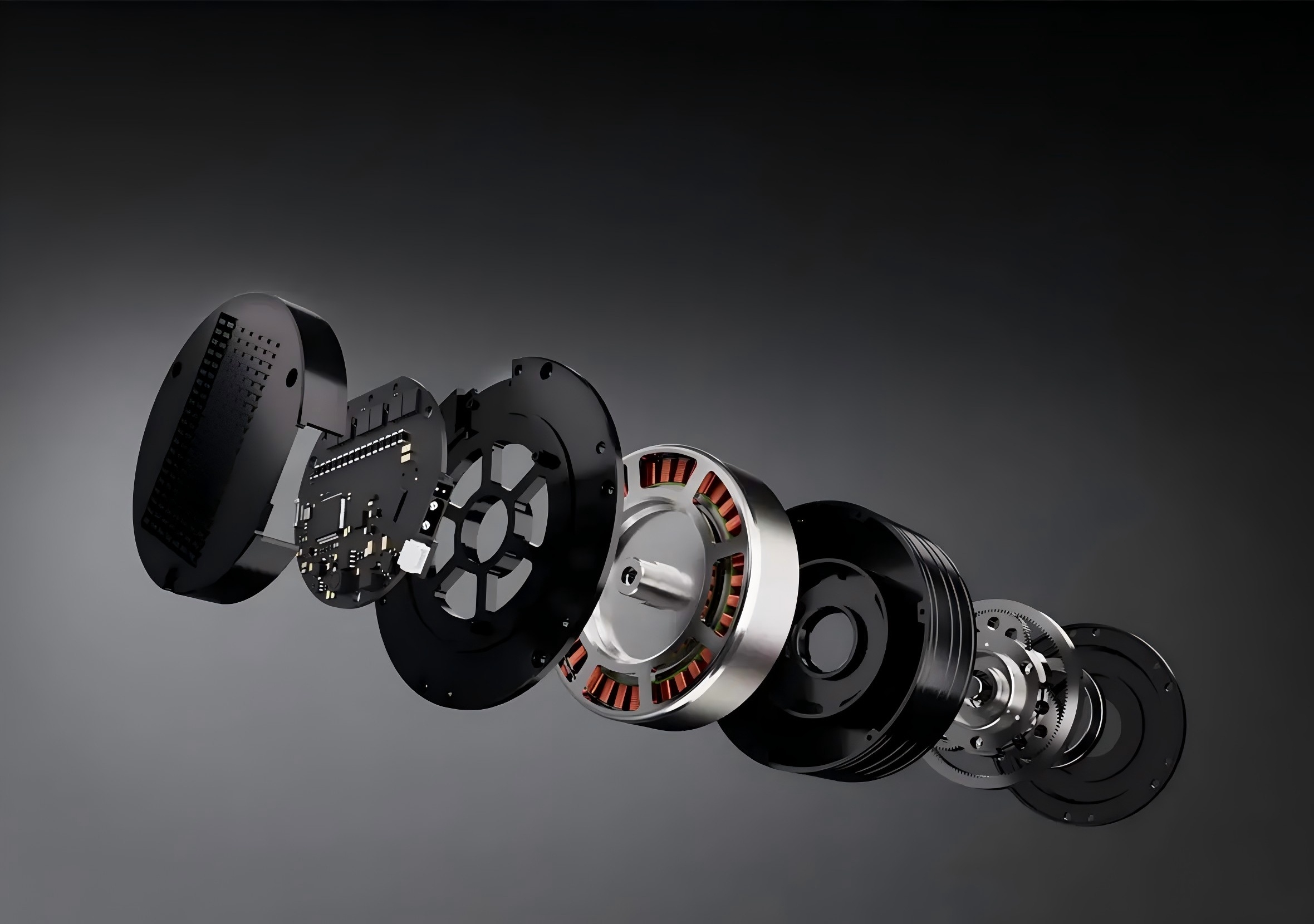
Today, we will analyze the power system of the upper limb joints in humanoid robots to understand why motors must be selected based on the specific joint.
As is well known, the working characteristics of the shoulder, elbow, and wrist joints in humanoid robots are completely different. Using the same motor solution for all can easily lead to wasted performance or system failure.
1. Because each joint "does a different job," we need to select based on the core requirements of each joint.
Joint | Role | Core Requirement |
Shoulder | Engine | High Torque, High Stability |
Elbow | Transmission Hub | Balance Power and Agility |
Wrist | Precision Executor | High Precision, Lightweight |
An Intuitive Analogy
Think of the robot arm as a human body:
Shoulder → Weightlifting (needs strength)
Elbow → Adjusting angle (needs coordination)
Wrist → Writing (needs precision)
Therefore, the performance of the joint motor directly impacts the robot's motion speed, positioning accuracy, load capacity, and long-term operational reliability.
2. An inappropriate motor may lead to:
Excessive heating
Unstable motion or oscillation
Limited control precision
Forced structural redesign in later development stages
Because of this, the selection of a robot joint motor is not merely a component-level decision but a system-level decision. It will affect the efficiency of robot motion, the precision of task execution, and the stability and reliability of long-term operation.
In humanoid robot design, the selection of the shoulder joint motor directly determines the performance ceiling of the upper limbs. Especially in real-world task scenarios (such as carrying objects or pushing carts), the shoulder joint must not only "move" but also be "stable, precise, and capable of sustained output."
1. Why is the Shoulder Joint Motor the Most Critical?
The shoulder joint bears:
The weight of the entire arm (elbow + wrist + end effector)
The maximum torque output
Complex multi-degree-of-freedom movements
2. Key Criteria for Shoulder Joint Motor Selection: Insights from the MenteeBot Cart-Pushing Task
In MenteeBot's actual demonstration, its cart-pushing action was particularly impressive. The robot naturally grasped the cart handle with both hands, its overall posture fluid and stable, closely resembling human operation. This "human-like" motion performance was not simple mechanical execution, but resulted from precise power system design and control strategies. To achieve this effect, Mentee Robotics selected CubeMars' AK80-64 KV80 robotic actuator module as one of the key drive units for the shoulder
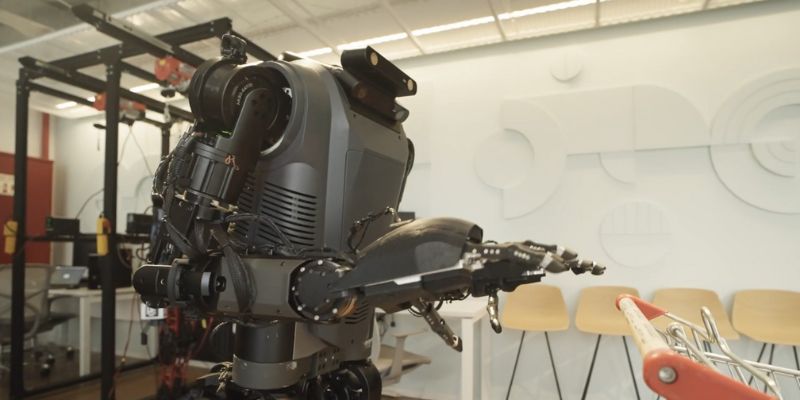
MenteeBot's natural cart-pushing performance is essentially the result of the combined action of a high-performance shoulder joint motor and sophisticated control capabilities.
Therefore, when selecting a shoulder joint motor, it's crucial to understand that this joint endures the greatest force.
Core Requirements:
Withstands the full weight of the arm + external loads
High torque, low speed, large reduction ratio
Must include an emergency brake / self-locking mechanism to prevent drooping
In humanoid robots, the elbow joint motor doesn't "compete in power" like the shoulder, nor does it "compete in precision" like the wrist. Its essence is: achieving the optimal balance between "torque, speed, and control."
1. First, Clarify: What are the Actual Requirements of the Elbow Joint?
In the humanoid robot structure: The elbow joint is primarily responsible for:
Lifting/Lowering the forearm
Posture adjustment (coordinating shoulder and wrist)
Dynamic motion control
2. Core Selection Parameters
Torque Range
Peak torque for elbow joints is typically: 40–80 Nm
Torque Density
Recommended for elbow joints: ≥25 Nm/kg
Dynamic Response Capability
Frequent motion + Rapid direction changes
Reducer Selection
Harmonic Drive Reducer
Control Capability
As the "motion transition core," the elbow joint must possess:
1. Torque Control
2. Impedance Control (Interaction)
3. High-Precision Feedback (Dual Encoders)
Therefore, choosing a humanoid robot elbow joint motor is not about selecting the "strongest," but about selecting the "most balanced": moderate torque, fast response, and precise control.
Core Requirements:
Load is smaller than the shoulder joint, but still needs to support the forearm + hand
Moderate size, moderate torque
Ideally also equipped with a brake for safety
In humanoid robots, the wrist joint motor is one of the joints that is "most easily underestimated yet most impactful on user experience." This is closely related to the core tasks of the wrist joint.
In humanoid robots, the wrist joint is primarily responsible for:
Hand posture adjustment (rotation / turning)
Fine manipulation (grasping, screwing, docking)
Multi-degree-of-freedom motion (typically 2~3 DOF)
Therefore, when selecting a wrist joint motor, greater emphasis should be placed on flexibility and lightness.
Core Requirements:
Only bears the load of the hand, low torque
Requires small size, light weight, fast response
High precision, suitable for fine movements
Why are Flexibility and Lightness Extremely Important for the Wrist Joint Motor?
This is because the wrist joint is located at the end of the robotic arm, the key link most directly involved in task execution. Its performance is "amplified" and reflected in the final action outcome.
1. The Load Reduction Effect: End Lightweighting Enhances Overall Mobility
Firstly, the end position is extremely sensitive to weight. A heavier motor significantly increases the inertia of the entire arm, not only reducing response speed but also increasing the burden on upstream joints (like the elbow and shoulder), affecting overall dynamic performance and energy consumption.
2. Dynamic Response: Agility Assurance for High-Frequency Movements
Secondly, the wrist joint handles high-frequency, small-amplitude fine movements, such as grasping alignment, angle fine-tuning, and tool operation. These actions require extremely high response speeds. Faster response makes movements more responsive; any delay can easily lead to jitter, incoherence, or even operation failure.
3. Precision Control: The Key to Success in Precision Tasks
Meanwhile, in precision task scenarios (such as assembly, inspection, interaction, etc.), control precision directly determines task success or failure. The motor needs higher positioning accuracy and stability to achieve subtle angle control, ensuring actions are "precise and repeatable."
4. Spatial Integration: The Precious Space of the Wrist Area
Furthermore, the wrist area is typically very limited and also needs to integrate sensors, cables, and even end effectors. A hollow structure and compact design can significantly improve integration efficiency, making the overall machine design more streamlined and concise.
Therefore, an excellent wrist joint motor must not only be "light" and "small," but also achieve excellence in response speed and control precision. This allows the robot to be truly flexible, stable, and efficient when performing complex and delicate tasks.
Mainstream Joint Motor Recommendations
Robot Joint Motor | Shoulder Joint (High Torque Core) | Elbow Joint (Dynamic Control Core) | Wrist Joint (Precision Control Core) |
Recommended Models | |||
Recommended Models |
Choosing the Right Upper Limb Power System Means Choosing Your Product's Ceiling
In today's increasingly competitive robotics industry, the power system is no longer just a "basic configuration" but a performance differentiator.
Choosing wrong may lead to:
1. Stiff movements
2. Insufficient precision
3. Shortened lifespan
Choosing right means:
1. A superior product experience
2. Stronger market competitiveness
Appropriate Motor Selection Based on Upper Limb Power
Comparison Chart of Three Major Upper Limb Joint Motors
A table to see the core differences at a glance
Dimension | Shoulder Joint | Elbow Joint | Wrist Joint |
Load Capacity | ⭐⭐⭐⭐⭐ (Highest) | ⭐⭐⭐⭐ | ⭐⭐ |
Torque Requirement | High (50–300 Nm+) | Medium (10–80 Nm) | Low (1–20 Nm) |
Speed Requirement | Medium | Medium-High | High |
Control Precision | High | High | Extremely High |
Control Difficulty | High | Medium | High |
Structural Space | Large | Medium | Small (Limited) |
Cooling Requirement | High | Medium | Low |
Common Motor Scheme | Large Inner Rotor + Harmonic Drive | Medium BLDC + Planetary/Harmonic Drive | Small Frameless / Direct Drive |
Example Products |
In humanoid robot design, torque calculation is the first step in motor selection. If calculated incorrectly, all subsequent designs (reducer, control, structure) will be problematic.
Core Formula
● τ (Torque) = Torque
● F (Force) = Force
● r (Radius) = Lever arm (distance from the rotation axis)
*(Calculation is for theoretical reference only; actual selection must be adjusted based on real working conditions.)
Practical Calculation Methods in Humanoid Robots
1. Gravity Torque
● m = Load mass (kg)
● g = Gravitational acceleration (9.81 m/s²)
● l = Distance from center of mass to joint (m)
2. Dynamic Torque
● I = Moment of inertia
● α = Angular acceleration
● External Load Torque
τ = F × r
*(Calculation is for theoretical reference only; actual selection must be adjusted based on real working conditions.)
3. Calculation Differences for Different Joints
Shoulder Joint | Elbow Joint | Wrist Joint |
Largest load (entire arm) | Medium load (forearm + end effector) | Smallest load |
Longest lever arm | High dynamic requirements | High precision requirements |
Humanoid robot motor torque calculation is essentially a comprehensive evaluation of "gravity + dynamics + external load," and must include a safety factor for engineering amplification.
In humanoid robot design, joint motors are not only the power source but also the key factor determining overall robot performance. Concerning the upper limb system of humanoid robots, motor selection has evolved from "functionality" to a core aspect of "performance optimization."
A humanoid robot joint motor is essentially a highly integrated actuator system, comprising a motor, reducer, encoder, and controller. Its performance depends not on a single parameter, but on the overall synergy capability and system design level.
In practical engineering, the functional differences between the shoulder, elbow, and wrist joints are very clear. The shoulder joint emphasizes high torque output, the elbow joint highlights dynamic coordination capability, while the wrist joint pursues high precision and lightweight. These differences dictate that motors must be "selected by joint" and cannot be configured uniformly.
Scientific motor selection must be based on torque calculations, including gravity torque, dynamic torque, and external loads, combined with a safety factor for engineering amplification. This step is the starting point for the entire system design and the key to avoiding problems later.
If selection is unreasonable, it often leads to issues like heating, jitter, control instability, and may even force a structural redesign, increasing development costs and time. Therefore, joint motor selection is essentially a system-level decision, not a simple component choice.
The key to humanoid robot joint motor selection is not choosing the "strongest performance," but selecting the "most suitable performance combination" based on the joint's function. Only in this way can more natural motion performance, higher control precision, and more reliable long-term operation be achieved.