Create your CubeMars account

Traditional inspection methods: manual inspections and helicopter inspections
Power line inspections, a critical task in the power system, have traditionally relied on manual inspections or helicopter-based inspections.
Limitations of Traditional Methods: High Costs, Low Efficiency, and Safety Hazards
While manual inspections allow for thorough checks based on experience, they are time-consuming and labor-intensive, and pose safety risks in environments such as high altitudes and inclement weather. Although helicopter inspections can improve efficiency, they still face challenges such as high costs and difficulty adapting to complex terrain.
Requirements for Modern Inspection: Enhanced Automation, Accuracy, and Efficiency
As demands for power system safety and operational efficiency increase, the limitations of traditional inspection methods are becoming increasingly apparent. Modern transmission line inspections must address issues such as high costs, low efficiency, and high risks, while improving inspection accuracy and efficiency and achieving greater automation.
Advantages of robotic inspection: Reduced risks to personnel and improved inspection efficiency
The application of robots in power line inspection has brought revolutionary changes to the power industry. Compared to traditional manual inspections, robots can operate reliably on high-voltage power lines, in rugged terrain, and under harsh weather conditions, significantly reducing safety risks during inspections and enabling the completion of a large volume of inspection tasks in a shorter time.
The Evolution of Robotics in Power Line Inspection
Manual and Mechanically Assisted Inspection
In the early days of the power system, power line inspections relied primarily on manual methods. Power companies depended on inspectors to check line safety and equipment condition on foot, by vehicle, or via helicopter.
Drone Inspection and Simple Robots
With the initial development of unmanned aerial vehicles (UAVs) and robotics technology, drones and robots were gradually introduced as auxiliary tools for power line inspection.
Development Phase: The Rise of Intelligent Robotic Systems
With rapid advancements in artificial intelligence, machine vision, sensor technology, and data analytics, power line inspection robots have gradually evolved toward greater intelligence and efficiency.
Modern Phase: High Integration and Deep Intelligence
In recent years, driven by further technological innovations, power line inspection robots have entered a new phase of development. In this phase, robotic technology has become significantly more mature.
High-Voltage Line Maintenance
Power inspection robots are capable of fully automated inspections and can comprehensively monitor equipment status using a variety of sensors. The robots can scan line conditions in real time, collect and analyze data, and easily access hazardous areas such as high elevations for monitoring.
Equipment Diagnostics
Inspection robots can utilize specialized detection equipment to automatically patrol and monitor equipment parameters in real time, quickly flagging anomalies. They are suitable for use in locations where manual operation is difficult or poses health risks, such as distribution rooms, converter stations, and high-voltage switchgear rooms.
To address the hazards associated with power line maintenance and reduce labor costs, a team from Company C developed the Gorilla Mk1 robot. Through technological innovation, the Gorilla Mk1 robot has controlled costs and effectively reduced the risks associated with manual power line maintenance.
1、Key Parameters
Weight | Towing Capacity | Full-load speed | Maximum slope |
20kg | 280kg | 20m/min | 30° |
2. Technical Features
All-wheel drive and electric wheel design ensure safe and stable operation
The Gorilla Mk1 robot is equipped with four independently driven electric wheels, which not only increase traction but also provide a high degree of stability.
Remote control system enables remote operation
The Gorilla Mk1 robot is equipped with multi-angle cameras that provide a clear view of the work environment. Through wireless signal transmission, operators can control the robot remotely using the remote control system.
Dynamic built-in control system ensures precise force application
The Gorilla Mk1 robot is equipped with a dynamic built-in control system that monitors and adjusts the force applied to power lines in real time, ensuring precise force application and preventing unnecessary wear on the lines or equipment.
3. Power System
The Gorilla Mk1 robot is equipped with four frameless torque motors, which effectively enhance traction and ensure the robot’s stability, enabling it to handle various complex environments and perform precise, safe, and efficient operations.
1. High Torque Density
High torque
Compact size
The high torque density of frameless torque motors enables a more compact robot design, allowing for flexible integration into the joints and drive systems of various inspection robots.
2. Extremely Low Backlash Torque
An optimized electromagnetic structure ensures smooth operation during low-speed inspections, reducing noise and vibration while enhancing inspection accuracy and comfort.
3. Compact Design Suitable for Integration
The motor is small and lightweight, making it ideal for embedding into critical components such as the joints and shafts of inspection robots, thereby providing high flexibility in complex environments.
4. High Customizability
The frameless design allows users to customize components such as support flanges, drive interfaces, and encoder mounts to meet specific structural requirements, greatly enhancing the robot’s adaptability and flexibility.
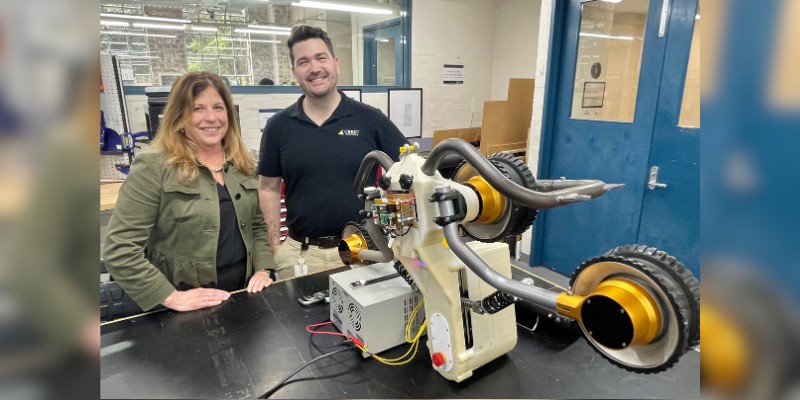
Application Example: In a real-world application involving an inspection robot equipped with the RI80 V2.0 KV75 frameless torque motor, the RI80 V2.0, powered by its high-performance electric drive system, is capable of navigating complex environments quickly and accurately reporting issues.
Performance Analysis: This robot has successfully addressed issues such as high costs, low efficiency, and high risks, effectively improving the accuracy and efficiency of inspections and achieving automation of the inspection process.
RI80 V2.0 KV75 Motor Parameters
Model | Motor Size | Bore diamete | Motor Weight | Peak Torque | No-load Speed |
Ф85*27mm | 40.5mm | 411g | 4.1Nm | 2960rpm@48V |
More CubeMars frameless torque motor recommendations
Frameless Inrunner Torque Motor – Smooth, Precise, Easy to Integrate
Frameless Outrunner Torque Motor – High Torque, Easy Integration
As an advanced drive technology, frameless torque motors can also be applied in industries such as manufacturing and healthcare.
Due to their exceptional performance and flexibility, frameless torque motors have found widespread use across various industrial sectors.
Robotic Arms, Assembly Lines, and Automated Equipment
In robotic arms, assembly lines, and automated equipment, frameless torque motors enable high-precision motion control. Robotic arms can perform complex operations such as precision assembly, gripping, and welding.
High-Precision Machine Tools
In high-precision machine tools, frameless torque motors provide extremely high torque output and rapid response capabilities, enabling precise cutting and positioning during the machining process.
Screen Printing
Since screen printing requires high-precision pattern alignment and consistent printing pressure, frameless torque motors ensure that every layer of printing achieves the desired results. Their superior dynamic performance effectively reduces printing errors, guaranteeing the clarity and accuracy of printed patterns.
With the arrival of an aging society, the demand for rehabilitation robots is gradually increasing, presenting a broad market outlook. Combined with advanced control algorithms, frameless torque motors enable rehabilitation robots to achieve precise and flexible motion control. By utilizing the repetitive movements provided by the robots, rehabilitation robots can assist patients in undergoing physical therapy and training in a safe environment.
Upper Limb Rehabilitation Robots
Focused on rehabilitation training for the arms and hands, helping patients regain grip strength, coordination, and flexibility.
Lower Limb Rehabilitation Robots
Used for leg rehabilitation, helping patients relearn basic movements such as walking, standing, and balancing.
Exoskeleton Robots
Through a wearable design, these provide support and strength augmentation to patients, assisting them in walking and other activities.
The high performance, high integration, and high customizability of the RI80 V2.0 KV75 frameless torque motor make it an ideal power solution for power line inspection robots.
Therefore, when selecting motors for robots, we need to pay closer attention to torque density, structural integration, and customizability to ensure they meet the high demands of practical applications.
As a company specializing in the R&D and manufacturing of robot motors, CubeMars can customize motors and power system solutions to meet specific customer needs. Until the present time, CubeMars has served over 1,600 global enterprises. Whether for industrial automation, humanoid robots, exoskeletons, or underwater propulsion systems, if you are selecting the right power system for your robot, please feel free to contact us!


