Create your CubeMars account

Why Is BLDC Motor Selection So Important?
In robots, robotic arms, automation equipment, drones, and smart manufacturing systems, the motor is a core component that determines the motion performance of the equipment.
Many engineers encounter similar questions when selecting a BLDC motor:
How much torque is required to meet the load requirements?
How should the KV value be selected?
Does the motor speed meet the application requirements?
Is a gearbox required?
Is the encoder accuracy sufficient?
How can a balance be achieved between weight, size, and performance?
Selecting a suitable BLDC motor is not simply a matter of comparing power or maximum speed. Instead, it requires comprehensive consideration of application requirements, load conditions, and system control requirements.
For ordinary rotating equipment, speed and power may be the primary concerns; however, for high-performance motion systems such as robotic joints, robotic arms, and electric actuators, engineers usually pay more attention to:
High torque output
High torque density
Fast dynamic response
Precise position control
Low-weight design
Long-term stable operation
Therefore, selecting the right BLDC motor is critical to ensuring the performance and reliability of the entire motion system.
A BLDC motor, or brushless DC motor, is a permanent-magnet synchronous motor that uses electronic commutation instead of traditional mechanical commutation.
Traditional brushed motors rely on brushes and a commutator to change the direction of current, while BLDC motors use an electronic controller to control current switching and achieve precise motion control of the rotor.
A complete BLDC motor system usually includes:
Motor body
Permanent-magnet rotor
Stator windings
Driver
Position sensor or encoder
Since mechanical brushes are eliminated, BLDC motors have the following advantages:
1. Higher Efficiency
Reducing mechanical friction losses improves energy conversion efficiency, making BLDC motors suitable for equipment that operates for long periods.
2. Longer Service Life
There is no brush wear issue, reducing maintenance requirements.
3. Higher Dynamic Performance
BLDC motors can achieve fast starting, acceleration, and precise motion control.
4. Better Suited for Robotics Applications
When combined with an encoder, gearbox, and control system, a high-performance motion solution can be formed.
Therefore, BLDC motors have become an important power component in modern robotics and automation systems.
For robots, exoskeletons, and humanoid robots, focusing only on maximum torque is not enough.
This is because robots typically require:
Lower weight
Smaller installation space
Higher output capability
Therefore, torque density has become an important indicator for evaluating motor performance.
Calculation formula:
Torque density = Output torque ÷ Motor weight
Unit:
Nm/kg
For example:
Two motors can both output 10Nm of torque:
Motor A weighs 1kg
Torque density:
10Nm/kg
Motor B weighs 0.5kg
Torque density:
20Nm/kg
For robotic joints, higher torque density means:
Lighter mechanical structures
Lower motion inertia
Faster dynamic response
Higher energy efficiency
Therefore, high-torque-density BLDC motors are receiving increasing attention in the robotics field.
The following core parameters should be given particular attention when selecting a BLDC motor:
| Parameter | Function |
| Torque | Determines how large a load the motor can drive |
| Speed (RPM) | Determines the motion speed of the equipment |
| KV value | Affects the motor speed characteristics |
| Voltage | Determines compatibility with the power supply system |
| Power | Reflects the motor's output capability |
| Size and weight | Affect mechanical integration |
| Encoder | Determines motion control accuracy |
| Gearbox | Increases output torque |
| Heat dissipation capability | Affects continuous operating performance |
For robotics and motion control applications, the most important parameters usually include:
Torque
Speed
KV value
Torque density
Encoder accuracy
Thermal performance
After completing the application requirements analysis, the next step is to select the appropriate BLDC motor parameters based on the actual operating conditions.
The most important steps in the actual selection process include:
1.First, Determine the Required Torque
Torque is one of the most critical parameters in BLDC motor selection.
It determines whether the motor can drive the target load
The basic torque calculation formula for a rotating system is:
T = F × r
Where:
T: Required torque (Nm)
F: Force generated by the load (N)
r: Rotation radius (m)
For example:
A robotic arm needs to carry a 5kg load, and the length of the robotic arm is 0.3m.
Gravitational force generated by the load:
F = 5 × 9.81 ≈ 49N
Required static torque:
T = 49 × 0.3
≈ 14.7Nm
However, in actual robotics applications, the motor cannot be selected directly based on this value.
This is because the system is also affected by:
Acceleration inertia
Frictional resistance
Load changes
External impacts
Changes in posture
and other factors during motion.
Therefore, a safety margin is usually required during actual motor selection:
Motor rated torque ≥ Actual load torque × Safety factor
The safety factor is usually determined according to application requirements:
| Application | Recommended safety margin |
| Equipment operating under stable conditions | 1.2~1.5 times |
| Automation equipment | 1.5~2 times |
| Dynamic robot motion | More than 2 times |
For robotic joints, dynamic performance is usually more important than simply meeting the static load requirement.
2. What Is the Difference Between Continuous Torque and Peak Torque?
This is a problem that is easily overlooked when selecting a BLDC motor.
Many engineers only focus on the maximum torque advertised for a product, but peak torque does not represent the motor's long-term output capability.
Continuous Torque
Continuous torque refers to the torque that the motor can output stably for a long period.
Suitable for:
Equipment operating for long periods
AGV mobile robots
Automation equipment
Robot posture holding
For example:
A robotic arm needs to maintain a fixed position for a long period and relies on continuous torque to maintain the load.
Peak Torque
Peak torque refers to the maximum output capability that the motor can reach within a short period.
Suitable for:
Rapid acceleration
Instantaneous load changes
High-dynamic robot movements
For example:
Robotic joint:
Normal load holding requires:
10Nm
Rapid motion may require:
20Nm
Therefore, the motor needs to meet both:
Sufficient continuous torque
Sufficient peak torque
Therefore, when selecting a BLDC motor, you cannot look only at the maximum peak torque. You also need to consider:
Duty cycle
Load changes
Motion speed
Heat dissipation conditions
for comprehensive evaluation.
3. How to Determine BLDC Motor Speed?
After determining the torque, the motor speed needs to be determined according to the motion requirements of the equipment.
Different applications have different requirements for RPM (speed):
| Application | Power tools |
| Drones | High speed, high efficiency |
| Gimbals | Low speed, high stability |
| Robotic joints | Medium-to-low speed, high torque |
| AGV | Determined according to wheel speed requirements |
| Power tools | High-speed operation |
In the case of direct motor drive
If the motor is directly connected to the load, the RPM needs to be calculated according to the target motion speed.
For example:
A rotating mechanism requires:
60 RPM
Then the motor output speed needs to be close to:
60 RPM
When using a gearbox:
In robotic systems, BLDC motors are usually used together with gearboxes.
A gearbox reduces the output speed while increasing the output torque.
Output speed = Motor speed ÷ Gear ratio.
For example:
A motor runs at 6000 RPM, and the gear ratio is 30:1:
Output speed = 6000 ÷ 30
= 200 RPM
Output torque ≈ Motor torque × Gear ratio × Efficiency.
For example:
If the motor torque is 1 Nm and the gear ratio is 30:1:
Theoretical output torque = 1 × 30
= 30 Nm
The actual value needs to take gearbox efficiency losses into account.
KV is an important parameter for motor selection.
It refers to the theoretical no-load speed increase per 1 V, expressed in RPM/V.
Theoretical speed ≈ KV × Voltage
For example:
A 100 KV motor at 24V:
100 × 24 = 2400 RPM
The actual speed is usually lower due to factors such as load, efficiency, voltage drop, control method, and friction losses.
High KV vs. Low KV:
High KV:
Higher speed, suitable for high-speed applications, with relatively lower torque; commonly used in drones, high-speed fans, and high-speed rotating equipment.
Low KV:
Lower speed and higher torque per unit current, making it more suitable for driving loads; commonly used in robotic joints, gimbals, electric actuators, and robotic arms.
For robotics applications, more attention is usually paid to high torque, high control precision, and low inertia. Therefore, low-KV, high-torque BLDC motors are often better suited to robotics applications.
The voltage must match the system power supply.
Common voltage options include 12V, 24V, 36V, 48V, and higher-voltage solutions.
The power system compatibility must be considered.
For example:
If a robot system uses a 48V battery, the motor, driver, and control system need to support the corresponding 48V voltage range.
Current demand can be calculated using:
P = V × I
Where:
P: Power (W)
V: Voltage (V)
I: Current (A)
At the same power level, a higher voltage results in a lower current.
For example:
A 480W system:
At 24V:
I = 480 ÷ 24 = 20A
At 48V:
I = 480 ÷ 48 = 10A
Advantages of higher voltage include:
Lower line losses
Less heat generation
Higher efficiency
Better performance during long-term operation
Therefore, 24V and 48V systems are becoming increasingly common in robots, AGVs, and industrial automation.
In many robotics and automation applications, a BLDC motor is combined with a gearbox, encoder, and driver to form a complete motion actuator system.
This is especially common in robotic joints, robotic arms, exoskeleton robots, and humanoid robots.
A single BLDC motor usually cannot simultaneously satisfy all of the following requirements:
High torque
Low speed
High precision
Compact size
Therefore, a gearbox and encoder are often required to achieve the desired motion performance.
The gearbox can increase output torque and reduce output speed, while the encoder provides position feedback for precise motion control.
This combination allows BLDC motors to be used in a wider range of high-performance motion applications.
High torque
Low speed
High-precision control
Therefore, a gearbox and feedback system need to be further configured.
1. Why Does a BLDC Motor Need a Gearbox?
BLDC motors usually have a relatively high speed, while actual robotic joints require:
Low-speed motion
High output torque
Precise control
The main functions of a gearbox include:
1. Reduce output speed
For example:
Motor:
6000 RPM
Gear ratio:
50:1
Output:
Approximately 120 RPM
2. Increase output torque
A gearbox can convert a high-speed, low-torque input into a low-speed, high-torque output.
For example:
Motor output:
2Nm
Gear ratio:
50:1
Theoretical output:
Approximately 100Nm
The actual value needs to take into account:
Gearbox efficiency
Friction losses
Operating temperature rise
3. Increase load capacity
For robotic joints, a gearbox can help the motor drive a larger mechanical load.
Common applications:
Industrial robots
Collaborative robots
Humanoid robots
Exoskeleton equipment
2. Why Does a BLDC Motor Need an Encoder?
An encoder is an important feedback component in a motion control system.
It can detect:
Motor rotor position
Speed changes
Output angle
Through real-time feedback, the controller can adjust motor motion more precisely.
The main functions of an encoder include:
1. Improve position control accuracy
For example:
A robotic arm needs to move accurately to a specified angle.
The encoder can provide real-time feedback on the current position, allowing the control system to perform closed-loop control.
2. Improve motion stability
Without an encoder, the system cannot accurately determine the actual position of the motor.
The following problems may occur:
Position errors
Missed steps
Unstable control
3. Improve dynamic response
During high-speed motion and rapid starting and stopping, encoder feedback can help the control system make rapid adjustments.
A reasonable BLDC motor selection process usually includes:
Define application requirements
↓
Calculate load torque
↓
Determine target speed
↓
Select KV value and operating voltage
↓
Evaluate power requirements
↓
Match the gearbox and encoder
↓
Verify size, weight, and thermal performance
The selection of a BLDC motor ultimately needs to return to the actual application scenario. Different robotic platforms have different motor requirements: robotic arms focus more on position control and force control performance, legged robots focus more on dynamic response and torque density, while mobile robots such as Mars rovers need to balance output torque, load capacity, and stable operation in complex environments.
In a 3-axis robotic arm project, the developer conducted practical tests on the CubeMars AK45 V3.0 QDD actuator and built a bilateral control system using the AK45-10 V3.0 KV75 and AK45-36 V3.0 KV80
The focus of this case was not simply to compare the maximum torque of the motors, but to test the actuator's backdrivability, force control capability, position feedback, and dynamic response in an actual robotic joint.
The CubeMars AK45 V3.0 adopts a dual-encoder design, which can simultaneously obtain position information from the motor side and output side. The motor-side encoder is used for rotor position feedback, while the output-side encoder directly detects the position of the gearbox output shaft, thereby improving the position feedback capability of the robotic joint.
In the test, the AK45-10 V3.0 KV75 uses a 10:1 gear ratio, while the AK45-36 V3.0 KV80 uses a 36:1 gear ratio. The lower gear ratio gives the AK45-10 better backdrivability, making it more suitable for robotic applications that require compliant motion and force control; the higher gear ratio can provide greater output torque, making it more suitable for applications that emphasize load capacity and position holding.
This case also demonstrates 3-axis bilateral control. The operator controls the robot's slave side through the master-side device and receives real-time force feedback. This shows that in robotic arms and human-robot interaction robots, motor selection requires attention not only to torque and speed, but also to:
Backdrivability
Torque control capability
Encoder feedback
Control response speed
Communication latency
Gear ratio
Selection Insights: Different Gear Ratios for Different Robot Joint Requirements
Testing of the AK45-10 and AK45-36 shows that selecting a QDD actuator should not be based solely on peak torque. It should also take into account the specific requirements of the robot joint, including backdrivability, output torque, motion compliance, and position control.
For applications that require more natural joint movement, strong backdrivability, force control, and human-robot interaction, a lower gear ratio can provide more direct force transmission and better backdrivability. For joints that require higher output torque, greater load capacity, and stronger position-holding capability, a higher gear ratio can be considered based on the load requirements.
Therefore, when selecting a BLDC motor or QDD actuator, the gear ratio should be determined based on the robot’s load, operating speed, joint compliance, force-control requirements, and position-control accuracy, rather than relying solely on maximum torque as the selection criterion.
Compared with fixed mechanical equipment, legged robots have more complex motor requirements. When the robot walks, jumps, turns, and adjusts its posture, the joints continuously accelerate, decelerate, and change direction. Therefore, the motor needs not only to provide sufficient torque, but also to have good dynamic response capability.
For legged robots, the following factors are recommended to receive particular attention when selecting a BLDC motor:
Peak torque
Continuous torque
Torque density
Motor weight
Backdrivability
Response speed
Joint dimensions
In particular, the weight of the motor itself directly affects the overall motion inertia of the robot. Therefore, it is not sufficient to simply select a "high-torque motor"; a balance needs to be achieved between torque and weight.
CubeMars QDD actuators adopt a relatively low gear ratio design, balancing output capability, dynamic response, and backdrivability, making them suitable for robotic platforms that require rapid joint motion. CubeMars official materials also position QDD actuators for high-dynamic applications such as legged robots.
For legged robots, the loads on different joints are also different. For example, the hip, knee, and ankle joints may experience significantly different torques and motion patterns. Therefore, during actual selection, calculations should also be performed separately according to joint position, motion direction, load, and motion frequency, rather than using the same specification throughout the entire robot.
Selection insight:
For legged robots, BLDC motor selection should prioritize high torque density, low weight, fast response, and good backdrivability, and the motor specifications should be determined separately according to the actual load of each joint.
The Mars rover project. Compared with robotic arms and legged robots, a Mars rover is a typical mobile robot, and its motors need to provide continuous power output during actual movement.
A Mars rover may need to deal with:
Uneven terrain
Slopes
Different road surface resistance
Frequent starting and stopping
Long-term operation
Therefore, when selecting a BLDC motor for this type of application, particular attention needs to be paid to output torque, speed, continuous operating capability, system efficiency, and reliability.
For mobile robots, the motor should not simply pursue peak torque. More importantly, it must be ensured that the motor can continuously provide sufficient output capability throughout the actual operating cycle.
Therefore, when selecting a motor for a Mars rover, the following approach can be used:
Step 1: Calculate the driving force required by the vehicle.
Calculate the required driving force according to the total vehicle weight, wheel radius, slope, and road surface resistance.
Step 2: Calculate the torque required by the wheels.
Determine the required torque at the motor output according to the driving force and wheel radius.
Step 3: Determine the target vehicle speed.
Determine the output speed according to the wheel diameter and target driving speed.
Step 4: Determine the gear ratio.
If the BLDC motor itself has a relatively high speed, a reduction mechanism can be used to reduce the output speed and increase the output torque.
Step 5: Verify continuous operating capability.
In addition to peak torque, continuous torque, temperature rise, and stability during long-term operation also need to be checked.
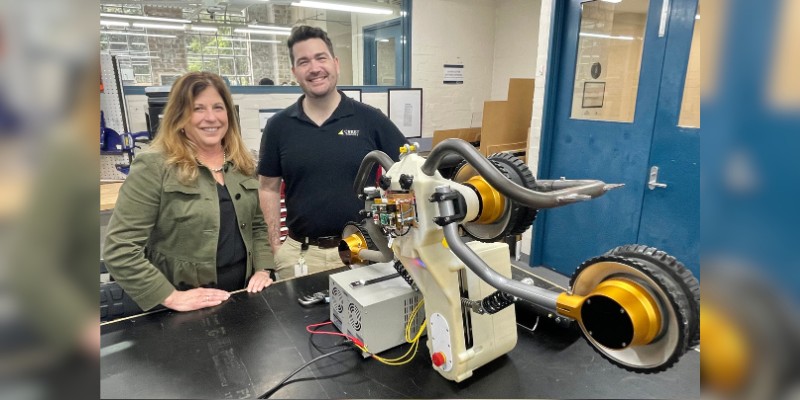
CubeMars robot actuator applications also cover scenarios such as mobile robots and Mars rovers. According to CubeMars official materials, a project from Toronto MetRobotics needed to complete navigation across irregular terrain and robotic arm operations in a complex Mars simulation environment, placing comprehensive requirements on actuator control accuracy, response speed, and stability.
Selection insight:
For mobile robots such as Mars rovers, motor selection should start from the entire vehicle system rather than focusing only on individual motor parameters. Load, vehicle speed, wheel size, gear ratio, continuous operating time, and operating environment all need to be considered comprehensively.
Different applications have different priorities when it comes to BLDC motor parameters.
1. Robotic Joints
Robotic joints usually require:
High torque
High torque density
Low inertia
High-precision feedback
Fast response
Key considerations:
| Parameter | Parameter |
| Torque | ★★★★★ |
| Torque density | ★★★★★ |
| Encoder | ★★★★★ |
| Response speed | ★★★★ |
| Weight | ★★★★ |
Recommended direction:
Low-KV, high-torque BLDC motor + high-precision encoder + gearbox.
2. Robotic Arms
Robotic arms need to balance:
Load capacity
Positioning accuracy
Dynamic performance
Key considerations:
Continuous torque
Peak torque
Position feedback accuracy
Motion smoothness
For collaborative robots, the following factors also need to be considered:
Low noise
Low vibration
Safety
3. Drones
Drone applications usually focus more on:
Weight
Efficiency
Speed
Key parameters:
High KV
High efficiency
Low-weight design
Unlike robotic joints, drones rely more heavily on high-speed rotational performance.
4. Gimbals
Gimbals mainly require:
Stability
Fast response
Precise control
Key considerations:
Low inertia
Low cogging torque (Cogging Torque)
Smooth operation
Encoder accuracy
5. AGV Mobile Robots
AGVs usually focus on:
Output torque
Operating efficiency
Long-term reliability
Key parameters:
Continuous torque
Heat dissipation capability
Motor service life
System efficiency
Mistake 1: Looking Only at Maximum Torque
Many users prioritize the question:
"What is the maximum peak torque?"
However, peak torque only represents short-term output capability.
Actual selection needs to consider all of the following:
Continuous torque
Peak torque
Duty cycle
Heat dissipation conditions
Mistake 2: Assuming a Higher KV Value Is Always Better
A higher KV value does not mean that the motor has better performance.
High KV:
Advantages:
Higher speed
Disadvantages:
Relatively lower torque
Low KV:
Advantages:
Stronger torque capability
More suitable for load applications
Correct selection method:
Based on:
Speed requirements
Load size
Voltage conditions
Make a comprehensive assessment.
Mistake 3: Ignoring Driver Compatibility
A BLDC motor does not operate independently.
The complete system needs to match:
Motor
Driver
Power supply
Control system
If the driving capability is insufficient, even an excellent motor cannot deliver its actual performance.
Mistake 4: Ignoring Thermal Design
During long-term high-load operation, temperature rise affects:
Motor efficiency
Output capability
Service life
Therefore, the following factors need to be considered:
Operating time
Ambient temperature
Load rate
Heat dissipation structure
For high-performance applications such as robots, robotic arms, and electric actuators, CubeMars provides motion control solutions covering different requirements.
These include:
Frameless Torque Motors
Integrated Actuators
High-precision encoder solutions
Robotic joint power systems
In robotic applications, engineers need to select not only a motor, but also a complete motion system.
An excellent robotic power solution needs to simultaneously provide:
High torque density
Compact size
Fast dynamic response
Precise control
Long-term reliable operation
Selecting a suitable BLDC motor is not simply a matter of finding the model with the highest power, highest speed, or highest torque. Instead, the goal is to find the best balance between performance, size, efficiency, and control accuracy according to specific application requirements.
During the actual selection process, engineers first need to define the motion requirements of the equipment, including:
Load size
Target speed
Operating time
Operating environment
Installation space
Control accuracy requirements
Then determine the key motor parameters based on these conditions:
Torque determines whether the motor can drive the load, speed determines motion efficiency, the KV value affects the motor speed characteristics, voltage determines system compatibility, and power determines the overall output capability.
For ordinary rotating equipment, selecting a suitable BLDC motor may mainly involve considering speed and power; however, for high-performance applications such as robots, robotic arms, exoskeletons, and intelligent actuators, focusing only on these parameters is not enough.
These applications also usually require consideration of:
High torque density for stronger output in a smaller package
Low-inertia design for faster dynamic response
High-precision encoder for accurate position feedback
Low noise and low vibration for improved motion stability
Excellent heat dissipation capability for long-term reliable operation
Overall matching between the motor, gearbox, and driver
Especially in robotics, BLDC motors usually do not operate independently, but serve as part of a complete motion system, with a gearbox, encoder, and controller together forming a high-performance actuator. Therefore, when selecting a motor for a robot, the entire system needs to be evaluated rather than simply comparing individual motor parameters.
A correct BLDC motor selection process should be:
Define application requirements → Calculate load torque → Determine operating speed → Select voltage and KV value → Evaluate power requirements → Match gearbox and encoder → Check size, weight, and heat dissipation performance.
Through a scientific selection method, problems such as insufficient motor performance, low efficiency, excessive temperature rise, or improper system matching can be avoided, while the reliability and service life of the equipment can be improved.
As robotics and automation technologies continue to develop, BLDC motors are moving toward higher power density, smaller size, more precise control, and greater intelligence. For next-generation robotic systems, selecting the right BLDC motor not only means obtaining stable and reliable power output, but also brings greater flexibility, response speed, and application potential to the entire motion system.
Therefore, whether for robotic joints, robotic arms, AGVs, electric actuators, or other intelligent devices, BLDC motor selection should be based on actual application requirements, with a comprehensive evaluation of torque, speed, efficiency, control capability, and system integration capability to find the motor solution that best fits the specific project.