Create your CubeMars account

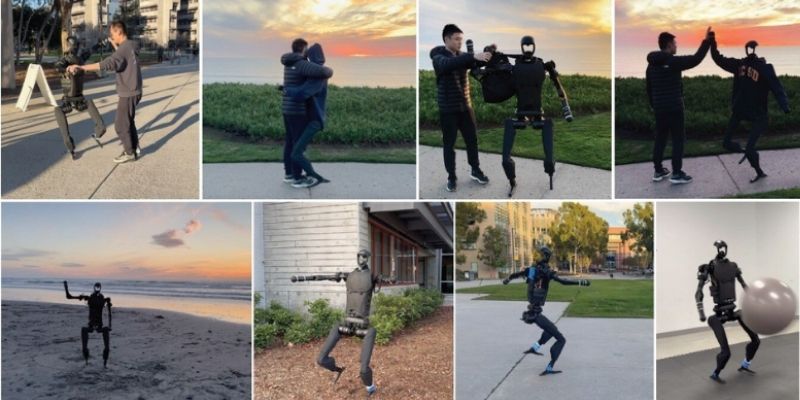
Engineers at the University of California San Diego have made significant advancements in humanoid robot technology. They have successfully trained a robot to effortlessly learn and perform a variety of expressive movements, including simple dance routines, as well as gestures like waving, high-fiving, and hugging, all while maintaining a steady gait across different terrains.
This development marks a major breakthrough in human-robot interaction. The robot’s ability to perform a range of expressive actions paves the way for its use in various environments, including factory assembly lines, hospitals, and homes. This robot could work safely alongside humans and potentially replace them in hazardous settings such as laboratories or disaster sites.
"Through expressive and more human-like body motions, we aim to build trust and showcase the potential for robots to coexist harmoniously with humans," said Xiaolong Wang, Professor in the Department of Electrical and Computer Engineering at UC San Diego’s Jacobs School of Engineering. "We are working to change the public perception of robots from a frightening image like The Terminator to a friendly and cooperative partner."
The robot’s remarkable expressiveness stems from its training process. The research team utilized extensive motion capture data and dance videos to teach the robot various human body movements. This approach allows the robot to quickly learn new dance routines and gestures, akin to a quick-learning dance student.
The training was divided into two parts: the upper body and the lower body. The robot's upper body was trained to replicate reference motions, such as dancing and high-fiving, while its lower body focused on maintaining a steady stepping motion to ensure balance on different terrains.
"The main goal is to demonstrate the robot’s ability to perform various actions while walking from one place to another without falling," Wang explained.
Despite separate training for the upper and lower body, the robot operates under a unified policy that governs its entire structure. This coordination ensures the robot can perform complex upper-body gestures while walking steadily across surfaces like gravel, dirt, wood chips, grass, and inclined concrete paths.
The development process included simulations on a virtual robot, which were then transferred to a real robot. The robot successfully demonstrated the ability to execute both learned and new movements under real-world conditions.
Currently, the robot’s movements are controlled by a human operator using a game controller, which adjusts the robot’s speed, direction, and specific actions. The team envisions future versions of the robot equipped with cameras to enable autonomous task execution and navigation.
The team is also focused on refining the robot's design to handle more intricate and fine-grained tasks. "By expanding the capabilities of the upper body, we can increase the range of motions and gestures the robot can perform," Wang added.
The progress made by the UC San Diego team in training humanoid robots to perform expressive movements and gestures represents a significant leap in human-robot interaction. By integrating these robots into everyday environments, we can look forward to a future where robots seamlessly collaborate with humans, enhancing efficiency and safety across various settings.


