Registrieren

In der modernen Industrie und in Arbeitsumgebungen mit hoher Arbeitsintensität führt das wiederholte Heben von Gewichten häufig zu Verletzungen der Wirbelsäule und der Rückenmuskulatur, insbesondere der Lendenwirbelsäule. Die Häufigkeit dieses Problems am Arbeitsplatz hat große Aufmerksamkeit auf sich gezogen. Als Antwort auf diese Herausforderung wurde die Exoskelett-Technologie mit dem Ziel entwickelt, eine wirksame Unterstützung zu bieten, die körperliche Belastung zu verringern und die Arbeitseffizienz zu verbessern.
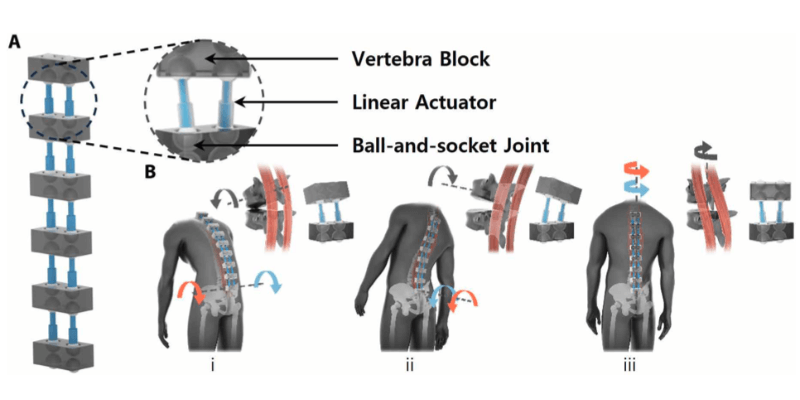
Die menschliche Wirbelsäule ist eine komplexe biomechanische Struktur, die sich aus mehreren Wirbeln und Zwischenwirbelgelenken zusammensetzt, die mehrere Freiheitsgrade der Bewegung ermöglichen. Jedes Zwischenwirbelgelenk besteht aus einer Bandscheibe, die Stöße abfedert, und zwei Paaren kleiner Gelenke, die das Beugen und Verdrehen der Wirbelsäule steuern. Diese Struktur ermöglicht es der Wirbelsäule, in drei Freiheitsgraden flexibel zu sein: Beugung, Streckung, seitliche Beugung und axiale Drehung. Die Musculi erector spinae befinden sich in der Nähe der Seiten der Wirbelsäule und arbeiten eng mit der Anatomie der Wirbelsäule zusammen, um eine Vielzahl von Wirbelsäulenbewegungen zu unterstützen, und sind entscheidend für die Koordination der zahlreichen Bewegungsfreiheitsgrade der Wirbelsäule, insbesondere beim asymmetrischen Gewichtheben.
Ein Forscherteam der Seoul National University hat kürzlich das Active Bilateral Back Extensor Exoskeleton Kit (BBEX) vorgestellt. Während die Exoskelett-Technologie selbst nicht die erste ihrer Art ist, führt das BBEX neue Innovationen in Bezug auf Design und Funktionalität ein, insbesondere im Hinblick auf die Modellierung der Wirbelsäule und der Rückenstreckermuskeln, um die bestehenden Rückenstützvorrichtungen zu verbessern.
Biomechanische Simulation: Das BBEX-Exoskelett verfügt über ein Design mit mehreren Freiheitsgraden, das die natürliche Struktur und die Bewegungsmuster der Wirbelsäule und der Rückenstreckermuskeln durch lineare Tandemaktoren nachahmt. Dieses Design ermöglicht es dem Exoskelett, eine multidirektionale Kraftunterstützung zu bieten und sich an eine Vielzahl von asymmetrischen Gewichthebeaufgaben anzupassen.
STÜTZUNG & KOMFORT: BBEX reduziert die Belastung der Wirbelsäule, indem es die Wirkung der erector spinae-Muskeln genau nachahmt und so eine natürliche Unterstützung bei hochintensiven Aufgaben bietet. Es ist so konzipiert, dass es mit der natürlichen Bewegung der menschlichen Wirbelsäule harmoniert, um Komfort und Effektivität zu verbessern.
Mehrdimensionale Kraftunterstützung: Das BBEX-Exoskelett ist mit einem sekundären Erektor-Spinae-Mechanismus (SES) ausgestattet, der aus einer Reihe von Tandem-Antriebsmodulen mit Wirbelblöcken, Kugelgelenken und linearen Aktuatoren besteht, die die bilaterale Konfiguration der Erektor-Spinae-Muskeln imitieren. Dieser Mechanismus ermöglicht eine der menschlichen Wirbelsäule ähnliche Rotation mit drei Freiheitsgraden und bietet eine wirksame mehrdimensionale Unterstützung beim Heben von Gewichten, entlastet die Rückenmuskulatur und verringert die Belastung der Wirbelsäulengelenke, insbesondere in Fällen, in denen die Rückenmuskelkräfte in erster Linie Scherkräfte auf die Gelenke ausüben, und in denen die Hilfskräfte die Auswirkungen dieser Kräfte wirksam minimieren.
Sicherheitsprüfung: Trotz der technologischen Innovationen von BBEX bleibt die Sicherheitsprüfung der Schlüssel. Das Gerät wird strengen Tests unterzogen, um die Stabilität und Zuverlässigkeit in realen Anwendungen zu gewährleisten.
Das BBEX-Exoskelett hat eine breite Palette von Anwendungsmöglichkeiten, darunter:
Industrielle Umgebungen: In Bereichen wie dem Baugewerbe, der Fertigung und der Lagerhaltung kann BBEX dazu beitragen, dass die Arbeitnehmer weniger belastet werden und produktiver sind.
Rehabilitation: Im medizinischen Bereich können die unterstützenden und helfenden Funktionen von BBEX den Patienten helfen, ihre motorischen Fähigkeiten wiederzuerlangen und ihre Lebensqualität zu verbessern.
Andere Anwendungsszenarien: Die zusätzliche Kraftunterstützung durch BBEX bei hochintensiven Einsätzen wie Militär- und Rettungseinsätzen ist ebenfalls von potenziellem Anwendungswert.
Das Active Bilateral Back Extensor Exoskeleton Kit (BBEX) stellt einen bedeutenden Fortschritt in der Exoskelett-Technologie dar. Durch die genaue Modellierung der biomechanischen Eigenschaften der Wirbelsäule zeigt das BBEX neue Möglichkeiten der multidimensionalen Kraftunterstützung auf.


