Create your CubeMars account

From "Able to Move" to "High-Performance Motion": How Motors Are Redefining Quadruped Robots
Over the past few years, quadruped robots (robot dogs) have undergone a significant technological transition:
From "able to walk" → to "stable walking"
From "basic motion" → to "high-speed dynamic running"
From "research prototype" → to "industrial-grade deployment (inspection / security / rescue)"
Throughout this process, one key trend has become increasingly clear:
The core of robotic performance competition is shifting from "algorithmic capability" to "actuation system capability."
Early robot development relied more on:
Gait planning
Control algorithms (PID / MPC)
Perception systems (vision / IMU)
However, as technology has advanced, the industry has gradually recognized a practical reality:
No matter how advanced the algorithm, without sufficiently powerful, fast, and precise actuators, high-performance motion cannot be achieved.
In other words:
Algorithms determine "how the robot wants to move"
Motors determine "whether it can actually do so"
Therefore, a core question now faces engineers:
How to select a motor truly suitable for a robot dog?
Which parameters are critical?
How to balance performance and cost?
Many people believe that a robot dog's "intelligence" comes primarily from algorithms.
But in real engineering, a more practical conclusion is:
The performance ceiling of a robot dog is often determined by the motor (actuator), not the algorithm.
I. Algorithms Only Provide Decisions; Motors Provide Execution
A simple analogy:
Algorithm → Brain (decides how to move)
Motor → Muscle (actually executes the movement)
If the "muscle" is not strong enough, fast enough, or precise enough:
No matter how good the algorithm, it cannot be realized
Ideal motions cannot be achieved
For example:
The algorithm commands a jump → insufficient motor torque → cannot jump
The algorithm requires rapid adjustment → slow response → the robot has already lost balance
Motor capability directly limits the algorithm's potential.
II. All Motion Is Essentially Motor Operation
Every action of a robot dog depends on the actuators:
Lifting a leg → motor outputs torque
Landing → motor absorbs impact
Balancing → motor continuously makes fine adjustments
Running → motor responds at high speed
In other words:
When a robot "appears to move," it is essentially the motor continuously outputting control results.
III. Actuator = Power + Control + Perception
Modern robot dogs do not use a "bare motor" but an integrated actuator, typically including:
Motor (power)
Gearbox (torque amplification)
Encoder (position feedback)
Driver (control execution)
This means:
The motor itself is already part of the control system.
What are the implications?
Control precision → affects stability
Response speed → affects dynamic capability
Torque output → affects load capacity
Actuator performance = Robot motion quality
IV. Motor Parameters Directly Determine Motion Performance
Different parameters correspond to different capabilities:
Torque → can it "hold up"?
Peak torque → can it "explode"?
Response speed → can it "keep up"?
Control precision → can it "stay steady"?
If any of these is insufficient:
The robot will shake
It will respond sluggishly
Or it will be unable to perform complex motions
V. Why Are High-Performance Robots Upgrading Their Actuators?
A clear trend in the industry in recent years is:
Shifting from algorithm optimization → to actuator system upgrades
The reason is simple:
Algorithms can optimize "strategy"
Actuators determine "physical capability"
In summary:
Algorithms determine what the robot wants to do, while motors determine how well it can do it.
1. Rated Torque – "Sustained Combat Capability"
Definition: The continuous output capability of the motor under long-term stable operation (Nm)
Why is it critical?
Determines whether the robot can "stand"
Determines whether it can operate for extended periods
Directly affects load capacity
Engineering conclusion: Rated torque = lower limit of basic performance
2. Peak Torque – "Instantaneous Burst Power"
Definition: The maximum output capability of the motor over a short period
Typical applications:
Jumping
Climbing
Emergency posture adjustment
Peak torque determines limit motion capability
Note:
Cannot be used continuously
Typically 2–3 times the rated torque
3. Gear Ratio – "Balancing Speed and Power"
Core relationship:
Higher gear ratio → higher torque / lower speed
Lower gear ratio → higher speed / more responsive
Selection logic:
Dynamic robots → low gear ratio
Heavy-load robots → high gear ratio
Essentially a trade-off between power and flexibility
4. Control Accuracy – "Core of Stability"
Key metrics:
Encoder precision (14bit / 16bit+)
Torque control accuracy
Impact:
Whether the robot shakes
Whether it can perform fine motions
Whether it can achieve biomimetic gaits
High accuracy = high stability
5. Response Speed – "Key to Running Capability"
Definition: Delay from control signal to motion execution
Impact:
Dynamic balance
Gait switching
Obstacle avoidance capability
The faster the response, the "smarter" the robot
6. Torque Density – "Core Metric for Lightweighting"
Definition: Output capability per unit weight (Nm/kg)
Significance:
Lighter → more agile
Lighter → more energy-efficient
Lighter → longer endurance
One of the core metrics for high-end robots
7. Voltage & Power
Common:
24V: Lightweight applications
48V: Industrial grade
Trend:
High-performance robots are gradually migrating to 48V systems (higher efficiency)
8. Level of Integration (Integrated Actuator)
An integrated actuator includes:
Motor + driver + encoder + gearbox
Advantages:
Reduces development complexity
Improves reliability
Shortens development cycle
Current mainstream trend in the industry
Project Background
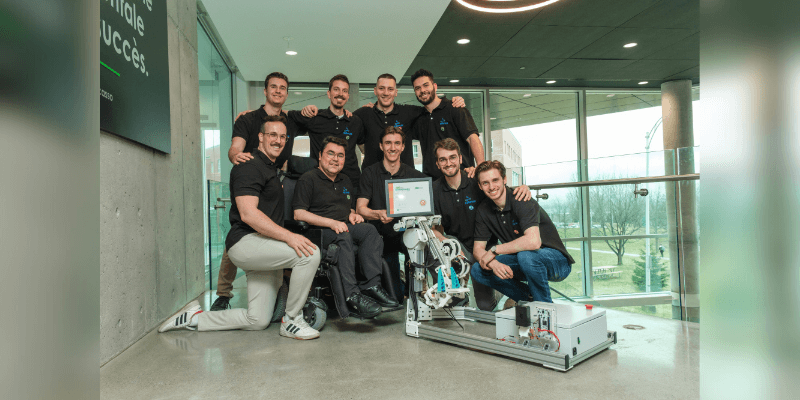
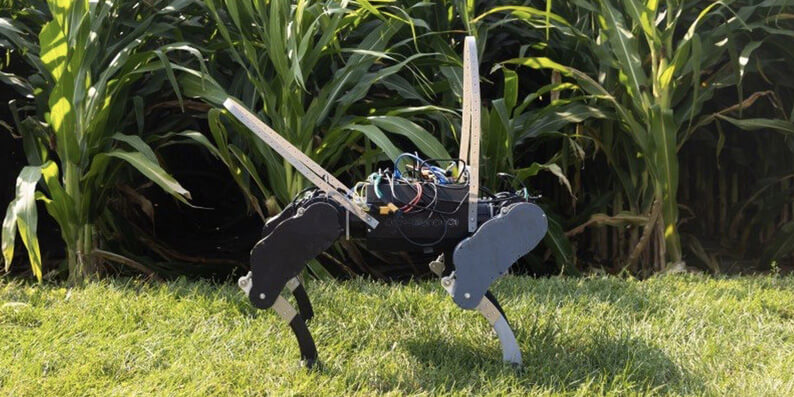
The quadruped robot (OmniAgRobot) from the University of Minnesota Agricultural Robotics Lab is used for:
Field inspection
Crop health monitoring
Soil data collection
This robot can move freely in cornfields, muddy terrain, and irregular terrain – something traditional wheeled robots struggle to achieve.
Why a Quadruped Structure?
Compared to wheeled robots or drones:
Muddy ground → wheeled robots easily get stuck
Between crop rows → wheeled robots cannot enter
Irregular terrain → insufficient stability
Quadruped robots offer:
Greater terrainability
Higher stability
More precise path control
Motor Selection: The Key Role of the AK70-10
The project ultimately chose the AK70-10 integrated actuator for the following core reasons:
① High Integration
Motor + gearbox + driver integrated
Simplifies mechanical structure and wiring
Improves system reliability
② High-Precision Control
Supports CAN communication
Supports multi-motor synchronization
Enables complex gait coordination
③ High Torque Output
Adapts to muddy ground, slopes, and other complex environments
Provides stable support
④ High Reliability and Ease of Deployment
Easy to install
Efficient debugging
Shortens development cycle
Actual Engineering Performance
During testing, the robot achieved:
Synchronized coordination of multiple motors
High-frequency position and torque control
Stable walking in complex terrain
Research team feedback:
High integration + high torque significantly improved system stability and development efficiency
Core Conclusion
The core requirements for agricultural robots are not "extreme performance" but:
Stability
Reliability
Sustainable operation
Essential needs:
Medium-high torque + high precision + high reliability
Project Highlights:
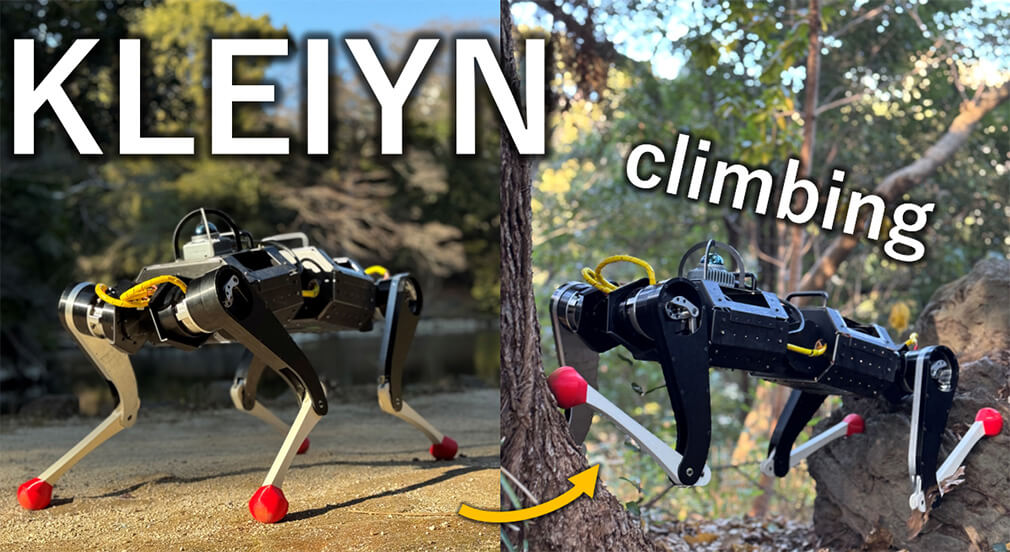
Can climb between narrow walls of 800–1000mm
Motion speed increased approximately 50-fold
Adapts to complex environments (e.g., chimneys/shafts)
Motor Configuration Breakdown
| Component | Actuator Model | Core Performance | Role |
| Leg Actuator | AK70-10 KV100 | Strong continuous support, high torque density | Provides stable support and continuous motion, suitable for walking and dynamic movement |
| Waist Actuator | AK10-9 V2.0 KV60 | Peak torque up to 48Nm, high burst output | Provides core burst power for posture adjustment and high-dynamic actions |
Why Can It Climb?
Three key factors:
1. High rated torque
Ensures continuous adhesion without falling
2. High peak torque
Provides burst power for leg lifting and propulsion
3. Low-latency response
Quickly adjusts contact points (prevents slipping / loss of balance)
Engineering conclusion:
Extreme motion = Torque + Response + Control, all three combined
Project Characteristics
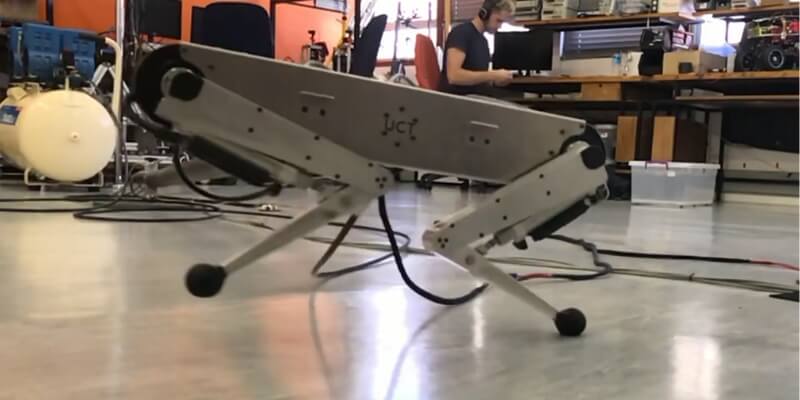
High-precision gait control
Strong force control capability
Used for research and control algorithm validation
Motor Capability Requirements
Precise foot placement control
Torque variation control (compliance control)
High-bandwidth response
Engineering Significance
In research robots:
High torque ≠ good performance
Controllability is the core
Core Conclusion
Future robot trend = Precision-driven + Force control integration
After understanding the core parameters and real-world cases, the most critical next step is:
Selecting the actuator solution that truly fits your project.
From the three typical cases – KLEIYN, the agricultural robot, and Kemba – we can identify a crucial pattern:
Different application scenarios correspond to fundamentally different "motor parameter combination strategies."
No single parameter is the strongest; the key is the right combination.
I. Extreme Motion Scenario (KLEIYN)
Keywords: Dynamic capability / Burst power / Response speed
Core needs:
High peak torque (burst)
High response speed (rapid adjustment)
Medium-high rated torque (sustained support)
Why?
Climbing, jumping, and fast movement all require substantial instantaneous power
Simultaneously, rapid adjustment is essential to avoid losing balance
Essential logic:
Prioritize "response + burst," then sustained capability
II. Agricultural / Industrial Scenario (University of Minnesota Robot)
Keywords: Stability / Reliability / Continuous operation
Core needs:
Stable rated torque
High reliability (long operation hours)
High integration (reduces system complexity)
Why?
Farm environments are complex but the pace is relatively slow
Requires long-duration operation, not extreme performance
Essential logic:
Prioritize "stability + reliability," not extreme performance
III. Research / Control Scenario (Kemba)
Keywords: Precision / Force control / Repeatability
Core needs:
High-precision encoder
Fine torque control
High-bandwidth control system
Why?
Need to validate algorithms
Need repeatable experimental results
Essential logic:
Prioritize "controllability," not just raw power
Comparison of the Three Scenario Types
| Scenario Type | Representative Case | Priority Order | Core Motor Metrics |
| Extreme Motion | KLEIYN | Response > Peak torque > Rated torque | Dynamic performance |
| Agricultural/Industrial | University of Minnesota | Rated torque > Reliability > Integration | Stability |
| Research Control | Kemba | Control precision > Force control > Response | Controllability |
| Application Scenario | Typical Use | Core Needs | Recommended Model | Reason |
| Dynamic Robot Dog | High-speed quadruped / jumping / climbing | High response + medium-high torque + low latency | AK70-10 KV100 | Excellent dynamic performance, balanced torque and response, suitable for running, jumping, and complex motions |
| Agricultural / Industrial Robot | Field inspection / pipeline inspection | Stability + reliability + long-duration operation | AK70-10 KV100 / AK80-8 KV60 | High rated torque + high integration, supports long-term stable operation |
| Heavy-Load Robot | Material handling / Industrial equipment | High torque + high load capacity | AK80-9 V3.0 KV100 | High rated torque + high integration, supports long-term stable operation |
| Research / Education Project | Lab work / control algorithm development | Flexibility + cost control + ease of development | AK60-6 V3.0 KV80 | Compact size, easy integration, suitable for rapid prototyping and development |
Quick Decision Guide
| Your Goal | Recommended Model |
| Run fast / Strong dynamics | AK70-10 KV100 |
| Stable and reliable operation | AK70-10 KV100 / AK80-8 KV60 |
| High torque / Heavy load capacity | AK80-9 V3.0 KV100 |
| Rapid development / Teaching | AK60-6 V3.0 KV80 |
The transition of quadruped robots from “able to move” to “high-performance motion” is no longer driven by algorithms, but by motor actuators. Algorithms determine how a robot “wants to move,” while motors determine how well it “can perform.” Modern integrated actuators are themselves the core of the control system, directly defining the performance ceiling of quadruped robots.
Different application scenarios correspond to completely different motor parameter combination strategies. Extreme motion scenarios prioritize response speed and peak torque, agricultural and industrial scenarios prioritize rated torque and reliability, while research and education scenarios prioritize control accuracy and force control capability. There is no “strongest” motor—only the most suitable parameter configuration.
Motor selection is not a competition of a single parameter, but a system-level balance among torque, response, precision, weight, and cost. Dynamic quadruped robots focus on response and burst power, industrial and agricultural scenarios emphasize stability and continuous operation, heavy-load applications require high torque reserves, and research and education place greater importance on controllability and ease of development.
The key to advancing quadruped robots from “able to move” to “high-performance motion” is not how powerful the algorithm is, but whether the motor can support, keep up, and control accurately. Only by choosing the right motor can a quadruped robot truly run fast, stand stable, and perform precise tasks.