Create your CubeMars account

Legged robots simulate biological movement, utilizing multiple joints and actuation systems for flexible locomotion. They typically rely on highly precise gait control algorithms and dynamic modeling to provide greater adaptability in complex terrains. The design of legged robots involves multi-degree-of-freedom actuation systems and efficient motor control systems, such as the single-legged robot StaccaToe, developed by the University of Massachusetts Amherst.
Wheeled robots rely on simple yet efficient wheeled drive systems. They typically feature lower manufacturing costs and higher speeds, making them suitable for most industrial and commercial environments. Wheeled robots use motors to drive wheels for linear or steering motion, enabling efficient and high-speed operation on flat surfaces, such as the four-wheeled robot Legacy V2, developed by the BR team at Saban University.
The table below compares the key differences between legged robots and wheeled robots in terms of mobility, control complexity, and motor system requirements.
| Features | Legged Robot(StaccaToe) | Wheeled Robot(Legacy V2) |
| Terrain Adaptability | High: Capable of navigating various complex and rugged terrains; suitable for scenarios such as post-disaster rescue and military reconnaissance. | Low: Suitable for flat terrain; features a four-wheel independent steering system to enhance maneuverability in tight spaces. |
| Speed | Slower: prioritizing stability and precise control | Faster: offering higher speeds and greater efficiency, especially on flat surfaces |
| Precise control | High: Utilizes an electric motor and precise gait control to ensure accurate movement | Moderate: The four-wheel independent steering system provides good maneuverability, but is highly dependent on flat terrain |
| Design complexity | High: Involves multi-degree-of-freedom joint actuation and complex control algorithms | Moderate: The four-wheel independent steering system is relatively simple, but still requires a complex electronic control system |
| Actuation System | Multiple joint actuators (hip, knee, ankle) requiring high peak torque. | Drive motors connected to wheels emphasizing continuous torque output. |
| Maintenance costs | High: Complex joints, sensors, and actuators require regular maintenance. | Low: Simple motor and drive systems that are easy to maintain |
Selecting Motors for Legged Robots: Balancing High Torque and Precise Control
Legged robots typically need to perform locomotion in complex terrains and environments, including climbing slopes, traversing obstacles, and handling uneven ground.
To achieve these precise movements, legged robots require not only high torque output, but also the ability to deliver continuous power while maintaining precision and stability.
Therefore, when selecting motors for legged robots, factors such as torque requirements, motion precision, and energy efficiency must be comprehensively considered to ensure the robot can handle complex tasks.
Balancing Torque Output and Precise Control
The core challenge for legged robot motors lies in providing high torque output while ensuring high precision and low vibration during movement. Consequently, a common solution involves using a joint module comprising a brushless DC motor (BLDC), a gearbox, and an encoder, which maintains stable output and precise control even at low speeds.
High Precision
Typically, BLDC motors paired with high-precision encoders or integrated servo actuators are used. Closed-loop control enables precise feedback of position and torque, ensuring the stability and repeatability of gait control.
High Responsiveness
Selecting BLDC motors with low rotor inertia or direct-drive/low-reduction-ratio solutions, combined with high-bandwidth drivers, enables rapid start-stop and dynamic response, meeting the demands of high-dynamic movements such as jumping and landing cushioning.
High-Performance and Energy-Efficient Design
For legged robots, the ability to operate continuously for extended periods is a critical consideration. Therefore, the energy efficiency of legged robot motors must be optimized. During the design phase, it is necessary to select high-efficiency motors and integrate them with high-efficiency drive systems to achieve the goal of extending runtime without sacrificing performance. Additionally, energy-efficient features can effectively improve the robot' s endurance, minimize energy losses during operation, and ensure the ability to continuously perform complex movements.
Integrated Control Systems and Dynamic Adjustment
Legged robots also require highly integrated control systems capable of dynamically adjusting motor output based on different motion tasks. Motors must not only provide stable power but also be able to respond quickly and adapt to varying loads and environmental changes. Therefore, the motor control system should support multi-mode regulation, such as closed-loop control of position, velocity, and torque, to ensure that the robot can flexibly and precisely adjust its motion state during complex tasks.
Practical Application
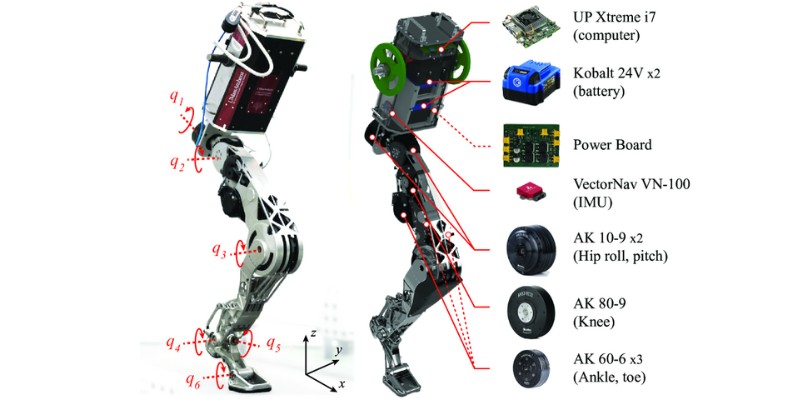
In the case of the single-legged robot StaccaToe, the AK80-9 KV100 V3.0 actuator used in its knee joint delivers high torque output and responsiveness, providing robust power support for the robot on complex terrain while maintaining precise motion control. Its multi-loop control (including position, speed, torque, and MIT hybrid modes) and intelligent adjustment capabilities allow the knee joint to precisely adapt to various load changes when executing complex gaits and traversing obstacles, ensuring the robot' s stability and agility.
The AK10-9 V2.0 KV60 and AK60-6 V1.1 KV80 actuator used in the ankle and foot joints also offer high-precision torque control, ensuring the robot's flexibility and stability during tasks such as jumping and toe balancing.
Key Parameters
Model | Motor Dimensions | Motor Weight | Peak Torque | No-Load Speed |
Ф98*38.5mm | 480g | 22Nm | 570rpm | |
Ф98*61.7mm | 960g | 48Nm | 320rpm | |
Ф79*39.5mm | 368g | 9Nm | 320rpm |
Compared to legged robots, wheeled robots rely more on sustained torque output and transmission system efficiency than on high dynamic joint torque.
Wheeled robots typically operate on relatively flat surfaces, with primary tasks including rapid movement, precise positioning, and efficient task execution. Although they require less terrain adaptability than legged robots, the demands of high-speed mobility and agile steering still necessitate precise motor systems and advanced drive control.
Therefore, when selecting motors for wheeled robots, it is essential to choose power systems capable of providing high torque output, high energy efficiency, and precise control.
High Torque Output and High Efficiency
High Torque Output
Wheeled robots require strong torque performance during startup, acceleration, and load variations (such as material handling or slope climbing). A common solution is to use BLDC motors combined with planetary gearboxes, which significantly amplify output torque while maintaining fast response. This configuration ensures stable and continuous torque output at low speeds, allowing the robot to maintain reliable motion performance and stability even under heavy loads or long-duration operation.
High Efficiency
Wheeled robots often operate continuously for extended periods, making system efficiency a critical factor in overall endurance. By utilizing high-efficiency BLDC motors combined with FOC (Field-Oriented Control) algorithms, electrical losses and heat generation can be effectively reduced. In addition, the brushless design minimizes mechanical friction, improving energy conversion efficiency. In real-world applications, this not only extends battery life but also enhances system reliability, meeting the demands of logistics, warehousing, and industrial automation for high-efficiency operation.
Differential Drive and Omnidirectional Drive
When selecting motors, wheeled robots typically adopt differential or omnidirectional drive systems to enhance mobility and control precision:
Differential Drive System
By controlling the speed difference between the left and right wheels, the robot can achieve steering and speed adjustment. This approach is simple, efficient, and widely used in applications requiring stability and straightforward control.
Omnidirectional Drive System
Using multiple omnidirectional wheels, robots can move smoothly in any direction. This is ideal for applications requiring high maneuverability in confined spaces or precise positioning.
Efficient Drive Systems and Control
To improve overall efficiency and ensure long-term stable operation, wheeled robots rely on efficient drive systems and intelligent motor control. These systems can dynamically adjust motor output based on task requirements, while minimizing energy consumption through precise control. By accurately regulating torque and speed, wheeled robots are able to perform tasks smoothly and efficiently across a wide range of applications.
Practical Application
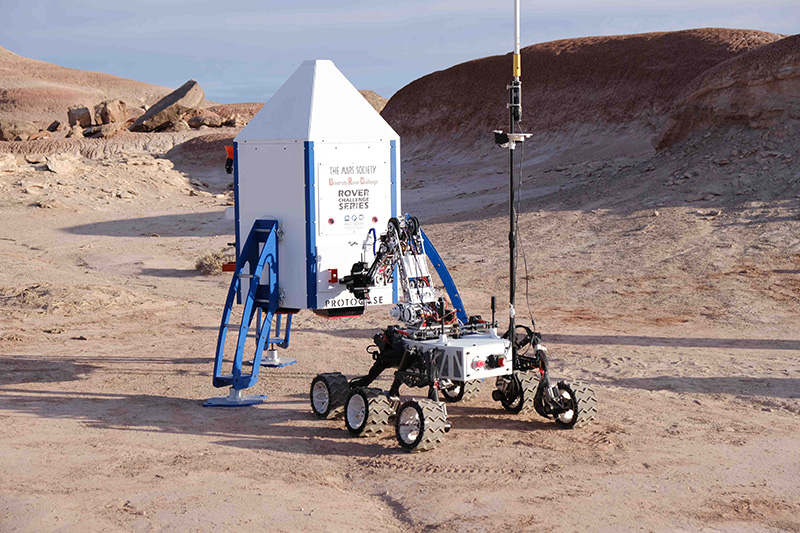
In the 2024 University Rover Challenge (URC), the TMR team adopted CubeMars' AK70-10 KV100 actuator, which meets the key requirements of wheeled robots for high torque, high energy efficiency, and precise control. This ensured the robot maintained stability and efficiency during long-duration, high-load missions, thereby enhancing the rover’s responsiveness and operational performance.
Key Parameters
Model | Motor Dimensions | Motor Weight | Peak Torque | No-Load Speed |
Ф89*50.25mm | 521g | 24.8Nm | 480rpm |
Terrain Adaptability and Flexibility
The key advantage of legged robots lies in their exceptional ability to adapt to complex terrains. They can easily traverse stairs, uneven surfaces, and obstacles, making them highly suitable for challenging environments such as disaster response and military reconnaissance.
Motor and Control System Optimization
By leveraging high-efficiency actuation systems and advanced control algorithms, legged robots can significantly improve motion stability while optimizing energy consumption. This is particularly critical for long-duration missions such as search-and-rescue operations and field reconnaissance.
Application
Disaster Response: Capable of navigating through debris and accessing hard-to-reach areas to locate survivors
Military Reconnaissance: Able to operate in rugged terrains and perform complex scouting tasks
Efficiency and Stability
Wheeled robots excel in flat environments, offering high speed and operational efficiency. They are widely used in industrial automation, warehouse management, and material handling applications.
Motor Selection and Performance
Wheeled robots typically utilize BLDC motors and actuators, which are known for their high efficiency, low noise, and long service life. These characteristics make them ideal for applications requiring continuous and stable operation.
Application
Automated Warehousing: Efficiently transport goods and improve overall operational productivity
Material Handling: Enable fast and precise transport in factories and logistics centers
The choice between legged and wheeled robots depends on several key factors:
Terrain Requirements: Legged robots are better suited for uneven terrain and obstacle-rich environments
Speed and Energy Efficiency: Wheeled robots are ideal for high-speed, energy-efficient operations on flat surfaces
Budget and Maintenance Costs: Legged robots typically involve higher initial investment and maintenance complexity, while wheeled robots offer a more cost-effective solution
The choice between legged and wheeled robots ultimately comes down to balancing application requirements and performance priorities.
Legged robots excel in complex terrains and scenarios requiring high flexibility and precise motion control, while wheeled robots offer superior efficiency and cost-effectiveness in structured environments. At the same time, motor selection plays a critical role as the core of the drive system, directly impacting overall performance and system stability. Achieving the optimal design requires a careful integration of robot architecture and motor systems, ensuring the best balance between performance, efficiency, and cost.


