Create your CubeMars account

In the field of robotics, selecting a drive solution is rarely about "choosing a motor" alone; it is more about finding a balance among torque density, dynamic control, structural integration, efficiency, and engineering complexity.
Therefore, when designing a high-performance robotic system, it is often accompanied by a key question:
How can high torque be achieved without sacrificing control performance, efficiency, or system simplicity?
At first glance, the answer may seem straightforward—choose a more powerful motor or add a gearbox. However, in real-world applications, high torque in robotics is not determined by a single component. Instead, it is the result of a carefully optimized trade-off between motor architecture, transmission design, and control strategy.
In modern robotic systems, high-torque actuation does not rely on one specific type of motor, but is built through system-level integration across different solution architectures.
Frameless motors, with their high torque density and flexible integration capability, are widely used as a key component in high-performance custom actuation systems. Based on this foundation, engineers can select different actuation architectures depending on system requirements:
Frameless motors (as the core component for custom designs)
QDD motors (low gear ratio, highly transparent integrated solutions)
Integrated actuators with reduction mechanisms (complete, plug-and-play systems)
Each approach represents a different level of system integration, achieving different balances between torque density, dynamic response, engineering complexity, and cost.
This article will break down how these technologies work—and more importantly, help you understand when to choose each solution.
Before comparing different motor types, it is important to understand a key principle:
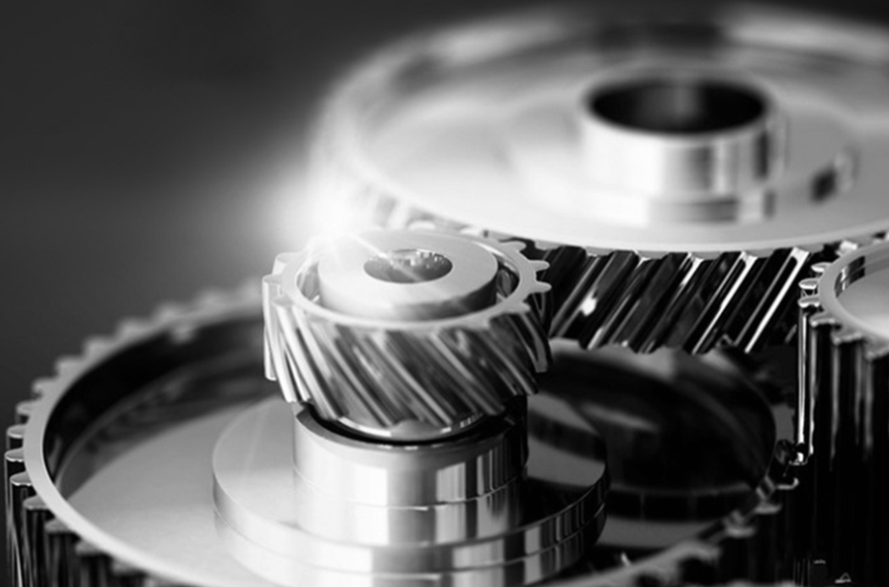
Torque in robotics is not an independent parameter—it is the result of system-level design decisions. Motor selection does not only determine how much torque a joint can output; it also directly affects a robot’s responsiveness, safety, efficiency, and mechanical complexity.
Before evaluating QDD, frameless motors, or integrated actuator solutions, we first need to clarify what "high torque" actually means in a system context.
Why "More Torque" Is Not Just a Bigger Motor
In robotics, "high torque" is often misunderstood as simply using a more powerful motor. In reality, torque output is not determined by the motor alone, but by the entire actuation architecture, including motor design, transmission strategy, and control approach.
For example, traditional systems typically achieve higher output torque by pairing a motor with a high-ratio gearbox. However, high reduction ratios can introduce issues such as friction, backlash, and reduced dynamic responsiveness.
On the other hand, direct-drive systems eliminate the gearbox entirely. While this improves mechanical simplicity and control transparency, achieving equivalent torque requires a significantly larger and higher-power motor, creating challenges in size, weight, and thermal management.
This is why modern robotics increasingly treats torque generation as a system engineering problem rather than a simple component selection task.
The Trade-off Between Torque, Control, and Efficiency
In robotic systems, all high-torque solutions involve a three-way trade-off:
Torque output (how much force can be generated)
Control performance (precision and responsiveness of motion control)
Efficiency and losses (energy loss during transmission)
High-ratio gearbox systems maximize torque output and it typically reduces backdrivability while increasing reflected inertia.
Direct-drive systems offer the best performance in control responsiveness and smoothness but face limitations in size and cost.
It is precisely within this trade-off space that the quasi-direct drive (QDD) architecture emerged.
QDD motors introduce a moderate reduction ratio (typically 6:1–10:1), achieving a balance between torque amplification, backdrivability, and force control performance. This allows robots to maintain strong torque output while preserving backdrivability, low friction, and accurate force control.
In contrast, frameless motors take a different approach: instead of optimizing the transmission, they remove structural constraints, allowing engineers to integrate the motor directly into the system. This enables higher torque density and greater design flexibility at the system level.
Why Motor Selection Shapes the Entire Robot
Choosing between different actuation architectures—including frameless motor-based designs, QDD systems, and integrated actuators—is not just a component-level decision. It fundamentally shapes the overall robot architecture.
QDD motors influence how a robot interacts with its environment by enabling compliant control and improving human–robot safety
Frameless motor designs determine joint compactness and integration depth
Integrated actuators significantly affect system complexity, reliability, and deployment efficiency by combining motor, gearbox, driver, and sensing into one unit
For example, QDD systems distribute torque generation between the motor and a low-ratio transmission, balancing responsiveness with engineering practicality.
Frameless motors, consisting only of stator and rotor, must be fully embedded into the mechanical structure. This requires engineers to design the housing, bearings, and thermal pathways from the ground up.
This makes it clear that motor selection is tightly coupled with mechanical design, control strategy, and even the overall cost structure of the product.
After understanding the system-level nature of torque, the next step is to compare the three dominant actuation approaches in modern robotics.
Although QDD systems, frameless motor-based designs, and gearbox-based integrated actuators can all deliver high torque, they differ significantly in how torque is generated, transmitted, and controlled. These differences directly impact robot performance, integration complexity, and overall system cost.
The table below provides a high-level comparison to help quickly identify the strengths and trade-offs of each approach.
Actuation Architecture Comparison
| Design Path | Typical Implementation | Key Characteristics | Suitable Applications |
| Frameless motor-based design | Frameless motor + custom mechanical structure | Extremely high torque density, maximum integration flexibility, high development complexity | High-performance robotic joints, humanoid robots |
| QDD architecture | Low reduction ratio actuator (6–10:1) | Balanced torque and control, backdrivable, fast response | Quadrupeds, humanoids, exoskeletons |
| High reduction integrated actuator | Integrated actuator with gearbox (10:1+) | High torque output, mature structure, easy deployment | Industrial robots, automation equipment |
While the table provides a clear comparison, the real decision lies in balancing three competing factors: performance, cost, and engineering complexity.
Frameless motor-based solutions offer the highest structural integration freedom. By embedding the motor directly into the mechanical system, engineers can optimize torque density and structural layout for specific applications. However, this comes with significantly higher design complexity and system-level engineering requirements.
QDD motors sit at the balance point between performance and practicality. With a low reduction ratio design, they maintain strong torque output while preserving responsiveness and backdrivability, making them suitable for applications requiring interaction quality, compliance, and efficiency.
Integrated actuator systems represent a highly consolidated solution for high-performance robotics. By tightly integrating the motor, gearbox, and drive system, they ensure strong torque output and stable control performance while significantly improving system consistency and engineering reliability.
This is also why robotics does not have a single “best” solution—each architecture exists to solve a different engineering problem.
Which One Fits Your Application?
At this stage, it is tempting to look for a "best" solution. But in robotics, the more important question is:
What is the core problem you are trying to solve?
If the system requires backdrivability, force control, or dynamic interaction performance, QDD architecture is usually the better fit.
If the goal is a highly compact design with maximum mechanical customization, a frameless motor-based actuator provides greater integration freedom.
If the priority is engineering reliability, development efficiency, and scalable deployment, integrated actuator solutions are typically more practical.
Although frameless motors offer high torque density and strong integration flexibility, it is important to clarify one key point:
They are not a complete actuation solution on their own.
In most robotic joint applications, frameless motors must be combined with a transmission system (such as harmonic or planetary gearboxes) to achieve the required torque output and control performance.
This means frameless motors should be understood as a core component within an actuation system, rather than a standalone solution.
Unlike complete actuator solutions such as QDD architectures or integrated actuators, frameless motors are designed to be embedded directly into mechanical structures, enabling engineers to fully optimize system layout, transmission paths, and thermal management.
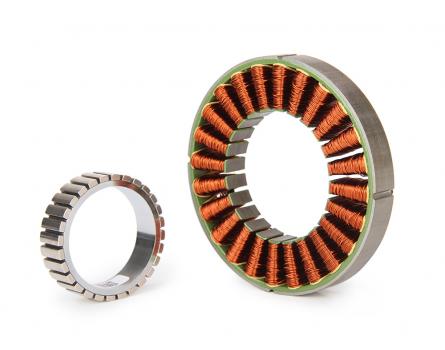
What Does "Frameless" Actually Mean? (Rotor + Stator Only)
A frameless motor consists of only two core components:
Stator (stationary electromagnetic coils)
Rotor (rotating magnetic element)
It does not include a housing, bearings, or output shaft.
This minimalist structure allows the motor to be directly integrated into mechanical systems, such as robotic joints or high-performance actuation modules.
For this reason, frameless motors are often referred to as embedded torque motors, emphasizing their role as a subsystem component rather than a standalone actuator.
Key Advantage: High Torque Density and Integration Freedom
The main advantage of frameless motors is their ability to deliver extremely high torque density within a very compact structure.
By removing the housing and standardized mechanical enclosure, engineers can:
Maximize joint space utilization
Reduce overall system weight
Achieve highly compact and efficient actuation designs
In addition, frameless motors provide a high degree of design freedom, allowing engineers to:
Customize shafts and mounting structures
Integrate bearings directly into the mechanical system
Optimize around specific load paths and force directions
This level of flexibility becomes especially important in applications where space, weight, and performance are all tightly constrained.
Typical Application Scenarios
A frameless motor is not a complete drive system, but a foundational component used to build high-performance actuators. Its actual performance depends heavily on the overall transmission and control design. Typical applications include:
Humanoid robot joints
High-performance robotic actuation joints
Exoskeletons and wearable robotics
High-precision gimbals and force-control systems
In these scenarios, system performance is determined by full-system optimization rather than the motor alone.
Engineering Use: Enabling Custom Actuator Design
In practice, frameless motors are best suited for projects that involve designing actuation systems from the ground up, rather than using off-the-shelf actuators.
To support this, manufacturers often provide frameless motor series optimized for integration.
For example, CubeMars frameless inrunner torque motors are designed with the following characteristics:
High torque output in compact structures
Flexible mechanical integration support
Suitable for custom robotic joint actuator design
Explore frameless motor solutions: RI Series Frameless Inrunner Torque Motor
This type of solution is best suited for engineering teams with system-level design capability, aiming to balance high performance with structural optimization.
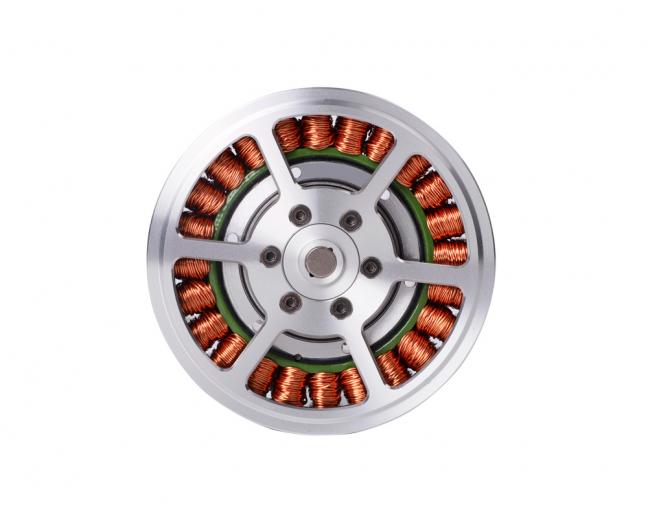
Among the different design paths for high-torque robotic actuation systems, the Quasi-Direct Drive (QDD) architecture has gained wide adoption in recent years. It is especially suited for applications that require both strong torque output and high dynamic control performance.
QDD motors sit between high-ratio gearbox systems and true direct-drive solutions. By introducing a low reduction ratio, they balance torque amplification with system responsiveness, making them a practical compromise between performance and engineering feasibility.
How QDD Works (Low Gear Ratio + Torque Amplification)
A QDD motor typically consists of a high-performance brushless motor paired with a low-ratio gearbox, usually in the range of 6:1 to 10:1.
Unlike traditional high-ratio systems, this design reduces friction and inertia introduced by the transmission system while still providing meaningful torque amplification. As a result, it achieves a more balanced trade-off between responsiveness and efficiency.
The core idea of QDD is simple: instead of relying heavily on high gear reduction, the motor and transmission jointly contribute to torque generation.This leads to:
Improved dynamic response
Lower transmission losses
More predictable and controllable torque behavior
Key Advantages: Backdrivability, Efficiency, and Force Control
One of the most important characteristics of QDD systems is backdrivability—the ability for external forces to drive the actuator in reverse.
This property is particularly valuable in modern robotics, especially for:
Human–robot interaction
Legged and humanoid locomotion
Force-based manipulation tasks
Because of the low reduction ratio, QDD motors typically offer:
Low friction and low backlash
High torque transparency for control systems
Better energy efficiency compared to high-ratio gearbox systems
At the same time, low gear ratio architectures can also reduce the system’s reflected inertia, thereby improving a robot’s force control capability and motion response performance in dynamic interactions.
These characteristics make QDD especially suitable for robots that need safe, dynamic interaction with their environment.
Typical Application Scenarios
QDD motors are widely used in applications that demand both dynamic performance and compliant control, such as:
Quadruped and humanoid robots
Exoskeleton systems
Collaborative robots (cobots)
Engineering Implementation: From Discrete Parts to Integrated QDD Modules
In real-world engineering, building a QDD actuator from scratch involves multiple steps, including motor selection, gearbox matching, encoder integration, and control tuning.
To reduce development complexity, many engineering teams now adopt integrated QDD solutions, where the motor, gearbox, and sensing system are combined into a compact module.
For example, CubeMars integrated QDD motor solutions typically feature:
Optimized matching between motor and low-ratio transmission
Compact structure with high power-to-weight performance
Reduced development time and lower integration risk
Explore QDD motor solutions: Quasi Direct Drive Motor – Higher Torque for Robot Joints
This approach allows engineering teams to focus more on system-level design and control strategy, rather than low-level actuator integration details.
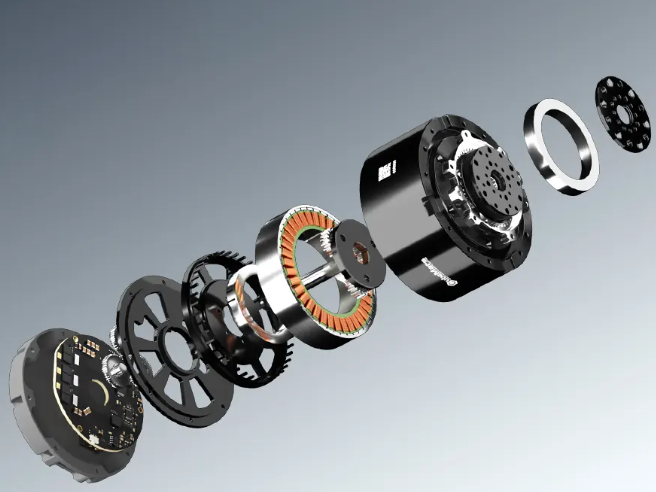
Unlike approaches that separate motors and actuation components into discrete modules, many modern robotic systems adopt an integrated actuator architecture. In this design, the motor (such as a frameless motor or inner-rotor brushless motor), gearbox, encoder, driver, and housing are combined into a single unified unit.
In this configuration, a robotic joint is no longer just a "motor + gearbox assembly," but a system-optimized actuation module. The internal power core is typically a brushless DC (BLDC) motor, paired with a reduction mechanism to achieve the required torque output and motion control performance.
Although QDD architectures and frameless motor-based designs represent higher-performance or higher-flexibility approaches, integrated actuators remain one of the most widely used solutions in current engineering practice.
The key reason is simple: they provide a more practical balance between performance, development complexity, and system reliability.
System-Level Advantages of Integrated Actuators
From a system perspective, integrated actuators offer several clear advantages:
Torque amplification through gearbox reduction, reducing demands on motor performance
Lower system design, assembly, and tuning complexity
Easier standardization and scalability for mass deployment
Rather than pushing for extreme performance, integrated actuators focus on reliability, scalability, and engineering efficiency.
Gearbox Types: Planetary vs Harmonic
Integrated actuator systems typically rely on a motor paired with a reduction gearbox. The two most common types in robotics are:
Planetary Gearbox
Compact structure with high power density and strong torque capacity
High transmission efficiency, suitable for continuous operation and high-load applications
Mature design with high reliability, widely used in industrial and mobile robotic systems
Harmonic (Strain Wave) Gearbox
Ideal for compact systems requiring high positioning accuracy
Better suited for precision transmission in space-constrained, high reduction ratio applications
The choice between these gearbox types directly affects stiffness, efficiency, and overall control performance of the actuator.
Typical Application Scenarios
Integrated actuators are commonly used in:
Industrial robots and automated production lines
Heavy-duty positioning systems
Applications requiring high stability and repeatability
In these cases, the system prioritizes stability, reliability, and long-term operational performance rather than extreme dynamic responsiveness or backdrivability.
Engineering Perspective: When to Choose Integrated Actuators
From a practical engineering standpoint, integrated actuators are often the preferred choice when:
High torque output is required, with emphasis on system stability and reliability
The application prioritizes robust, continuous operation
A mature, standardized solution is preferred over custom development
Under these conditions, integrated actuators provide a stable, reliable, and scalable foundation for robotic systems.
After comparing QDD systems, frameless motors, and integrated actuators, we now shift from theory to practical engineering decisions.
In real-world projects, the goal is not to find the "best technology," but to identify the most suitable balance between performance requirements, system constraints, and available development resources.
The following key criteria can help guide that decision.
Do You Need Backdrivability or Compliance?
One of the most important questions is: does your system need to physically interact with its environment?
If your application involves:
Human–robot interaction
Legged locomotion
Force-based manipulation
then backdrivability and compliance become critical requirements.
In these cases, QDD motors are often the preferred choice because their low reduction ratio enables:
Smooth force transmission
Lower mechanical resistance
Safer interaction with external forces
It is important to emphasize that this is not about one motor being "better," but rather about the actuation architecture being better suited for this type of control behavior.
Torque Density vs Compact Design Requirements
If your system is constrained by space, weight, or structural layout, then torque density and integration flexibility become the dominant factors.
Typical scenarios include:
Compact robotic joints
High-degree-of-freedom humanoid or dexterous robots
Systems requiring deep structural integration
In these cases, frameless motors offer clear advantages because they allow:
Direct embedding into mechanical structures
Optimized joint size and mass distribution
Greater freedom in mechanical design
However, it is important to remember that a frameless motor is not a complete actuation solution. Its performance depends on the full system design, including transmission selection and control strategy.
Cost, Development Time, and Engineering Complexity
In many projects, final decisions are driven not by performance alone, but by resource constraints.
If the priority is:
Faster development and deployment
System stability and reduced engineering risk
Standardization and maintainability
then integrated actuator solutions are often preferred because they:
Significantly reduce system integration complexity
Minimize tuning and matching effort
Provide higher consistency and reliability
From a system perspective, these solutions typically reduce overall development cost—not just hardware cost, but engineering time and integration effort.
Level of Control Over Mechanical Architecture
Another key factor is how much control your team has over the mechanical design and integration process. Different actuation paths place very different demands on system design capability.
If you are developing a highly customized robotic system and have full mechanical design and validation capability, frameless motors can be used as core components to maximize structural freedom and optimization potential
If you prefer modular development or rapid integration, you will typically choose mature actuator solutions such as integrated actuators or QDD-based modules to reduce design and tuning complexity
This decision is usually determined by:
The team's mechanical and system integration capability
Available development timeline
Project complexity and risk tolerance
To simplify the selection process, you can quickly narrow down the appropriate actuation architecture based on a few key system requirements:
When Your System Prioritizes Dynamics and Interaction
You will typically lean toward a low reduction-ratio architecture such as QDD when you need:
→ Strong backdrivability
→ Dynamic motion capability and force control performance
→ A balance between responsiveness and torque outputIn this case, the focus is not maximum torque, but controllability and safe physical interaction.
When Your System Is Constrained by Space or Requires Deep Customization
You may consider using frameless motors as the core component when you need:
→ Maximum possible torque density
→ Full freedom in mechanical design and structure
→ Deep integration within compact joint architectures
It is important to note that frameless motors are not a complete actuation solution. They typically require co-design with gearboxes and control systems to form a fully functional drive system.
When Your Project Prioritizes Engineering Efficiency and Deployment
You will usually prefer integrated actuator solutions when you need:
→ Reduced system design and integration complexity
→ Shorter development and tuning cycles
→ A mature, stable, and repeatable actuation unit
From a system perspective, this approach helps reduce overall engineering cost and project risk—not just hardware complexity, but also development effort.
Engineering Conclusion
Ultimately, there is no universal "best" solution for robotic actuation.
A more rational decision process is:
→ First define system constraints (performance / structure / cost / development resources)
→ Then select the actuation architecture that best fits those constraintsRather than choosing based on a specific technology or product category, the decision should always be driven by system-level requirements.
Application-Based Recommendation Table
To make selection more practical, the table below maps typical application needs to suitable actuation architectures and representative solutions:
| Application Requirement | Recommended Solution | Example Model | Reason |
| Dynamic motion & human–robot interaction | QDD motor | AKE80-8 KV30 | Low reduction ratio + high backdrivability, suitable for force control and safe interaction |
| Legged robots / humanoid robots | QDD motor | AKE90-8 KV35 | Fast dynamic response with balanced torque and control performance |
| Compact robotic joints | Frameless motor solution | RI80 V2.0 KV75 | High torque density with compact structural integration capability |
| Industrial / high-load systems | Integrated actuator | Planetary integrated actuator system | Mature and reliable, optimized for torque output and stability |
These examples are for reference only. Final selection must always be validated against real application constraints, including mechanical limitations and system-level design factors.
For teams aiming to further optimize system design, integrated actuation solutions from CubeMars can also be considered, including QDD and frameless motor solutions tailored for different robotic applications.
Selecting a high-torque motor for robotics is not simply a parameter comparison task. The key is choosing the right actuation architecture for the application.
QDD systems, frameless motors, and integrated actuators each represent different trade-offs between performance, integration complexity, and cost. The right choice should always be made in the context of the full system design.
Rather than searching for a single "optimal solution," the real goal is alignment with application needs—covering dynamic performance, mechanical constraints, and available development resources. The most effective solution is the one that achieves system-level balance, not just superiority in a single metric.