Create your CubeMars account

With the continuous development of robotics technology, robotic actuators are no longer just simple power output components. Instead, they are gradually becoming one of the core systems that determine overall robot performance. Especially in next-generation robotic applications such as humanoid robots, collaborative robotic arms, quadruped robots, and exoskeleton devices, engineers are placing increasingly higher demands on actuators.
In the past, robotic systems focused more on pure torque output and motion capability. Today, however, robot development places much greater emphasis on system integration, structural compactness, dynamic response capability, and long-term operational stability. Actuators are required not only to provide sufficient power, but also to balance size, weight, control precision, and overall mechanical layout.
As robotic systems continue to demand higher levels of structural integration and improved internal cable routing capabilities, hollow shaft planetary actuators are increasingly being adopted in certain highly integrated robotic joint applications.
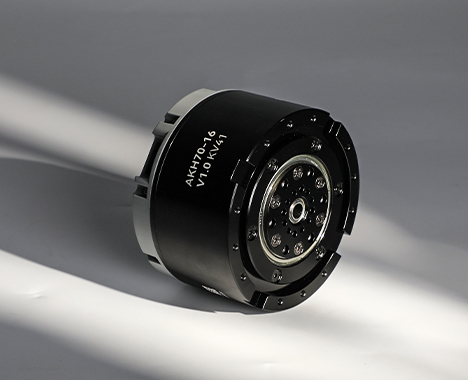
A hollow shaft planetary actuator is typically a highly integrated power system that combines a motor, planetary gear reduction mechanism, encoder, and drive control system into a single platform, forming a more compact integrated structure.
Through the load-sharing mechanism of the sun gear, planetary gears, and internal ring gear, the system is capable of achieving high torque output within a compact volume while maintaining transmission efficiency, structural compactness, and good dynamic response characteristics.
Its most important structural feature is the hollow shaft design. This structure allows cables, signal wires, sensor lines, and even partial mechanical connections to pass directly through the center of the actuator without requiring external routing or additional space allocation. This gives robotic joints greater design freedom and provides a better internal wiring solution for complex multi-degree-of-freedom systems.
In robotic joint design, traditional drive solutions usually adopt a “motor + planetary gearbox + encoder + driver” separated architecture. This configuration was commonly used in early industrial robots and offers flexibility in modularity and ease of maintenance. However, in modern high-integration robotic systems, its limitations are becoming increasingly evident.
First, at the structural level, separated architectures require dedicated space for each functional module. This makes the overall joint structure more complex and increases internal wiring difficulty. As the number of degrees of freedom increases, this distributed layout further compresses available space and limits compact structural design.
Second, in terms of system integration, multi-component architectures introduce more mechanical and electrical connection points. This not only increases assembly complexity but also increases the number of potential failure points, affecting long-term reliability.
In contrast, hollow shaft planetary actuators adopt an integrated design, combining the motor, gearbox, and control system into a single structure. The hollow shaft allows internal cable routing through the center. This significantly reduces external connections, resulting in higher space utilization and a more compact structure while maintaining strong torque output capability.
In addition, due to the reduction of additional connecting components and separated mounting structures, the integrated design generally helps improve system integration consistency and reduces assembly errors as well as certain transmission losses, thereby enhancing overall control stability and engineering reliability.
Therefore, in robotic applications that require high space efficiency, system integration, and dynamic performance, hollow shaft planetary actuators are becoming a more advantageous engineering solution.
Category | Traditional Separated Drive | Hollow Shaft Integrated Actuator |
Structure | Separated modular architecture | Highly integrated structure |
Space Utilization | More external wiring | Better internal cable routing |
Integration Difficulty | Relatively high | Relatively lower |
System Consistency | Depends on assembly and matching | Easier to standardize |
Typical Features | Flexible and easy to maintain | Compact and highly integrated |
As robotics moves toward lightweight and high integration, mechanical design is becoming increasingly complex. Engineers must consider not only power output but also sensor layout, cable management, and overall structural coordination.
Especially in humanoid robots and collaborative robots, complex internal wiring often affects structural design, assembly efficiency, and maintenance. The hollow shaft structure helps engineers better organize internal space, making the joint structure cleaner and reducing issues such as cable twisting or interference during motion.
At the same time, hollow shaft design is better aligned with the modular design requirements of modern robotics. Engineers can more easily achieve joint integration, rapid assembly, and later maintenance, thereby shortening overall development cycles.
CubeMars’ AKH series hollow planetary actuators adopt an integrated hollow shaft design philosophy. While ensuring compact structure, they also provide more flexible internal routing space for robotic joint systems, making them suitable for high-integration robotic development.
In robotics, the role of a gearbox is not only to reduce speed, but more importantly to increase torque output and optimize the motion characteristics of the entire power system.
Compared with conventional gear structures, planetary gear systems offer higher integration efficiency. Through the sun gear, planetary gears, and ring gear sharing the load, the system can achieve high torque output within a compact volume.
Planetary gear reduction structures are capable of achieving high torque output within a relatively compact volume while maintaining efficiency, structural maturity, and engineering reliability, and are therefore widely used in robotic joint systems.
In addition, planetary gear systems offer excellent load distribution capabilities. In robotics applications involving frequent starts and stops, high dynamic motion, and complex trajectory control, gear systems must handle continuously changing loads. Compared to traditional structures, planetary gear systems generally provide more stable transmission performance and longer service life.
For example, the CubeMars AKH70-48 V1.0 KV41 adopts a higher reduction ratio design, making it more suitable for high-torque robotic joint applications. The AKH70-16 V1.0 KV41, on the other hand, offers a better balance between output speed and dynamic response, making it suitable for medium-to-light load robotic systems.
Key parameters
Model | Rated Torque (Nm) | Rated Speed (RPM) | Size (Diameter × Thickness, mm) |
74 | 28 | φ90*81.5 | |
26 | 90 | φ90*60.5 |
Currently, hollow shaft planetary actuators are widely used in multiple robotic fields, and their application scope continues to expand as robotics moves toward higher integration and dynamic performance.
Humanoid robots
In humanoid robots, joint space is extremely limited, and structural compactness is critical.
Hollow shaft planetary actuators integrate motor and gearbox systems while using the hollow shaft for internal routing. This allows vision, sensor, and power cables to pass through the joint center.
This design significantly reduces external wiring interference and improves structural freedom and maintainability, enabling more stable and natural motion in humanoid robots.
Collaborative robotic arms
In collaborative robot applications, both safety and structural simplicity are important.
Hollow shaft actuators reduce external transmission and wiring structures, making robotic arm joints more compact and improving overall rigidity and integration.
At the same time, reduced structural complexity helps lower maintenance difficulty and improves long-term system reliability, especially in industrial assembly, flexible manufacturing, and human-robot collaboration scenarios.
Quadruped robots
Quadruped robots require high dynamic response and torque density, especially during running, jumping, or complex terrain movement.
Hollow shaft planetary actuators, due to their high level of integration and compact structure, are more conducive to optimizing the spatial layout and powertrain design of robotic joints, thereby helping to improve system dynamic performance and motion stability.
Exoskeleton devices
In exoskeleton applications, wearer comfort and lightweight design are critical.
The hollow shaft design allows cables and control signals to pass through the joint center, reducing external interference structures and making the device better aligned with human motion trajectories.
Its high torque density also supports applications such as assisted walking and load-bearing assistance.
AGV and industrial automation systems
In automated guided vehicles (AGVs) and industrial automation equipment, systems often require high-reliability drive solutions within limited space.
Hollow shaft planetary actuators use modular integrated design, reducing installation space requirements and simplifying wiring and structural layout, thereby improving deployment efficiency and system stability.
The development of robotics technology is driving actuators to evolve from traditional power components into highly integrated joint systems.
Compared with traditional separated drive systems, hollow shaft planetary actuators not only provide higher system integration but also offer advantages in structural design, power output, and space utilization.
As the markets for humanoid robots, intelligent mobile robots, and collaborative robots continue to expand, hollow shaft planetary actuators are becoming an increasingly common joint actuation solution in robotic systems that demand higher levels of structural integration, internal cable routing, and spatial utilization efficiency.


