Create your CubeMars account

Conventional robotic drive systems are typically composed of multiple functional modules, including the motor itself, an external driver, an encoder, and a reducer. These components are connected through electrical connections and mechanical structures to form a complete actuation unit.
In practical engineering, this architecture offers high flexibility. Engineers can select motors, reducers, and controllers of different specifications based on specific requirements, enabling customized system design.
However, this flexibility also brings higher system complexity. Parameters such as motor characteristics, gear ratios, driver current capacity, and encoder feedback accuracy must be carefully matched across the system. At the same time, the control system must complete the tuning of current loops, speed loops, and position loops.
Essentially, this is a typical systems engineering problem, requiring strong expertise in motor control and system integration.
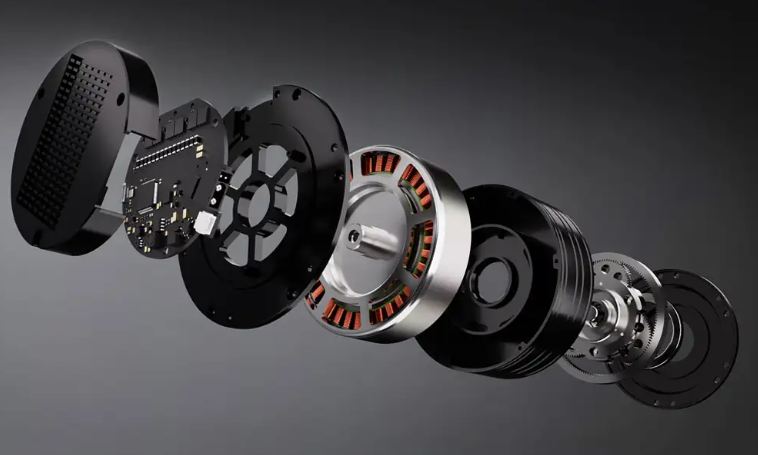
An integrated electric actuator is a mechatronic actuation unit that integrates the motor, driver, encoder, and reducer into a single structure, and is widely used in robotics and intelligent motion control systems.
A typical integrated actuator usually consists of the following core modules:
Brushless DC motor (BLDC)
Integrated drive unit (supporting FOC control)
High-resolution position feedback system (encoder)
Planetary or harmonic reducer (optional depending on application requirements)
Such products connect to upper-level control systems through standard communication interfaces (such as CAN, RS485, or EtherCAT), enabling modular integration into robotic motion systems for rapid deployment and flexible application.
Compared with conventional separated drive solutions, integrated actuators complete the matching and optimization of the motor, drive, and transmission system at the product design stage, thereby significantly reducing system integration and debugging complexity on the user side while improving overall motion control consistency and reliability.
Reduced System Integration Complexity
In conventional architectures, engineers need to complete motor selection, driver matching, encoder configuration, and control parameter tuning. This process is not only time-consuming but also highly dependent on experience.
Integrated actuators complete system-level optimization at the factory stage, eliminating the need for users to handle underlying matching issues. Engineers only need to send control commands via communication interfaces to achieve position, speed, or torque control.
This approach significantly reduces system design complexity and minimizes performance issues caused by parameter mismatches.
Improved Space Utilization and Power Density
In robotic systems, joint space is usually highly constrained, especially in quadruped robots, humanoid robots, and exoskeleton applications, where high torque output is required within limited space.
Integrated actuators adopt compact structural design by integrating drive and transmission systems, effectively reducing overall volume. At the same time, optimized transmission paths and structural layouts enable higher torque output within the same volume.
This high power density characteristic makes them more suitable for robot joint designs with limited space and high performance requirements.
Optimized System Performance Matching
In conventional systems, parameter mismatches may occur between components, such as mismatched motor inertia and reducer stiffness, or insufficient driver bandwidth leading to delayed control response.
Integrated actuators complete the overall optimization of the motor, electronics, and transmission system during the design stage, including control algorithm tuning and feedback system integration, ensuring coordinated operation among all modules.
In practical applications, this optimization is reflected in smoother low-speed operation, more stable dynamic response, and higher control accuracy.
Improved System Reliability
In conventional solutions, multi-component structures mean more connection interfaces and potential failure points. For example, cables, connectors, and external drivers may experience issues under vibration or long-term operation.
Integrated actuators reduce external connections and interfaces, effectively lowering system failure risks. At the same time, their integrated structure provides higher mechanical rigidity, improving stability under dynamic conditions.
This reliability advantage is particularly important in mobile robots and complex environments.
Shortened Development Cycle
In robot development, system integration and debugging often account for significant time costs. Conventional solutions require multiple stages, including selection, installation, debugging, and optimization.
Integrated actuators provide standardized modules that greatly simplify the development process. Engineers can focus more on motion control algorithms and system functionality rather than low-level drive debugging.
This advantage is especially valuable for research institutions, startups, and projects requiring rapid iteration.
Optimized Thermal Management and Service Life
Thermal management is a key factor affecting motor performance and lifespan. In conventional systems, heat sources are distributed across different components, making unified thermal design difficult.
Integrated actuators achieve centralized heat management and optimized heat dissipation paths through overall structural design. At the same time, some products are equipped with temperature monitoring and protection mechanisms, enabling power limiting or protection control under over-temperature conditions.
This system-level thermal management capability helps improve long-term operational stability and extend service life.
Quadruped Robots
Quadruped robots impose extremely high requirements on joint drive systems, including high torque density, fast dynamic response, and stable output in complex environments. Especially during jumping, running, and movement over complex terrain, joint actuators must not only provide continuous output but also maintain precise control under instantaneous load changes.
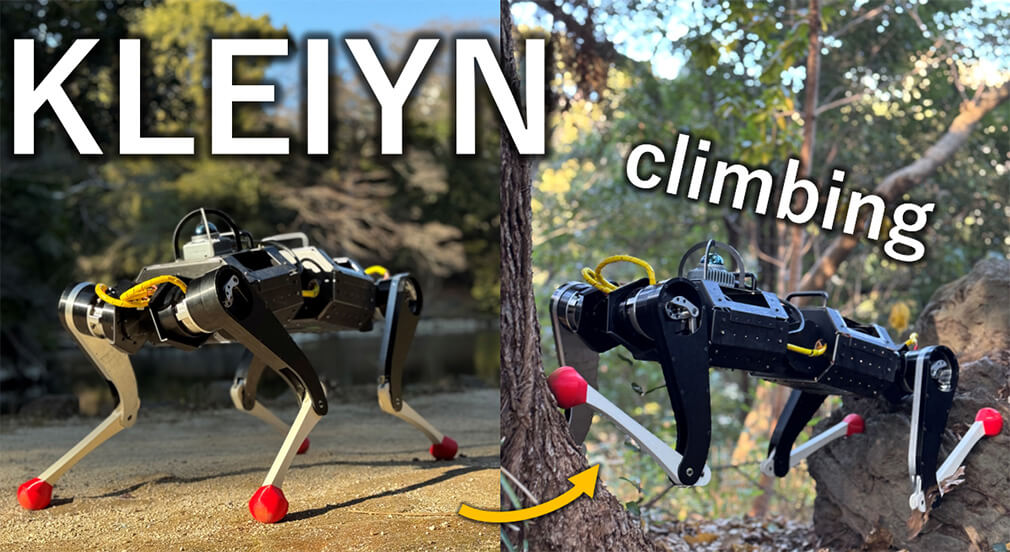
In practical applications, integrated electric actuators have become a mainstream solution for quadruped robot joint drives. For example, the second-generation quadruped robot Kleiyn developed by the JSK Laboratory of the University of Tokyo demonstrates the advantages of this technical approach in complex environments. The robot can not only walk stably on uneven terrain but also achieve high-speed and stable “chimney climbing,” showcasing the expansion from planar motion to three-dimensional movement.
In its drive system:
The leg joints use AK70-10 KV100 actuators, with a maximum torque of 24.8 Nm, meeting the fast response requirements in high-frequency motion
The waist joint uses the AK10-9 V2.0 KV60 actuator, with a maximum torque of 48 Nm, providing stable support and high load capacity for the torso
With high torque output, low latency response, and quasi-direct drive characteristics, these integrated electric actuators maintain smoothness and stability under high dynamic and high-load conditions.
Model | Motor Size | Motor Weight | Peak Torque | No-load Speed |
Ф89*50.25mm | 521g | 24.8Nm | 480rpm | |
Ф98*61.7mm | 960g | 48Nm | 320rpm |
Humanoid Robots
In humanoid robot systems, joint space is highly constrained, while multi-degree-of-freedom coordinated control is required, placing higher demands on actuator size, performance, and control precision.
Integrated electric actuators integrate the motor, drive, and transmission system into a compact structure, enabling sufficient torque output within limited space. At the same time, high-resolution encoders and optimized control algorithms enable precise control of complex motions.
In practical applications, these actuators not only support basic joint movements but also enable more complex dynamic behaviors such as balance control, gait switching, and human-robot interaction.
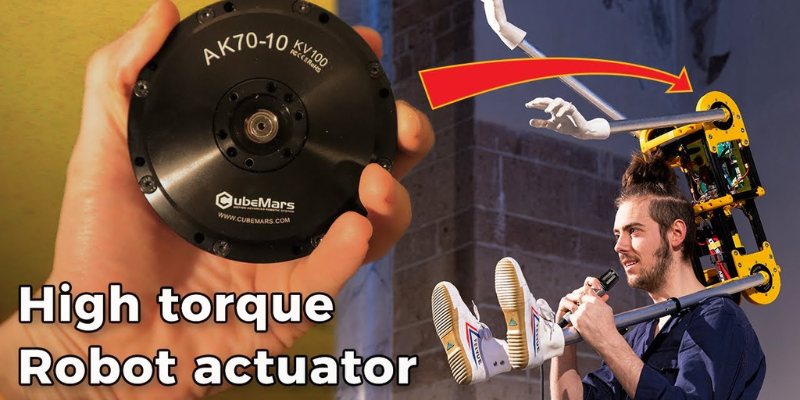
For example, artist Daniel Simu will bring his robot Robin to the stage to perform a collaborative dance with humans. Such applications not only require motion precision but also emphasize smoothness and expressiveness.
In this project, the robot uses CubeMars AK series actuators as the core drive units. This series of actuators is known for low backlash and high precision, performing well in applications requiring precise positioning and smooth operation, and features a highly integrated design with dual encoder feedback, supporting both servo control and MIT control modes.
AK Series Robotic Actuator – Highly Integrated for Robotics
Exoskeleton Systems
Exoskeleton systems impose different requirements on actuators compared to traditional robots, including lightweight design, safety, and smooth torque output to ensure natural human-machine interaction.
The AI-driven lower-limb exoskeleton system developed by Georgia Tech, Stanford University, and the University of Pennsylvania is a typical application case of integrated electric actuators in this field. The system has been published in Science Advances and has demonstrated significant improvements in human walking efficiency in real-world environments.
The system uses CubeMars AK80-9 KV100 actuators as core drive units, with key parameters as follows:
Model | Motor Size | Motor Weight | Peak Torque | No-load Speed |
Ф98*38.5mm | 480g | 22Nm | 570rpm |
The actuator effectively reduces the self-weight energy consumption of the exoskeleton system through high torque density and lightweight design. At the same time, its integrated structure combines a brushless motor, planetary reducer, and drive module to achieve smooth and efficient torque output.
At the control level, the system supports switching between servo control and MIT control modes, and features one-click parameter identification and adaptive tuning capabilities, significantly simplifying the debugging process and improving control accuracy. This is particularly critical for wearable devices requiring high dynamic response and precise torque control.
In practical robotic applications, different scenarios impose significantly different requirements on drive systems. Whether it is high dynamic joint control in quadruped robots, lightweight and precise torque output in exoskeleton systems, or high reliability and long-term stability in industrial environments, standardized products often cannot fully meet all requirements.
CubeMars leverages years of technical expertise in robotic motors to continuously provide customized drive solutions for various robotic applications. The company focuses on the research, development, and manufacturing of robotic motors, with full capabilities from motor design to integrated actuator development, enabling targeted optimization of torque output, structural dimensions, control methods, and interface forms based on project requirements.
Currently, CubeMars has provided customized robotic motor services to more than 1,600 companies worldwide and has established partnerships with over 1,000 robotics companies and research institutions. Its products are widely used in industrial automation, humanoid robots, exoskeleton systems, medical robots, and wheeled robots, delivering reliable robotic power solutions for various applications.
Through customized services, engineering teams can gain greater flexibility at the system design stage, achieving better matching in performance, structure, and control, thereby improving overall system efficiency and reliability.
Integrated electric actuators achieve comprehensive optimization of drive performance, structural compactness, and control consistency at the system level by integrating motors, drivers, encoders, and reducers into a single unit.
Compared with traditional separated motor systems, they offer significant advantages in system integration, power density, dynamic response, and development efficiency, better meeting the needs of modern robotics in high dynamic control, high-precision motion, and compact structural design.
As robotics technology continues to evolve toward multi-degree-of-freedom coordination, high dynamic performance, and miniaturization, integrated actuators are becoming an important technological approach in robotic motion control systems and are increasingly widely adopted in quadruped robots, humanoid robots, exoskeleton systems, and industrial automation.


