Create your CubeMars account

Underwater robots are increasingly being used in ocean exploration, underwater inspection, scientific research, resource exploration, and engineering operations. From small remotely operated vehicles (ROVs) to autonomous underwater vehicles (AUVs), these systems need to perform tasks such as movement, turning, attitude adjustment, and precise positioning in complex underwater environments.
Compared with ground robots, underwater robots place higher demands on their power systems. The power system must not only provide sufficient propulsion, but also maintain stable operation under conditions such as continuous exposure to water, changing water pressure, limited energy, and compact installation space. At the same time, waterproofing, heat dissipation, efficiency, reliability, and precise control can all directly affect the overall motion performance of the robot.
Therefore, designing a power system for an underwater robot is not simply about increasing power output. It requires a balance between propulsion performance, energy consumption, structural size, environmental adaptability, and system reliability. This article first examines the basic requirements of underwater robot power systems, then analyzes the key challenges encountered in practical design and the corresponding solutions, before introducing underwater thruster solutions for different applications.
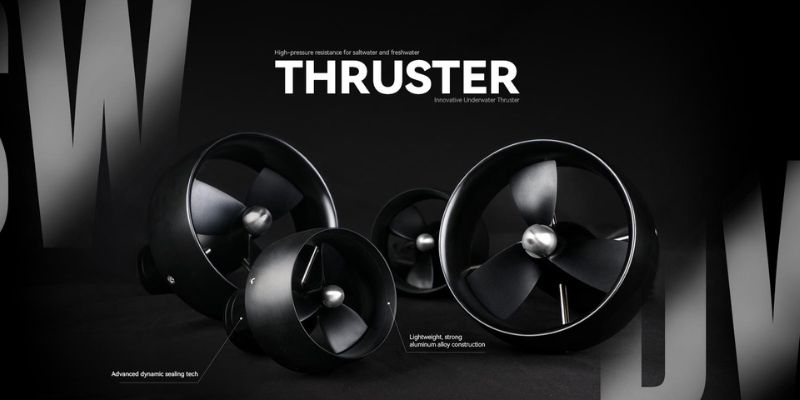
The power system of an underwater robot is not only responsible for providing propulsion, but also directly affects the robot's endurance, maneuverability, and operational stability. Different types of underwater robots vary in size, payload, and mission requirements, so their specific power requirements can also differ. From an overall design perspective, however, the following aspects are generally important considerations for engineers.
Propulsion Performance Determines Basic Motion Capability
The first consideration is propulsion performance. Underwater robots rely on thrusters to overcome their own resistance, water currents, and the effects of payloads while performing movements such as forward motion, turning, vertical movement, and attitude adjustment.
In practical designs, propulsion requirements are generally related to the following factors:
Robot weight and the equipment and payload it carries
Water currents and resistance in the operating environment
Types of movements the robot needs to perform
Number, installation positions, and thrust directions of the thrusters
Therefore, the maximum thrust should not be the only factor considered when selecting a power system. For robots that need to operate for extended periods, it is equally important to consider whether the thrusters can maintain stable output within the actual operating range and whether the motor, thruster, and overall robot load are properly matched.
Energy Efficiency Should Be Considered Alongside Propulsion Requirements
Once sufficient propulsion is available, the next question is how much energy is required to generate it. Underwater robots typically rely on batteries for power, while battery capacity is constrained by weight, size, and mission requirements. As a result, the efficiency of the power system directly affects the robot's endurance.
| Requirement | Power System Performance to Consider |
| Long-duration autonomous operation | High propulsion efficiency and low energy consumption |
| High-load operation | Stable continuous output |
| Limited battery capacity | Reasonable power consumption |
| Long-duration continuous operation | Low losses and effective thermal management |
Efficiency also affects motor temperature rise. Under the same output conditions, higher energy losses generally result in more heat generation. Therefore, for underwater power systems, efficiency is not only related to endurance, but is also closely connected to continuous operation and reliability.
Once propulsion and energy consumption have been addressed, the underwater environment itself introduces another unavoidable challenge.
Environmental Adaptability Determines Whether the Power System Can Operate Long Term
Ground robots can use housings and ventilation systems to protect their motors, while underwater robots need to operate under continuous exposure to water and, in some cases, significant external water pressure. The power system therefore needs reliable sealing, while pressure resistance must also be considered according to the target operating depth.
If the equipment is used in seawater, corrosion caused by salt must also be taken into account. For platforms designed for long-term operation, the focus should be on the environmental adaptability of the entire power system, including the long-term reliability of the motor, driver, connectors, and related mechanical structures.
Therefore, the protection design of an underwater power system needs to be based on the actual operating environment rather than simply determining suitability according to a single waterproof rating.
Compact Integration and Precise Control Affect Overall Robot Performance
In addition to output capability and environmental adaptability, the power system must also fit within the overall structure of the underwater robot. Batteries, sensors, controllers, and mission payloads often need to be integrated within limited space. As a result, motors and thrusters need to achieve a balance between size, weight, and output capability.
For underwater robots equipped with multiple thrusters, the power system also has to support more complex motion control. Different thrusters need to work together to achieve turning, lateral movement, vertical movement, and attitude adjustment. Therefore, the power system needs not only sufficient output, but also good response and speed control performance, while maintaining stable coordination with the driver and control system.
Overall, an underwater robot power system needs to balance propulsion performance, energy efficiency, environmental adaptability, structural integration, and control capability. The simultaneous presence of these requirements is also what makes underwater power system design more complex than that of conventional robotic power systems.
Compared with conventional robots, underwater power systems need to operate in a more complex environment. Continuous exposure to water, external water pressure, limited installation space, and long operating periods can cause originally independent design objectives to interact with one another. For example, stronger sealing improves water protection but may make heat dissipation more difficult, while higher output can provide greater thrust but may also increase power consumption and temperature rise.
Waterproofing and Heat Dissipation Are Often Challenges That Need to Be Solved Together
Motors generate heat during operation, while underwater power systems need sealed structures to prevent water from entering internal components. This means designers cannot focus only on improving waterproofing; they also need to determine how to effectively transfer internal heat to the outside.
Insufficient heat dissipation can lead to increased temperature rise and reduced efficiency during continuous operation, and may even affect the long-term reliability of motors and electronic components. Therefore, underwater power systems need to be designed by considering sealing structures, heat transfer paths, and motor efficiency together.
In simple terms, the relationship can be understood as:
More reliable sealing → greater thermal management requirements → higher overall design requirements
High Thrust and Compact Size Present a Natural Trade-Off
Underwater robots generally need their power systems to be as small and lightweight as possible while still providing sufficient thrust to overcome water resistance and carry mission payloads.
This trade-off is particularly apparent in compact platforms such as small ROVs and AUVs:
| Design Objective | Resulting Requirement |
| Higher thrust | Stronger electromagnetic and mechanical output |
| Smaller size | Higher power density |
| Lower weight | Higher structural integration |
| Lower power consumption | Higher motor and propulsion efficiency |
| Long operating time | Better thermal management and reliability |
Therefore, motor size should not simply be increased according to maximum output requirements. Instead, electromagnetic design, structural design, and thruster matching need to be optimized together to achieve sufficient power within a limited space.
Long-Term Exposure to Water Further Amplifies Reliability Challenges
The real challenge for an underwater power system is not simply whether it can operate in water, but whether it can operate reliably for an extended period.
A short underwater test cannot fully reflect the long-term reliability of a power system. As operating time increases, seals may be affected by aging, connection points may experience corrosion, and mechanical components such as bearings may undergo continuous wear.
Especially in seawater environments, salt can further increase the corrosion risk of metal components. Therefore, the reliability of an underwater power system needs to be considered throughout its entire lifecycle, including:
Material selection: Selecting appropriate materials and protection methods according to freshwater, seawater, and other operating environments.
Sealing structures: Ensuring effective protection is maintained after long-term operation.
Mechanical components: Reducing long-term wear of bearings, shafts, and other components.
Connection points: Maintaining stable electrical connections under continuous exposure to water.
This means that the design objective of an underwater power system should not be limited to meeting initial performance requirements, but should also consider performance retention over long-term operation.
Multi-Thruster Systems Make Motion Control More Complex
For systems using a single thruster, the control logic is relatively simple. However, in underwater robots such as ROVs that use multiple thrusters, the output of each thruster affects the motion of the entire robot.
For example, when the robot needs to turn or move laterally, the control system needs to apply different outputs to thrusters at different positions. If there are significant response differences between thrusters, the smoothness and control accuracy of the robot's movement may be affected.
Therefore, power system design also needs to consider the matching between the motor, driver, thruster, and control system. For robots that require hovering, precise positioning, or underwater operation tasks, the response speed and consistency of propulsion output can be just as important as peak thrust.
Overall, the challenges in underwater power system design are not about solving a single problem independently. Instead, designers need to address the relationships between waterproofing and heat dissipation, performance and size, short-term performance and long-term reliability, as well as propulsion output and precise control. These interconnected engineering challenges make a systematic design approach essential for underwater power systems.
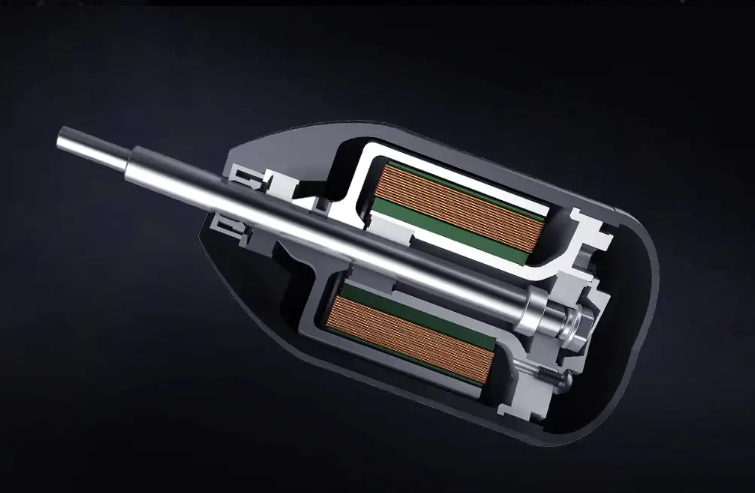
Facing complex underwater environments, power system design needs to extend beyond the motor itself to sealing structures, thermal management, material selection, and drive control. Rather than optimizing for a single issue, it is more important to ensure that different components work together to achieve a balance between performance and reliability.
Improve Waterproofing and Pressure Resistance Through Overall Structural Design
Waterproofing an underwater power system is not simply a matter of adding an outer housing. Instead, it requires a comprehensive protection structure covering the motor, driver, cables, and connection points.
Depending on the operating environment, designers can focus on the following aspects:
Sealing structures: Reduce the possibility of water entering internal components.
Connection points: Reduce the risk of cables and connectors becoming potential water ingress paths.
Housing strength: Withstand external pressure according to the target operating depth.
Internal protection: Further protect critical electronic components through methods such as potting.
Protection solutions should be adjusted according to different operating depths and environments rather than using exactly the same design for every application.
Control Temperature Rise Through Motor Efficiency and Thermal Management
Solving heat dissipation issues should not rely solely on additional cooling structures. More importantly, unnecessary energy losses should be reduced at the heat source itself.
Therefore, motor design can be optimized in the following ways:
| Design Direction | Main Function |
| Improve motor efficiency | Reduce energy losses during operation |
| Optimize electromagnetic design | Reduce losses while meeting output requirements |
| Improve heat transfer paths | Help transfer internal heat to the outside |
| Reasonably control continuous output | Avoid excessive temperature rise during long-term operation |
Water itself provides good heat transfer capabilities, but how effectively heat generated inside the motor can be transferred outward still depends on motor structure and material design. Therefore, waterproofing and heat dissipation should be considered together from the beginning of the design process.
Improve Long-Term Reliability Through Materials and Mechanical Structures
For underwater robots designed for long-term operation, it is not enough to ensure that the motor works properly when new. Materials, seals, and mechanical components need to withstand continuous exposure to water, pressure changes, and different water conditions.
Corrosion protection is particularly important in seawater environments. Proper selection of materials, surface treatments, and sealing solutions can help reduce the impact of corrosion on structures and connection components.
At the same time, moving components such as bearings and shafts also need to be designed with long-term wear in mind. Only by combining electrical protection with mechanical reliability can the service life of the power system be effectively improved.
Meet Space Constraints Through High Power Density and System Integration
When an underwater robot needs higher power within limited space, simply increasing the motor size is not an ideal solution.
A more effective approach is to consider the motor, drive system, and propulsion structure as a whole, increasing the effective output available per unit volume while minimizing additional connection and installation space.
For small underwater robots, a compact power system can also free up more space for batteries, sensors, and other mission payloads, providing greater flexibility in overall robot design.
Achieve Precise Propulsion Through the Motor, Driver, and Control System
Finally, propulsion output needs to be translated into predictable robot movement through the control system.
A complete underwater propulsion system typically involves:
Motor → Driver → Thruster → Control System → Robot Motion
If the response or matching of any component is inadequate, the final motion performance may be affected.
Therefore, in multi-thruster underwater robots, the output capability, response characteristics, and control methods of the thrusters need to be properly matched according to the robot's motion requirements, allowing multiple thrusters to work together. This system-level matching is particularly important for applications requiring hovering, precise positioning, and complex attitude control.
Overall, the solutions for underwater power systems are not based on a single technology, but consist of sealing, thermal management, materials, structural design, motors, and control systems working together. Only by designing the system according to the overall application requirements can sufficient propulsion and long-term reliability be achieved in complex underwater environments.
For underwater thrusters, these design requirements ultimately need to be implemented in specific motors and system structures. Achieving stable output within a limited size while also balancing waterproofing, heat dissipation, efficiency, and long-term reliability has therefore become a key consideration in underwater power product design.
For engineers, however, solving these design challenges is only the first step. The power system must ultimately be matched to the specific type of robot and its mission requirements. Different underwater robots vary significantly in size, operating depth, payload, and movement requirements. Therefore, power system selection should not simply be based on the principle that “more thrust is always better.” Engineers need to consider propulsion, operating depth, efficiency, size, and control requirements together.
Small Underwater Robots Prioritize Compact Size and Maneuverability
For small ROVs, AUVs, and research or educational platforms, there is usually limited internal space available for power equipment. These platforms also often need to maintain a low overall weight to minimize the impact on buoyancy and overall structural design.
Therefore, the power system needs to provide sufficient propulsion while remaining as compact and lightweight as possible. In practical selection, engineers can focus on thruster size, weight, output per unit volume, and installation method.
For small platforms using multiple thrusters, it is also important to consider whether the thruster layout can support the required forward and reverse motion, turning, vertical movement, and attitude adjustment.
ROVs Need to Balance Thrust, Maneuverability, and Operating Depth
ROVs typically use multiple thrusters to achieve underwater movement, making the power system an important factor in overall maneuverability. In addition to basic forward and reverse motion, ROVs may need to move laterally, vertically, turn, or hover at a fixed position. This requires thrusters to provide stable and controllable propulsion.
At the same time, ROVs can operate at significantly different depths. The pressure resistance requirements for shallow-water inspection and nearshore operations can be very different from those for deep-water exploration and underwater engineering. Therefore, when selecting a thruster, thrust and operating depth should be considered together rather than evaluating either one in isolation.
AUVs and Long-Duration Platforms Should Prioritize Efficiency
For AUVs and other underwater robots that need to complete missions autonomously over extended periods, power consumption directly affects overall endurance. Therefore, while meeting navigation requirements, the power system should minimize unnecessary energy consumption.
These platforms do not necessarily require the highest possible peak thrust. More importantly, the thruster should maintain high efficiency during normal cruising conditions. Long-term operating temperature, reliability, and compatibility with battery capacity should also be considered.
In other words, ROVs tend to focus more on “Can it provide sufficient propulsion?”, while AUVs often focus more on “Can it operate longer with limited energy?” Understanding this distinction makes it easier to determine the right direction for power system selection.
How CubeMars Applies These Design Principles to Underwater Thrusters
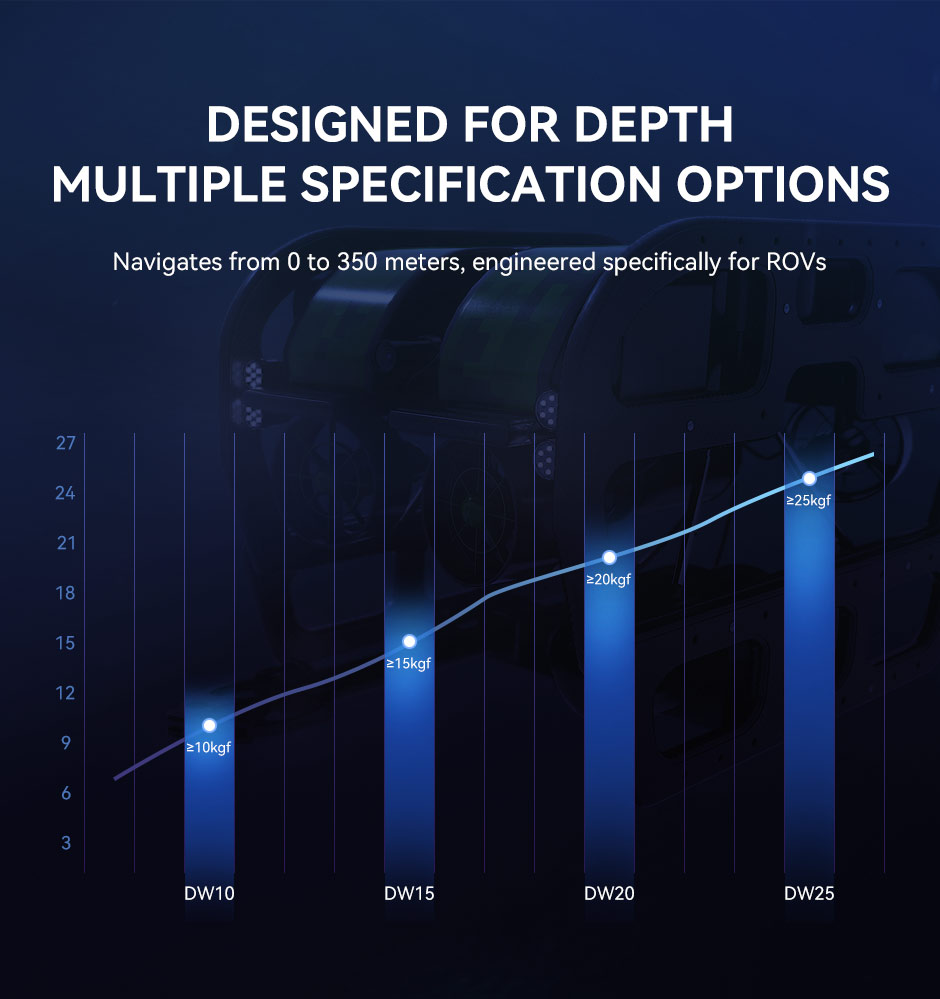
The design challenges discussed above ultimately need to be addressed in actual power products. To meet underwater robots' requirements for waterproofing, pressure resistance, efficiency, thrust, and structural integration, CubeMars incorporates these design priorities into its underwater thruster development. Through the coordinated design of motors, drive systems, sealing structures, and propulsion structures, CubeMars provides corresponding power solutions for different underwater applications.
Based on robot type, operating depth, and thrust requirements, different product series can be selected:
| Product | Design Focus | Max. Bollard Thrust | Operating Depth | Suitable Applications |
| W30 | Compact structure and system integration | ≥7.7 kgf | 0–200 m | Compact underwater platforms, lightweight ROVs |
| SW7 | Lightweight design and shallow-water applications | ≥7 kgf | 0–30 m | Small underwater robots, shallow-water platforms |
| DW10 | Thrust and deep-water adaptability | ≥10 kgf | 0–350 m | ROVs, underwater exploration platforms |
| DW25 | High thrust and deep-water applications | ≥25 kgf | 0–350 m | High-thrust ROVs, underwater operation platforms |
Based on the design requirements discussed above, different underwater platforms have different priorities for their power systems. W30 is more suitable for underwater platforms with limited space that require simplified propulsion system integration. The SW Series provides corresponding options for lightweight and shallow-water applications. For ROVs requiring higher thrust or operation at greater depths, the DW Series can provide higher propulsion output and corresponding environmental adaptability.
This means that underwater thruster selection should not be based solely on thrust or operating depth. Instead, motor output, structural size, protection capability, efficiency, and actual mission requirements should all be considered together. Through different product series, CubeMars applies the power system design principles discussed above to specific products, providing matched propulsion solutions for different types of underwater robots.
Ultimately, selection should be based on the actual mission requirements. Engineers can first determine the required thrust and operating depth, then further evaluate robot size, payload, energy budget, and movement requirements. This approach makes it possible to find a more suitable balance between propulsion performance and overall robot design.
The design of an underwater robot power system is essentially a multi-objective balancing process. Propulsion determines whether the robot can perform its intended movements, efficiency affects endurance and continuous operation, while waterproofing, pressure resistance, heat dissipation, and structural integration determine whether the power system can operate reliably in real underwater environments over the long term.
As ROVs, AUVs, and other underwater robots move toward greater depths, longer endurance, and more complex missions, their power systems also need higher reliability and stronger environmental adaptability. For engineers, rather than simply pursuing a single performance parameter, it is more important to match the power system to the robot type, operating depth, payload, and mission requirements as a whole.
CubeMars underwater thrusters cover different thrust levels and operating depths, providing a range of power options for compact underwater platforms, ROVs, and underwater operation equipment. By properly matching the thruster to the overall robot requirements, engineers can achieve a more suitable balance between propulsion performance, energy efficiency, and system reliability, providing reliable propulsion solutions for different underwater applications.