Create your CubeMars account

In rehabilitation robotics and exoskeleton applications, although existing systems are already capable of providing a certain level of motion assistance, the overall performance of mechanical joints still shows clear limitations during real-world use.
At present, many exoskeleton systems mainly rely on relatively rigid drive and control methods, making it difficult to achieve sufficiently refined dynamic adjustment capabilities during continuously changing human movements.
During actual gait motion, these limitations are commonly reflected in the following aspects:
| Common Issue | Impact on the System |
| Joint movement is not smooth enough | Reduces gait naturalness |
| Motion transitions are not soft enough | Increases the sense of abrupt movement |
| Transitions between different gait phases feel unnatural | Reduces overall motion continuity |
| Insufficient response speed | Difficult to follow changes in human movement in real time |
These issues directly affect the overall user experience of exoskeleton systems, especially in rehabilitation scenarios that require long-duration repetitive gait training.
In addition, when human gait rhythm or load conditions change, some systems may experience delayed joint movement or reduced synchronization due to insufficient response speed, further affecting motion stability and coordination.
From an application perspective, the core challenge faced by current exoskeleton systems is no longer simply whether they can provide assistive force, but rather how to achieve better joint adaptability and faster dynamic response capabilities during complex and continuously changing movements.
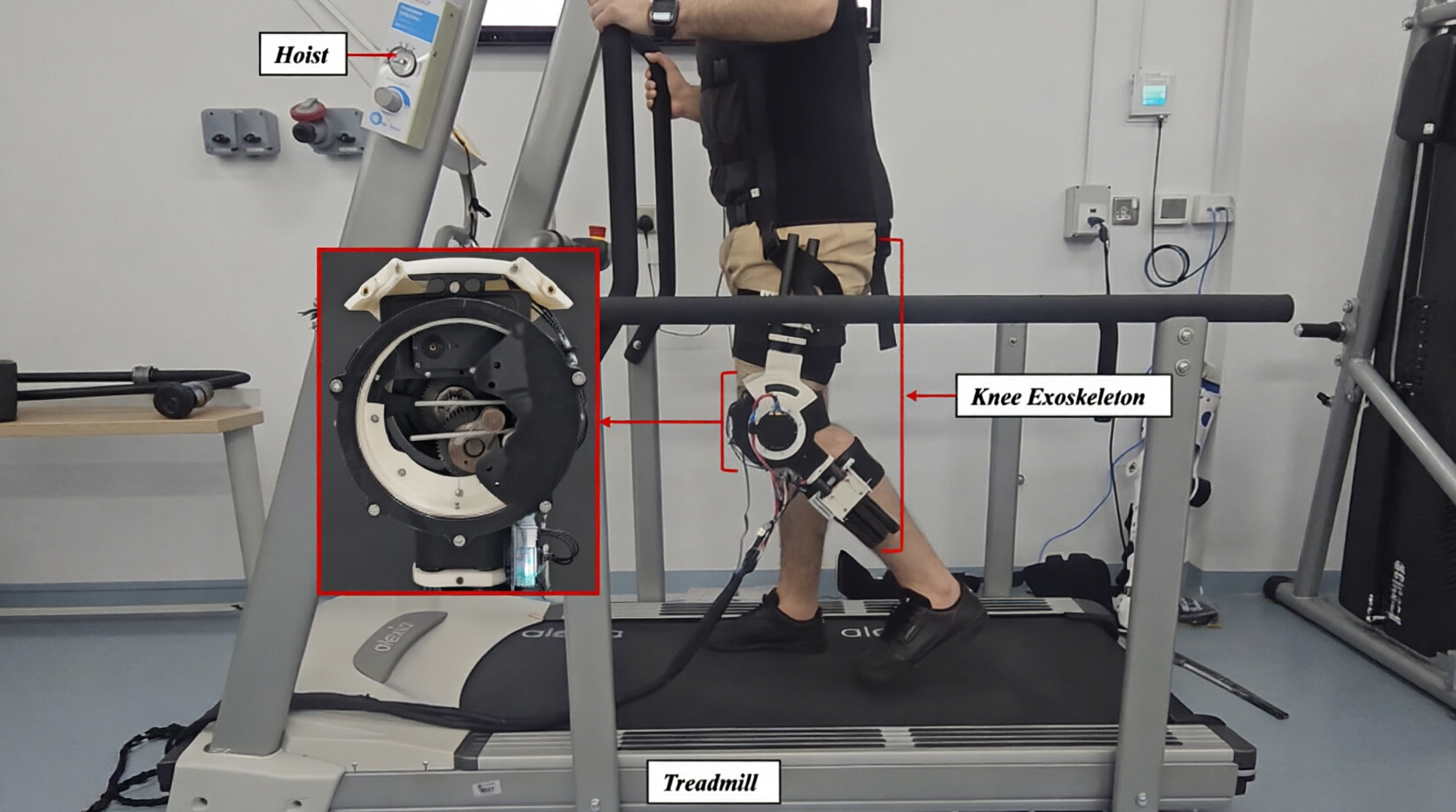
Human walking is essentially a continuously changing dynamic process, and the knee joint is one of the most critical joints throughout the entire gait cycle. During different gait phases, the motion state, load conditions, and mechanical characteristics of the knee joint are constantly changing.
For example, during the stance phase, the knee joint requires greater stability and support capability to bear body weight and maintain gait balance. During the swing phase, however, the joint needs to reduce resistance and stiffness, allowing the leg to swing more naturally, thereby reducing additional energy consumption and improving motion smoothness.
This means that, in real-world operation, exoskeleton systems cannot rely solely on fixed stiffness or static control strategies. Instead, they must continuously and dynamically adjust joint output according to changes in human movement states.
Why Dynamic Adaptability Matters
In practical applications, the “adaptability” between the exoskeleton and the human body directly affects the overall motion performance of the system.
If the mechanical joints cannot respond quickly enough to changes in human gait, exoskeleton systems will typically exhibit the following issues during different motion phases:
Delayed response during the stance phase, reducing structural stability
Excessive impedance during the swing phase, increasing movement burden
Unsmooth transitions between gait phases, affecting motion continuity
Lack of synchronization between joint control and human movement, reducing rehabilitation training effectiveness
Because users often need to perform repetitive gait training for extended periods, systems that cannot continuously adapt to changing human motion may negatively affect comfort, stability, and overall movement continuity during rehabilitation.
Therefore, in rehabilitation exoskeleton applications, dynamic adaptability becomes especially critical.
The Impact of Response Speed on System Performance
In addition to joint adaptability, response speed is another key factor affecting exoskeleton performance.
During real gait motion, human movement rhythm and joint loading conditions are continuously changing. As a result, the exoskeleton system must complete state adjustments within extremely short periods of time, including:
Joint stiffness adjustment
Output torque regulation
Motion state switching
Gait synchronization control
If the system response speed is insufficient, even a correct control strategy may fail to achieve effective gait matching due to adjustment delays.
Therefore, for high-performance exoskeleton systems, the true challenge is not simply output capability itself, but whether the system can achieve the following during dynamic movement:
Real-time adaptation to human motion states
Rapid response to gait changes
Stable control performance during continuous movement
Driven by these requirements, joint actuation solutions featuring variable stiffness and high responsiveness have gradually become an important research direction in modern rehabilitation robotics and exoskeleton systems.
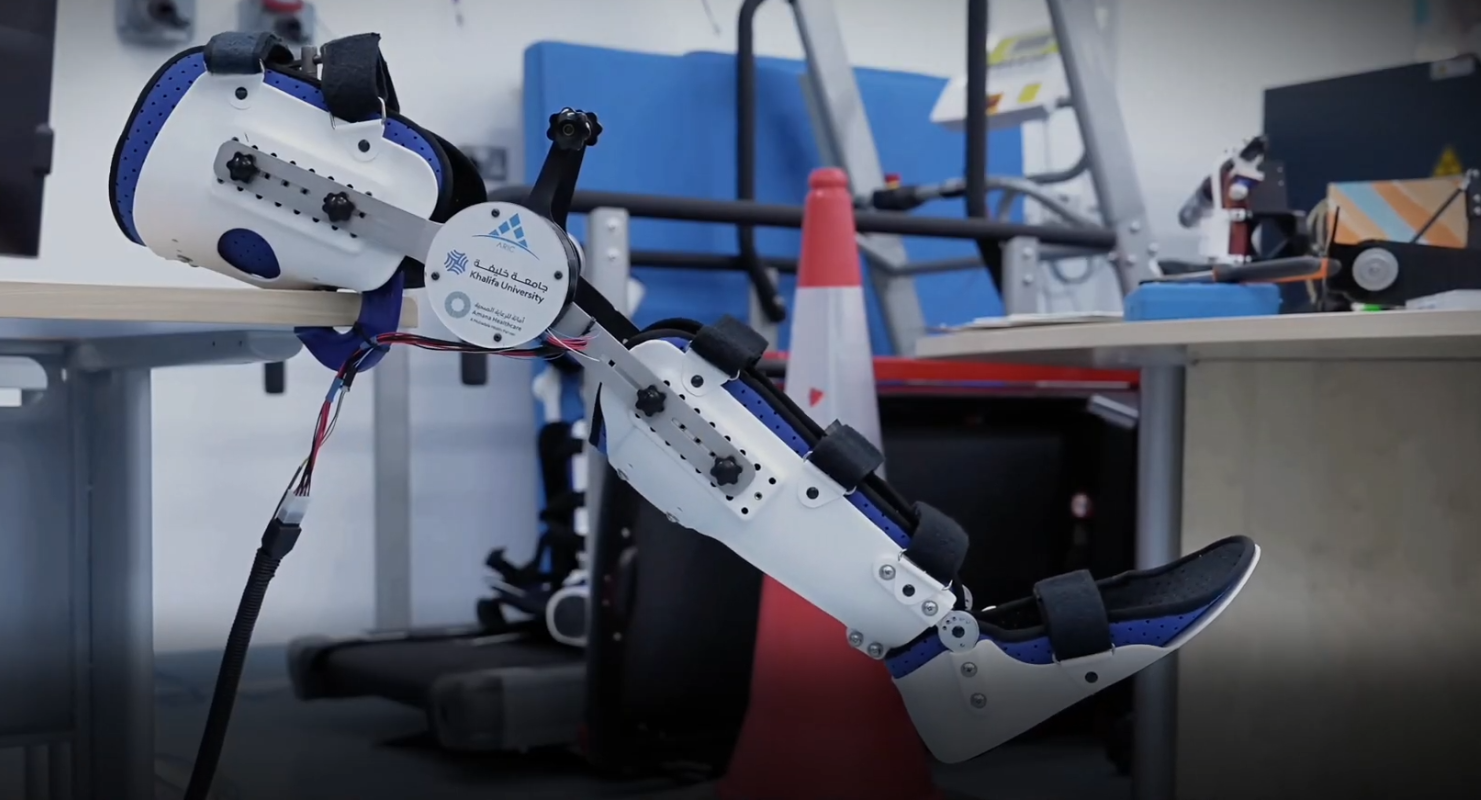
Driven by the increasing demand for better joint adaptability and dynamic response performance, a research team from Khalifa University proposed a tunable-stiffness knee exoskeleton system for gait rehabilitation training. The system was designed and validated in the study Design and Validation of a Knee Exoskeleton with Tunable Compliance for Gait Rehabilitation.
Unlike traditional fixed-stiffness exoskeletons, this system focuses more on the dynamic behavior of the knee joint throughout the gait cycle. By adopting an actuation approach that more closely mimics human muscle characteristics, the researchers aimed to improve the naturalness and stability of exoskeleton-assisted movement.
Dynamic Stiffness Design for Changing Gait Conditions
During normal human walking, the knee joint does not remain in a constant state.
Different gait phases impose significantly different mechanical requirements on the joint:
| Gait Phase | Joint Requirement |
| Stance Phase | Higher stiffness and stability to support body load |
| Swing Phase | Lower resistance and softer motion behavior to reduce energy consumption and improve movement smoothness |
Traditional rigid exoskeletons often struggle to achieve smooth transitions between these phases due to their lack of dynamic adjustment capability.
To address this issue, the research team introduced a tunable compliance mechanism into the knee joint actuator, allowing the system to dynamically adjust joint stiffness according to gait changes and more closely replicate natural human motion characteristics.
Exoskeleton System Architecture
The overall system mainly consists of the following components:
| System Module | Function |
| Knee Joint Actuator | Provides fundamental motion output and joint driving force |
| Tunable Compliance Mechanism | Dynamically adjusts joint stiffness and motion characteristics |
| Control System | Performs gait cycle tracking and real-time adjustment |
| Drive Unit | Delivers high-response power output |
Among these components, the tunable compliance mechanism serves as the core of the entire system.
By introducing an elastic adjustment structure into the actuation chain, the researchers enabled the joint to exhibit different dynamic characteristics during different motion phases. This design not only helps reduce impact issues commonly associated with rigid structures, but also improves motion continuity during gait phase transitions.
Control and Response Performance
To achieve more stable gait synchronization, the research team combined a dynamic model with PID control algorithms for real-time joint state control.
The system can rapidly adjust stiffness states according to gait changes while dynamically responding to load variations during movement.
Experimental results showed that:
The system could complete stiffness switching within approximately 0.2 seconds
The stiffness adjustment range reached 30–500 Nm/rad
The system demonstrated improved continuity and synchronization during gait transitions
Compared with traditional fixed-stiffness exoskeleton solutions, this design showed better performance in terms of dynamic response speed, joint adaptability, and motion smoothness.
In addition, the research team adopted a lightweight structural design using Tough PLA 3D-printed components and carbon fiber rods to reduce overall weight and improve wearing comfort. The modular adjustment structure also allows the system to accommodate users of different heights, further enhancing its practical applicability in rehabilitation training scenarios.
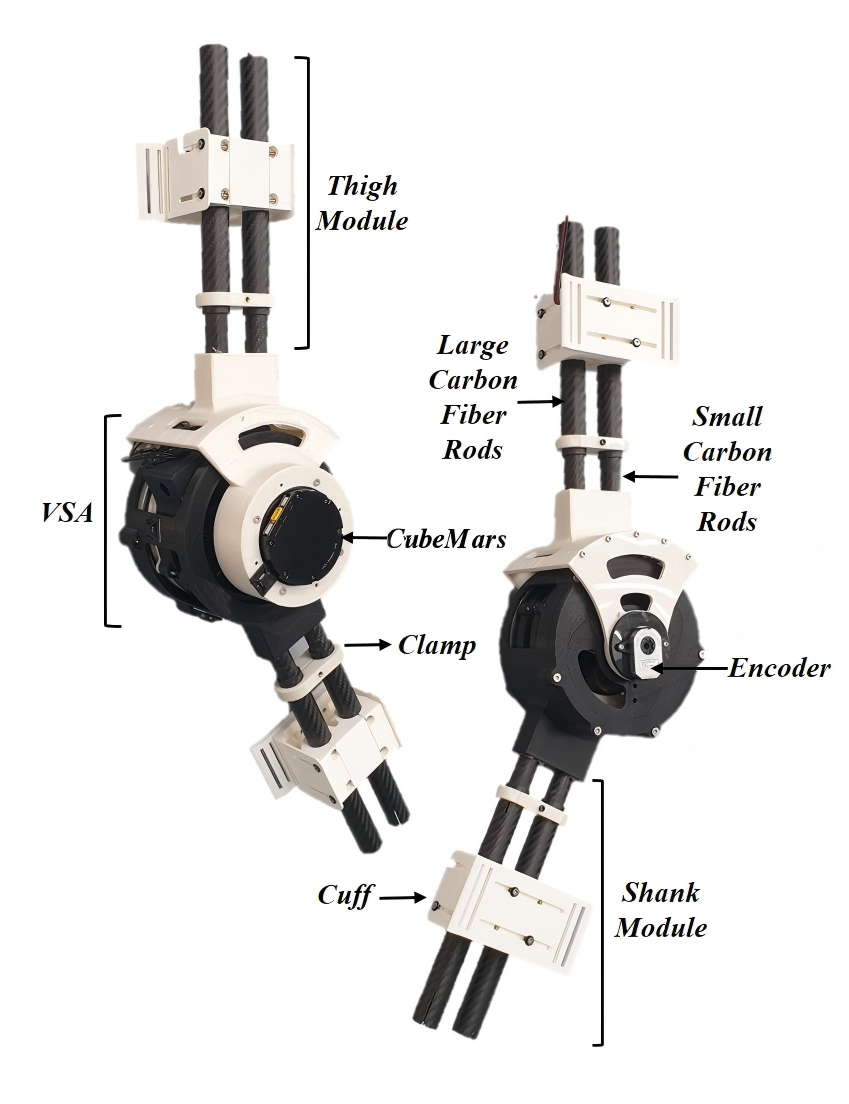
In this tunable-stiffness knee exoskeleton system, the CubeMars AK80-64 serves as the core drive unit, undertaking the critical tasks of joint power output and dynamic response support. This enables the entire system to operate stably under complex gait conditions.
Unlike traditional separated motor-and-reducer architectures, the AK80-64 adopts a highly integrated design that combines a brushless motor, planetary gearbox, encoder, and driver into a single compact unit. This allows the actuator to deliver high output density and precise control performance within limited installation space.
This characteristic is particularly important for exoskeleton joint structures, where the system must simultaneously achieve:
High torque
Fast response
High stability
within a compact mechanical architecture.
High-Torque Output for Dynamic Gait Loading
During gait rehabilitation, the knee joint continuously switches between stance and swing phases, resulting in constantly changing load conditions.
Within the system, the AK80-64 mainly provides foundational actuation and force output support, featuring:
| Key Capability | Engineering Function |
| High torque density | Supports instantaneous load demands during the stance phase |
| Wide dynamic output range | Adapts to force variations across different gait phases |
| Stable continuous output | Maintains continuity during rehabilitation training |
Its output capability of up to 48 Nm rated torque and 120 Nm peak torque enables the actuator to cover the primary load requirements encountered during walking and rehabilitation training, providing a reliable power foundation for the variable-stiffness system.
Coordinated Control Capability with the Variable-Stiffness System
The core challenge of this exoskeleton system is not simply force generation itself, but rather achieving dynamic coordination during stiffness transitions.
Through high-resolution encoder feedback and servo control capability, the AK80-64 forms a closed-loop collaborative system with the upper-level controller. This allows the joint to maintain continuous output during stiffness switching, avoiding noticeable force discontinuities or control delays.
This coordination capability enables the system to maintain smooth motion transitions and gait consistency even during stiffness switching events occurring on the order of approximately 0.2 seconds.
System Advantages Brought by the Integrated Design
The integrated structure of the AK80-64 further reduces overall mechanical complexity within the system, allowing the drive unit to achieve higher output density within limited space while reducing dependence on external wiring and separate control modules.
This design is especially important for exoskeleton systems because it not only affects performance, but also directly influences weight distribution and long-term wearing comfort.
Exoskeleton Joint Motor Selection Reference (Product Recommendation)
In exoskeleton and rehabilitation robot applications, joint drive motors typically need to balance:
High torque density
Low inertia
Fast response speed
Compact structure
Different joint locations — including the hip, knee, and ankle — also impose significantly different performance requirements. As a result, actuator selection is usually matched according to specific application scenarios.
Recommended Exoskeleton Actuator Comparison
| Model | Core Engineering Characteristics | Recommended Exoskeleton Applications |
| CubeMars AK80-64 KV80 | High-torque integrated actuator with 64:1 planetary reduction, stable continuous output, suitable for high-load dynamic support scenarios | Gait rehabilitation exoskeletons, lower-limb power assistance systems, tunable-stiffness rehabilitation exoskeletons |
| CubeMars AK60-6 V1.1 KV80 | Lightweight integrated actuator with fast dynamic response and compact structure, optimized for wearable mobility systems | Lightweight wearable exoskeletons, ankle assistance systems, portable rehabilitation devices |
| CubeMars AK70-10 KV100 | Integrated actuator featuring balanced dynamic performance and enhanced structural impact resistance with cross-roller bearing support | Multi-joint lower-limb exoskeletons, dynamic gait training systems, wearable robotic assistance platforms |
In this research system, the CubeMars AK80-64 was primarily used to provide stable power support and dynamic response capability for the tunable-stiffness knee exoskeleton architecture, helping the system maintain smooth gait transitions and reliable human-machine coordination during rehabilitation training.
This case study focused on a tunable-stiffness knee exoskeleton system. Starting from the dynamic characteristics of human gait, it analyzed the limitations of traditional exoskeleton systems in terms of joint adaptability and response speed. It further highlighted that achieving a balance between stable support and compliant motion transition during complex continuous movement has become a key challenge in modern exoskeleton system design.
To address these challenges, the system introduced a tunable compliance mechanism together with dynamic control strategies, enabling the knee joint to rapidly switch states across different gait phases. This approach improved overall motion continuity and human-machine coordination. From both experimental and design perspectives, the system demonstrated strong performance in gait matching, response speed, and motion smoothness.
Within this system architecture, the CubeMars AK80-64 served as the core drive unit, providing stable power output and high-response control capability for the joint. This enabled the variable-stiffness mechanism to operate reliably under complex gait conditions. The case further demonstrates the engineering value and application potential of high-performance integrated actuators in exoskeleton and rehabilitation robotics applications.


