Créer votre compte CubeMars

Dans les domaines de la robotique de rééducation et des applications d’exosquelettes, bien que les systèmes existants soient déjà capables de fournir un certain niveau d’assistance au mouvement, les performances globales des articulations mécaniques présentent encore des limites évidentes dans des conditions d’utilisation réelles.
À l’heure actuelle, de nombreux systèmes d’exosquelettes reposent principalement sur des méthodes de commande et d’entraînement relativement rigides, ce qui rend difficile l’obtention de capacités d’ajustement dynamique suffisamment fines face aux mouvements humains en constante évolution.
Lors de la marche réelle, ces limitations se manifestent généralement par les aspects suivants :
| Problème courant | Impact sur le système |
| Mouvement articulaire insuffisamment fluide | Réduit le caractère naturel de la marche |
| Transitions de mouvement insuffisamment souples | Augmente la sensation de mouvements brusques |
| Transitions peu naturelles entre les différentes phases de marche | Réduit la continuité globale du mouvement |
| Vitesse de réponse insuffisante | Difficulté à suivre en temps réel les changements du mouvement humain |
Ces problèmes affectent directement l’expérience utilisateur globale des systèmes d’exosquelettes, en particulier dans les scénarios de rééducation nécessitant un entraînement répétitif de la marche sur de longues durées.
De plus, lorsque le rythme de marche humain ou les conditions de charge changent, certains systèmes peuvent présenter des retards de mouvement articulaire ou une synchronisation réduite en raison d’une vitesse de réponse insuffisante, ce qui affecte davantage la stabilité et la coordination du mouvement.
Du point de vue des applications, le principal défi des systèmes d’exosquelettes actuels n’est plus simplement de savoir s’ils peuvent fournir une assistance en force, mais plutôt comment obtenir une meilleure adaptabilité articulaire et des capacités de réponse dynamique plus rapides dans des mouvements complexes et en évolution continue.
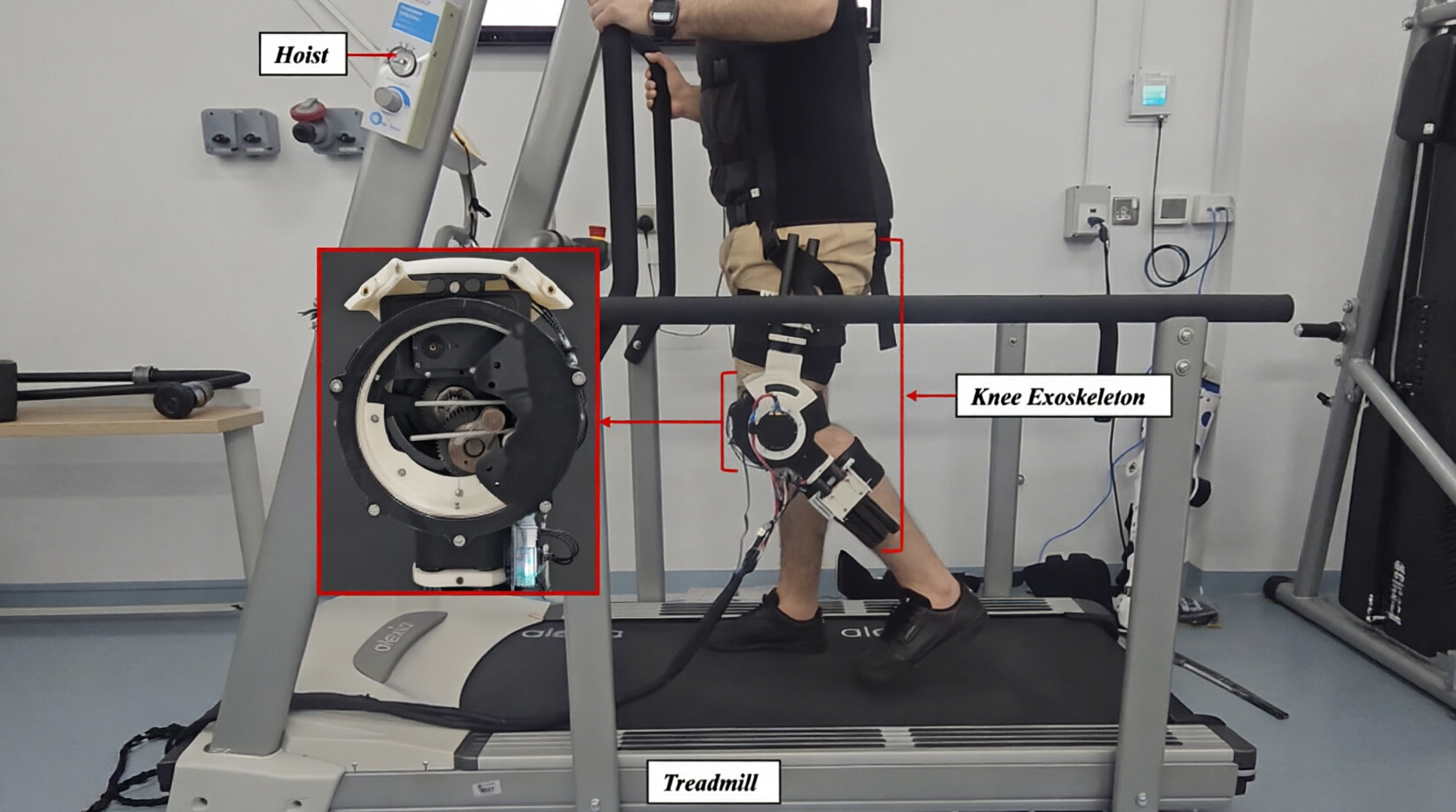
La marche humaine est essentiellement un processus dynamique en évolution continue, et l’articulation du genou constitue l’une des articulations les plus critiques tout au long du cycle de marche. Au cours des différentes phases de la marche, l’état du mouvement, les conditions de charge et les caractéristiques mécaniques du genou changent constamment.
Par exemple, durant la phase d’appui, le genou nécessite une plus grande stabilité et une capacité de soutien accrue afin de supporter le poids du corps et maintenir l’équilibre de la marche. En revanche, pendant la phase oscillante, l’articulation doit réduire sa résistance et sa rigidité afin de permettre à la jambe de se déplacer plus naturellement, réduisant ainsi la consommation énergétique supplémentaire et améliorant la fluidité du mouvement.
Cela signifie que, dans des conditions réelles d’utilisation, les systèmes d’exosquelettes ne peuvent pas s’appuyer uniquement sur une rigidité fixe ou des stratégies de contrôle statiques. Ils doivent au contraire ajuster continuellement et dynamiquement la sortie articulaire en fonction des changements de l’état de mouvement humain.
Pourquoi l’adaptabilité dynamique est essentielle
Dans les applications pratiques, “l’adaptabilité” entre l’exosquelette et le corps humain influence directement les performances globales du mouvement du système.
Si les articulations mécaniques ne réagissent pas suffisamment rapidement aux changements de la marche humaine, les systèmes d’exosquelettes présentent généralement les problèmes suivants selon les différentes phases du mouvement :
Réponse retardée durant la phase d’appui, réduisant la stabilité structurelle
Impédance excessive durant la phase oscillante, augmentant l’effort de mouvement
Transitions peu fluides entre les phases de marche, affectant la continuité du mouvement
Manque de synchronisation entre le contrôle articulaire et le mouvement humain, réduisant l’efficacité de la rééducation
Comme les utilisateurs doivent souvent effectuer des entraînements répétitifs de la marche sur de longues périodes, les systèmes incapables de s’adapter continuellement aux changements du mouvement humain peuvent nuire au confort, à la stabilité et à la continuité globale des mouvements pendant la rééducation.
Par conséquent, dans les applications d’exosquelettes de rééducation, l’adaptabilité dynamique devient particulièrement importante.
L’impact de la vitesse de réponse sur les performances du système
Outre l’adaptabilité articulaire, la vitesse de réponse constitue un autre facteur clé influençant les performances des exosquelettes.
Lors de la marche réelle, le rythme du mouvement humain et les conditions de charge des articulations changent continuellement. Le système d’exosquelette doit donc effectuer des ajustements d’état dans des délais extrêmement courts, notamment :
Ajustement de la rigidité articulaire
Régulation du couple de sortie
Changement d’état du mouvement
Contrôle de la synchronisation de la marche
Si la vitesse de réponse du système est insuffisante, même une stratégie de contrôle correcte peut échouer à assurer une adaptation efficace à la marche en raison des retards d’ajustement.
Ainsi, pour les systèmes d’exosquelettes haute performance, le véritable défi ne réside pas uniquement dans la capacité de sortie elle-même, mais dans la capacité du système à réaliser les fonctions suivantes pendant les mouvements dynamiques :
Adaptation en temps réel aux états de mouvement humain
Réponse rapide aux changements de la marche
Performance de contrôle stable pendant les mouvements continus
Sous l’impulsion de ces exigences, les solutions d’actionnement articulaire à rigidité variable et à haute réactivité sont progressivement devenues une orientation majeure de recherche dans les domaines modernes de la robotique de rééducation et des systèmes d’exosquelettes.
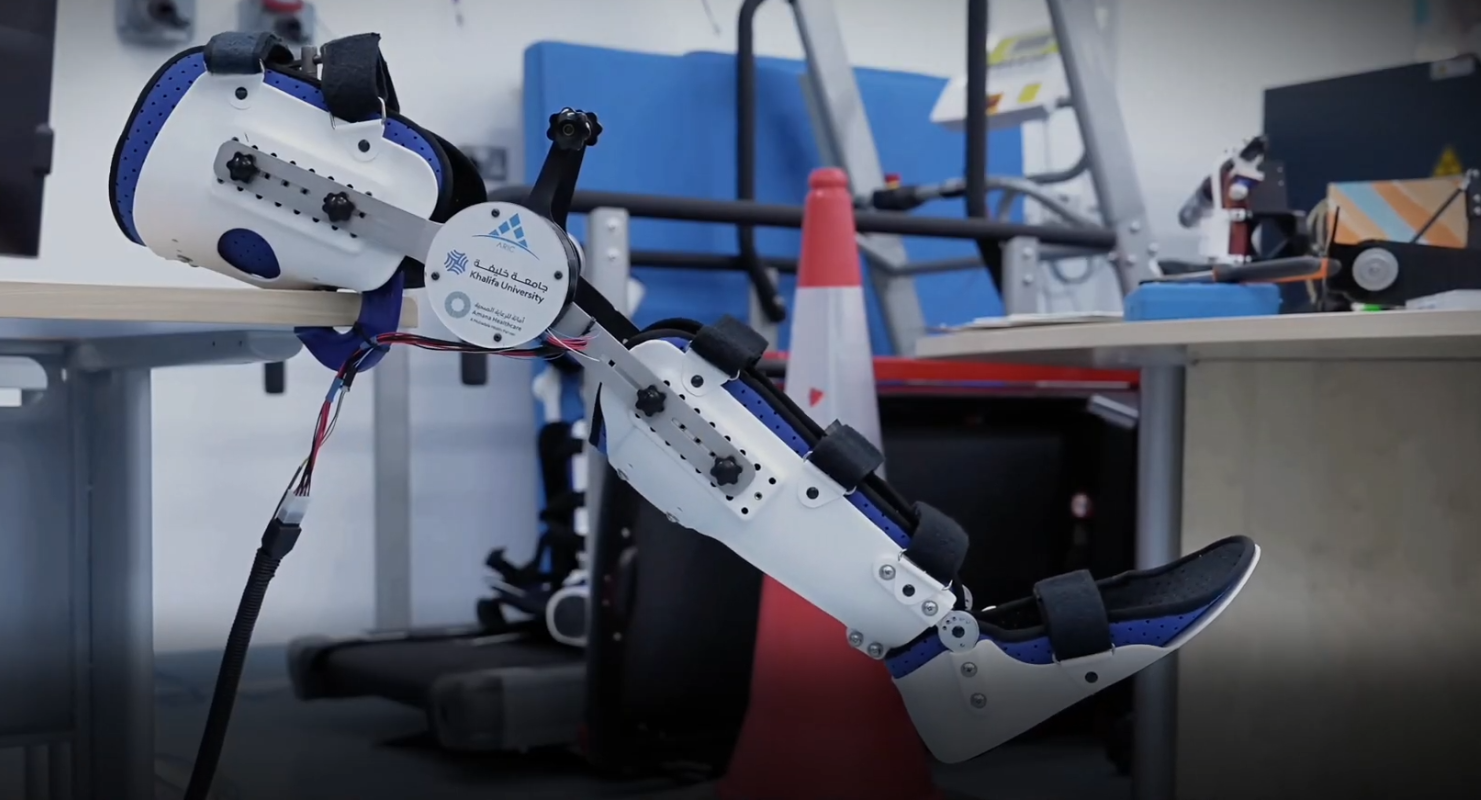
Sous l’effet de la demande croissante pour une meilleure adaptabilité articulaire et des performances de réponse dynamique plus élevées, une équipe de recherche de l’Université Khalifa a proposé un système d’exosquelette de genou à rigidité réglable pour l’entraînement à la rééducation de la marche. Ce système a été conçu et validé dans l’étude Design and Validation of a Knee Exoskeleton with Tunable Compliance for Gait Rehabilitation.
Contrairement aux exosquelettes traditionnels à rigidité fixe, ce système se concentre davantage sur le comportement dynamique de l’articulation du genou tout au long du cycle de marche. En adoptant une approche d’actionnement qui imite plus fidèlement les caractéristiques des muscles humains, les chercheurs ont cherché à améliorer la naturalité et la stabilité des mouvements assistés par exosquelette.
Conception de rigidité dynamique pour des conditions de marche changeantes
Lors de la marche humaine normale, le genou ne reste pas dans un état constant.
Différentes phases de la marche imposent des exigences mécaniques très différentes à l’articulation :
| Phase de marche | Exigence articulaire |
| Phase d’appui | Rigidité et stabilité élevées pour supporter la charge corporelle |
| Phase oscillante | Faible résistance et comportement plus souple pour réduire la dépense énergétique et améliorer la fluidité du mouvement |
Les exosquelettes rigides traditionnels ont souvent des difficultés à assurer des transitions fluides entre ces phases en raison de leur manque de capacité d’adaptation dynamique.
Pour résoudre ce problème, l’équipe de recherche a introduit un mécanisme de compliance réglable dans l’actionneur du genou, permettant au système d’ajuster dynamiquement la rigidité articulaire en fonction des changements de la marche et de reproduire plus fidèlement les caractéristiques naturelles du mouvement humain.
Architecture du système d’exosquelette
Le système global se compose principalement des éléments suivants :
| Module système | Fonction |
| Actionneur du genou | Fournit le mouvement de base et la force d’entraînement articulaire |
| Mécanisme de compliance réglable | Ajuste dynamiquement la rigidité et les caractéristiques du mouvement |
| Système de contrôle | Assure le suivi du cycle de marche et l’ajustement en temps réel |
| Unité d’entraînement | Fournit une puissance à haute réactivité |
Parmi ces composants, le mécanisme de compliance réglable constitue le cœur du système.
En intégrant une structure élastique dans la chaîne d’actionnement, les chercheurs ont permis à l’articulation de présenter des caractéristiques dynamiques différentes selon les phases du mouvement. Cette conception permet non seulement de réduire les impacts typiques des structures rigides, mais aussi d’améliorer la continuité du mouvement lors des transitions de phase de marche.
Performance de contrôle et de réponse
Afin d’assurer une synchronisation de marche plus stable, l’équipe de recherche a combiné un modèle dynamique avec des algorithmes de contrôle PID pour un contrôle en temps réel de l’état articulaire.
Le système peut ajuster rapidement l’état de rigidité en fonction des changements de la marche, tout en répondant dynamiquement aux variations de charge pendant le mouvement.
Les résultats expérimentaux ont montré que :
Le changement de rigidité peut être effectué en environ 0,2 seconde
La plage de rigidité atteint 30–500 Nm/rad
Le système présente une meilleure continuité et synchronisation lors des transitions de marche
Comparé aux exosquelettes traditionnels à rigidité fixe, ce système présente de meilleures performances en termes de vitesse de réponse dynamique, d’adaptabilité articulaire et de fluidité des mouvements.
En outre, l’équipe de recherche a adopté une conception structurelle légère utilisant des composants imprimés en 3D en Tough PLA et des tiges en fibre de carbone afin de réduire le poids total et d’améliorer le confort de port. La structure modulaire permet également d’adapter le système à des utilisateurs de différentes tailles, renforçant ainsi son applicabilité en rééducation.
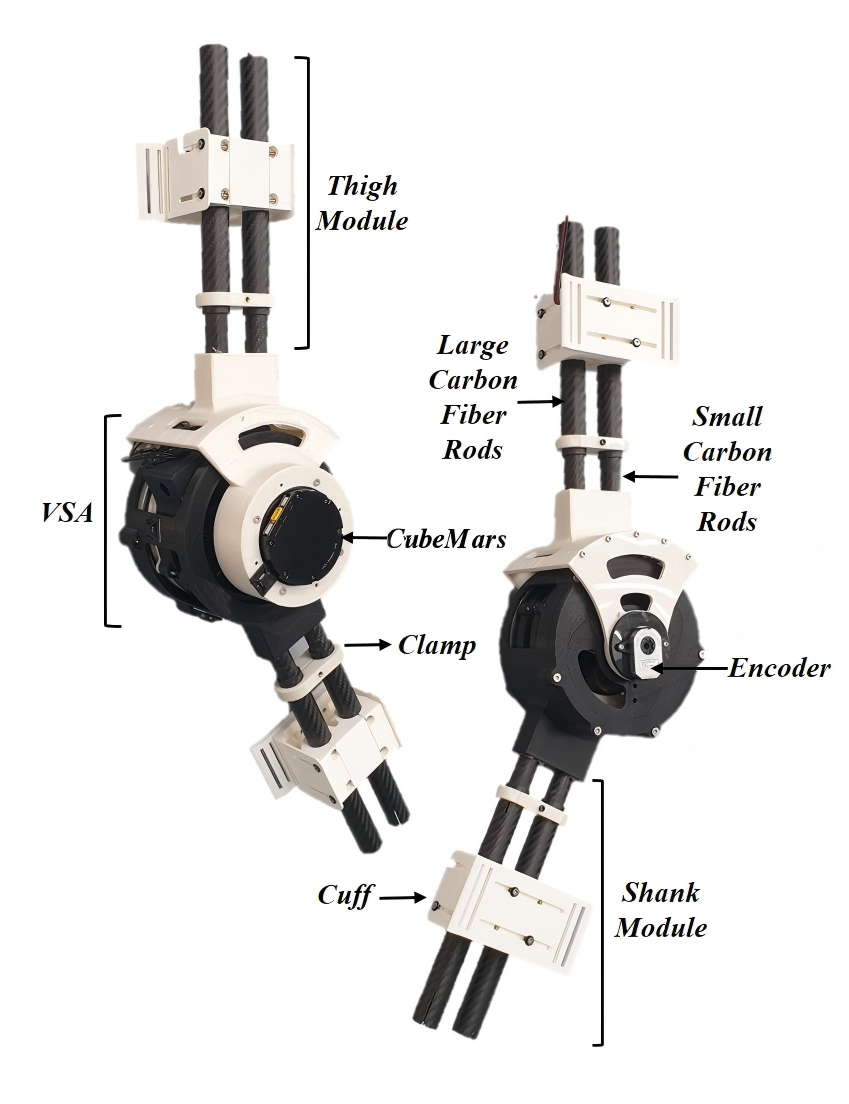
Dans ce système d’exosquelette de genou à rigidité réglable, le CubeMars AK80-64 joue le rôle de module d’entraînement principal (core drive unit), en assurant les fonctions critiques de production de couple articulaire et de support de réponse dynamique. Cela permet au système de fonctionner de manière stable dans des conditions de marche complexes.
Contrairement aux architectures traditionnelles séparant moteur et réducteur, l’AK80-64 adopte une conception hautement intégrée combinant un moteur brushless, un réducteur planétaire, un codeur et un driver dans une seule unité compacte. Cette intégration permet d’obtenir une forte densité de puissance et des performances de contrôle précises dans un espace d’installation limité.
Cette caractéristique est particulièrement importante pour les structures articulaires d’exosquelettes, où le système doit simultanément atteindre :
Un couple élevé
Une réponse rapide
Une grande stabilité
dans une architecture mécanique compacte.
Sortie de couple élevée pour les charges dynamiques de marche
Lors de la rééducation de la marche, l’articulation du genou alterne en continu entre les phases d’appui et d’oscillation, entraînant des conditions de charge constamment variables.
Dans le système, l’AK80-64 fournit principalement un soutien fondamental en actionnement et en force, avec les caractéristiques suivantes :
| Capacité clé | Fonction d’ingénierie |
| Forte densité de couple | Répond aux demandes de charge instantanées pendant la phase d’appui |
| Large plage de sortie dynamique | S’adapte aux variations de force selon les phases de marche |
| Sortie continue stable | Maintient la continuité pendant l’entraînement de rééducation |
Sa capacité de sortie allant jusqu’à 48 Nm de couple nominal et 120 Nm de couple de pointe permet à l’actionneur de couvrir les principales exigences de charge rencontrées lors de la marche et de la rééducation, fournissant une base énergétique fiable pour le système à rigidité variable.
Capacité de contrôle coordonné avec le système à rigidité variable
Le principal défi de ce système d’exosquelette ne réside pas uniquement dans la génération de force, mais dans la coordination dynamique lors des transitions de rigidité.
Grâce à un retour d’information haute résolution via encodeur et à des capacités de contrôle servo, l’AK80-64 forme un système collaboratif en boucle fermée avec le contrôleur supérieur. Cela permet de maintenir une sortie continue lors des changements de rigidité, en évitant les discontinuités de force ou les retards de contrôle perceptibles.
Cette capacité de coordination permet au système de conserver des transitions de mouvement fluides et une cohérence de la marche, même lors de transitions de rigidité se produisant sur des échelles de l’ordre de 0,2 seconde.
Avantages du système apportés par la conception intégrée
La structure intégrée de l’AK80-64 réduit davantage la complexité mécanique globale du système, permettant à l’unité d’entraînement d’atteindre une densité de puissance plus élevée dans un espace limité, tout en réduisant la dépendance au câblage externe et aux modules de contrôle séparés.
Cette conception est particulièrement importante pour les systèmes d’exosquelettes, car elle n’affecte pas seulement les performances, mais influence également directement la répartition des masses et le confort de port à long terme.
Référence pour la sélection des moteurs d’articulations d’exosquelette (recommandation produit)
Dans les applications de robotique de rééducation et d’exosquelettes, les moteurs d’actionnement articulaires doivent généralement trouver un équilibre entre :
Une forte densité de couple
Une faible inertie
Une vitesse de réponse élevée
Une structure compacte
De plus, les différentes articulations — hanche, genou et cheville — imposent des exigences de performance très différentes. Par conséquent, le choix de l’actionneur est généralement adapté en fonction du scénario d’application spécifique.
Comparaison recommandée des actionneurs pour exosquelettes
| Modèle | Caractéristiques techniques principales | Applications recommandées en exosquelette |
| CubeMars AK80-64 KV80 | Actionneur intégré à couple élevé avec réduction planétaire 64:1, sortie continue stable, adapté aux scénarios de support dynamique à forte charge | Exosquelettes de rééducation de la marche, systèmes d’assistance des membres inférieurs, exosquelettes de rééducation à rigidité réglable |
| CubeMars AK60-6 V1.1 KV80 | Actionneur intégré léger avec réponse dynamique rapide et structure compacte, optimisé pour les systèmes portables | Exosquelettes portables légers, systèmes d’assistance de la cheville, dispositifs de rééducation portatifs |
| CubeMars AK70-10 KV100 | Actionneur intégré offrant des performances dynamiques équilibrées et une meilleure résistance aux chocs grâce à des roulements à rouleaux croisés | Exosquelettes multi-articulaires des membres inférieurs, systèmes d’entraînement de la marche dynamique, plateformes robotiques d’assistance portables |
Dans ce système de recherche, le CubeMars AK80-64 est principalement utilisé pour fournir un soutien de puissance stable et une capacité de réponse dynamique à l’architecture d’exosquelette de genou à rigidité réglable, permettant au système de maintenir des transitions de marche fluides et une coordination homme-machine fiable pendant l’entraînement de rééducation.
Cette étude de cas porte sur un système d’exosquelette de genou à rigidité réglable. En partant des caractéristiques dynamiques de la marche humaine, elle analyse les limites des systèmes d’exosquelettes traditionnels en termes d’adaptabilité articulaire et de vitesse de réponse. Elle met également en évidence que l’obtention d’un équilibre entre soutien stable et transitions de mouvement souples dans des mouvements continus complexes constitue un défi majeur dans la conception moderne des exosquelettes.
Pour relever ces défis, le système introduit un mécanisme de compliance réglable associé à des stratégies de contrôle dynamique, permettant à l’articulation du genou de changer rapidement d’état entre différentes phases de marche. Cette approche améliore la continuité globale du mouvement et la coordination homme-machine. Du point de vue expérimental et conceptuel, le système démontre de solides performances en matière de correspondance de la marche, de vitesse de réponse et de fluidité des mouvements.
Dans cette architecture, le CubeMars AK80-64 joue le rôle d’unité d’entraînement principale, fournissant une sortie de puissance stable et une capacité de contrôle à haute réactivité pour l’articulation. Cela permet au mécanisme à rigidité variable de fonctionner de manière fiable dans des conditions de marche complexes. Cette étude illustre également la valeur technique et le potentiel d’application des actionneurs intégrés haute performance dans les exosquelettes et la robotique de rééducation.


